


Artificial Intelligence and Machine Learning Articles
Finance Manager to Data Analytics: Career Growth, Salary and Seniority
How to Evaluate LLM Outputs in Production Deployments
AI/ML Skills Gap 2026: Why Companies Can't Find Job-Ready Talent
20 AI/ML Interview Questions Recruiters Can Use Without a Tech Background - Best Guide

Get In Touch For Details! Request More Information

Kimi K2.5: Complete Guide to Moonshot’s AI Model
Jul 08, 2026 5 Min Read 2503 Views
(Last Updated)
Can an AI model process entire documents, reason across multiple steps, and still maintain accuracy at scale? As enterprise workflows shift toward long-context intelligence, traditional models face limitations in handling large inputs and structured reasoning. Kimi K2.5 by Moonshot AI addresses this gap with extended context windows and optimized inference, making it relevant for research and knowledge-driven tasks.
Read this blog to understand Kimi K2.5, its architecture, modes, benchmarks, and how it compares with leading AI models.
Quick Answer:
Kimi K2.5 is an advanced AI model developed by Moonshot AI, designed for high-context understanding and multilingual capabilities. It supports extended context windows, making it suitable for tasks like document analysis and conversational AI. Kimi K2.5 stands out for its ability to process large inputs efficiently while strengthening accuracy, making it a strong competitor to models like GPT and Claude.
- Kimi K2.5 is trained on ~15 trillion text and visual tokens, built on the Kimi-K2-Base.
- Kimi ranks highly, scoring 47.1% on select benchmarks and 50.2% on HLE.
- Kimi K2.5 is a 1 trillion-parameter MoE model with 32 billion active parameters.
Table of contents
- What is Kimi K2.5?
- Kimi K2.5 Operational Modes and How to Use Them
- Kimi K2.5 Pricing Details
- How Kimi K2.5’s Architecture Differs
- Kimi K2.5 Benchmark Performance
- Advantages of Kimi K2.5
- Limitations of Kimi K2.5
- Kimi K2.5 vs Claude Opus 4.5 vs GPT-5.2 vs Gemini 2.0
- Quick Comparison:
- Conclusion
- FAQs
- Is Kimi K2.5 free?
- Is Kimi K2.5 open source?
- Is Kimi a Chinese company?
- Does Kimi K2.5 support coding tasks?
- Is Kimi K2.5 better than ChatGPT?
What is Kimi K2.5?
Kimi K2.5 is an open-source multimodal agentic large language model developed by Moonshot AI. It is designed for high-context processing and structured reasoning tasks. It supports extended context windows, allowing it to analyze large documents, maintain continuity across long conversations, and perform multi-step inference.
Explore: Kimi K2 Tutorial: 5 Real Examples to Use Kimi.ai Like an Expert
Kimi K2.5 Operational Modes and How to Use Them
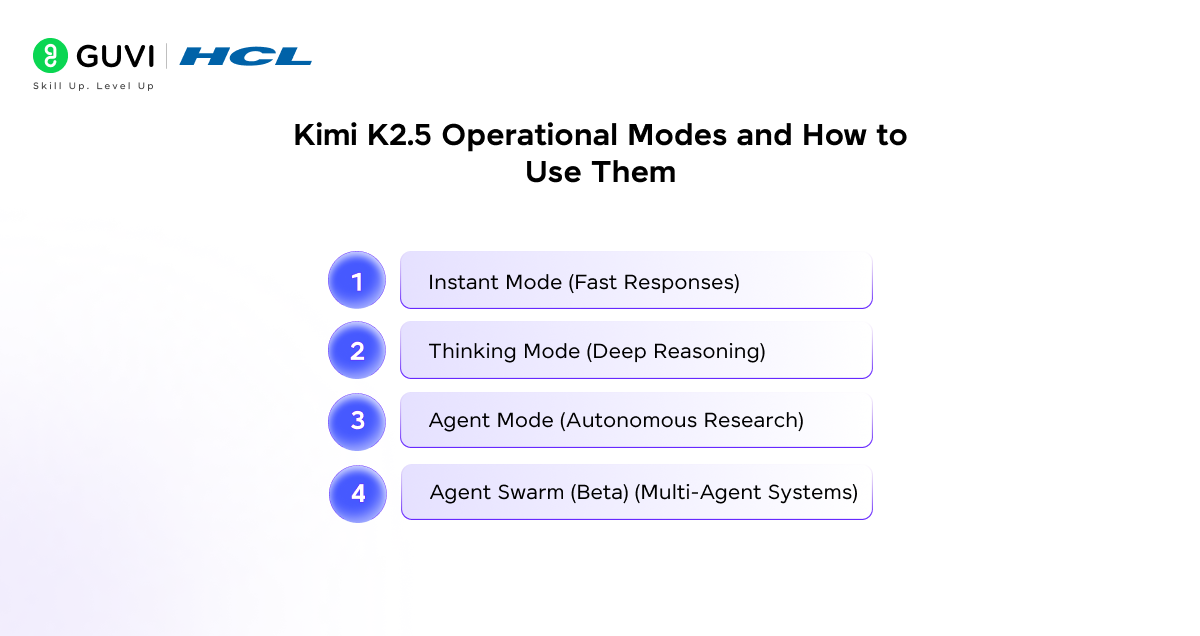
1. Instant Mode (Fast Responses)
Instant mode is optimized for low-latency inference, where response time is prioritized over extended reasoning depth. It uses shorter context evaluation cycles and lightweight decoding strategies to deliver near real-time outputs. This mode is suitable for interactive applications such as chat interfaces, quick summaries, and lightweight coding assistance, where throughput and responsiveness are critical.
Key Features
- Low latency response generation
- Optimized for high query throughput
- Reduced computational overhead per request
- Suitable for short-context tasks
How to Use
- Select Instant mode in the interface or API configuration
- Use concise prompts to maximize speed
- Avoid long documents or multi-step reasoning queries
- Deploy in chatbots or real-time assistants
2. Thinking Mode (Deep Reasoning)
Thinking mode allocates higher compute per query and applies extended reasoning passes before generating output. It is designed for tasks that require logical consistency, multi-step problem solving, and structured analysis. The model evaluates context more thoroughly, which improves accuracy in complex queries such as technical explanations, code generation, and research synthesis.
Key Features
- Multi-step reasoning capability
- Improved accuracy for complex tasks
- Better context retention during inference
- Suitable for analytical and technical workflows
How to Use
- Enable Thinking mode for complex or multi-layered prompts
- Provide detailed input with clear objectives
- Use for coding, debugging, or research-heavy tasks
- Allow slightly higher response time for improved output quality
3. Agent Mode (Autonomous Research)
Agent mode introduces task-level autonomy, where the model can plan and refine steps toward a defined objective. It interacts with external tools, retrieves relevant information, and iteratively improves outputs. This mode is structured around goal-oriented execution rather than single-turn responses, making it suitable for workflows that require continuous context updates and decision-making.
Key Features
- Goal-driven task execution
- Iterative planning and refinement
- Integration with external tools and data sources
- Context-aware decision making
How to Use
- Define a clear objective or task goal in the prompt
- Allow the model to break tasks into steps
- Use in research automation, workflow orchestration, or data gathering
- Monitor outputs and refine instructions for better control
4. Agent Swarm (Beta) (Multi-Agent Systems)
Agent Swarm extends Agent mode by coordinating multiple specialized agents to handle large-scale or parallel tasks. Each agent operates with a defined role, and a coordination layer manages task distribution and result aggregation. This architecture improves scalability and task decomposition for complex workflows such as automation testing and multi-step data pipelines.
Key Features
- Parallel task execution across multiple agents
- Role-based specialization for each agent
- Scalable architecture for large workloads
- Coordinated output aggregation
How to Use
- Define the overall task and assign sub-tasks or roles
- Configure multiple agents through the platform or API
- Use for large research, data processing, or enterprise workflows
- Validate outputs from each agent before final aggregation
Kimi K2.5 Pricing Details
| Feature | Kimi K2.5 (Moonshot AI) |
| Input Cost | $0.45 – $0.60 per 1M tokens |
| Output Cost | $2.50 – $3.00 per 1M tokens |
| Context Window | 262,144 tokens |
| Model Capability | Long-context reasoning and structured tasks |
| Multimodal Support | Yes (vision capabilities supported) |
How Kimi K2.5’s Architecture Differs
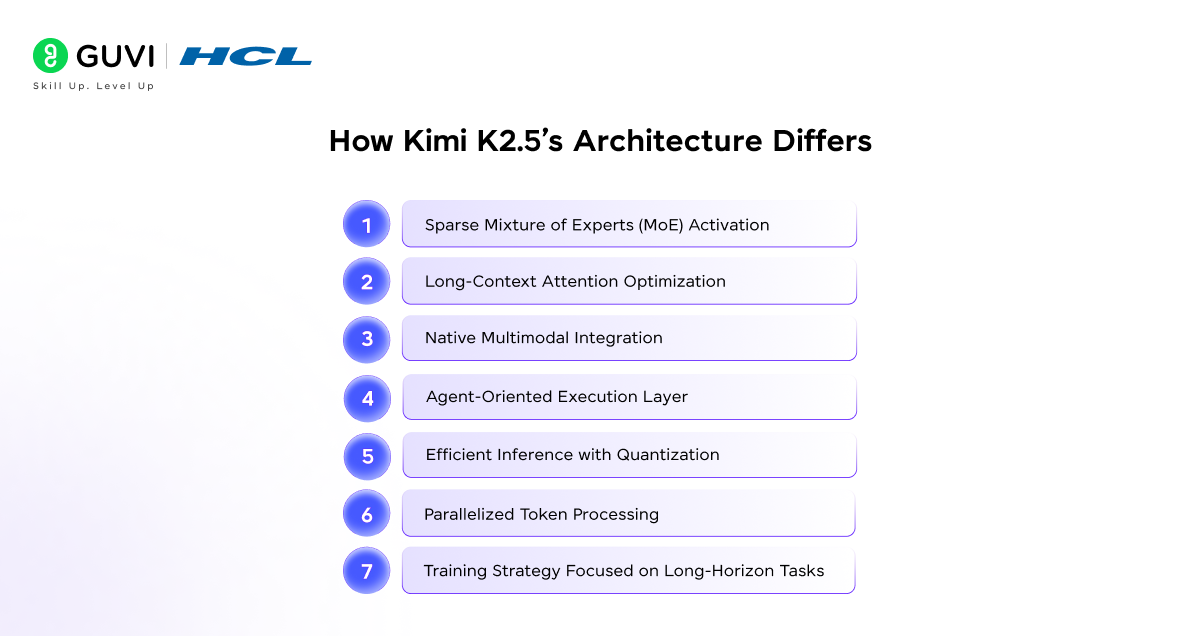
- Sparse Mixture of Experts (MoE) Activation
Kimi K2.5 uses a sparse Mixture of Experts architecture where only a subset of parameters is activated per token. Instead of running the full model for every inference step, it routes inputs through selected expert networks. This reduces compute load while maintaining high model capacity, allowing efficient scaling without proportional increases in latency or cost.
- Long-Context Attention Optimization
The model is designed for extended context windows, supporting large-scale inputs such as full documents and multi-turn workflows. It applies optimized attention mechanisms that reduce quadratic scaling issues typically seen in transformers. This allows stable performance across long sequences without context degradation or excessive memory usage.
- Native Multimodal Integration
Kimi K2.5 integrates text, image, and video understanding within a unified architecture. Unlike adapter-based systems, multimodal capabilities are built directly into the training pipeline. This results in consistent cross-modal reasoning, where the model can align visual and textual inputs without relying on external modules.
- Agent-Oriented Execution Layer
The architecture includes support for agent-based workflows at the system level. It is structured to handle iterative reasoning, tool usage, and task planning across multiple steps. This allows the model to maintain state across long execution chains and reduces failure rates in extended agent sessions.
- Efficient Inference with Quantization
Kimi K2.5 incorporates native low-bit quantization, such as INT4, to reduce memory bandwidth and improve inference speed. This enables deployment in resource-constrained environments while maintaining output quality. The approach balances precision and efficiency, making large-scale usage more practical.
- Parallelized Token Processing
The model leverages parallel decoding and optimized token routing to improve throughput. This is particularly effective in long-context and agent workflows where multiple reasoning steps are required. It reduces bottlenecks during generation and supports faster response times under heavy workloads.

- Training Strategy Focused on Long-Horizon Tasks
Kimi K2.5 is trained with datasets and objectives that emphasize long-horizon reasoning, multi-step problem solving, and real-world task execution. This differs from traditional short-context optimization and allows the model to perform reliably in scenarios such as document analysis and enterprise automation.
Go beyond understanding AI models like Kimi K2.5 and build real-world expertise in AI and machine learning. Join HCL GUVI’s Artificial Intelligence and Machine Learning Course to learn through live online classes by industry experts and Intel engineers, master in-demand skills like Python, ML, MLOps, Generative AI, and Agentic AI, and gain hands-on experience with 20+ industry-grade projects, 1:1 doubt sessions, and placement support with 1000+ hiring partners.
Kimi K2.5 Benchmark Performance
- Coding Benchmarks
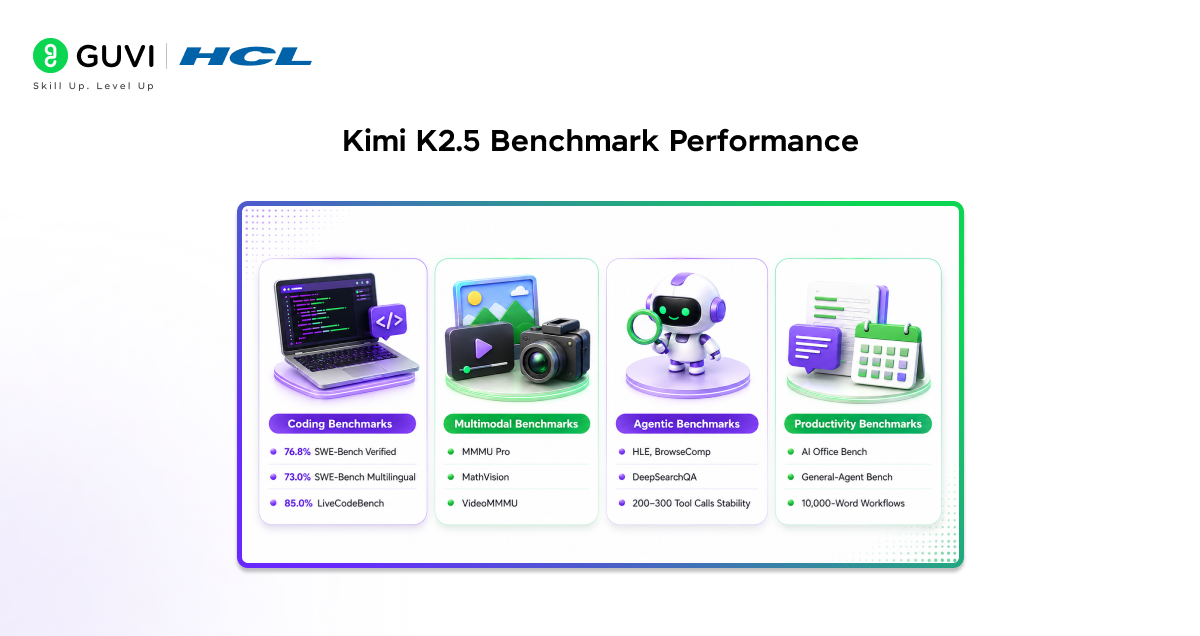
Kimi K2.5 demonstrates strong performance in real-world software engineering tasks. It achieves 76.8% on SWE-Bench Verified and 73.0% on SWE-Bench Multilingual, indicating the ability to resolve GitHub issues, understand codebases, and generate correct fixes across languages. On LiveCodeBench, it reaches 85.0%, reflecting reliable performance in competitive programming and dynamic coding scenarios.
- Multimodal Benchmarks
Kimi K2.5 is trained as a native multimodal model using large-scale text and visual data, which supports consistent performance across image and video tasks. It performs strongly on benchmarks such as MMMU Pro, MathVision, and VideoMMMU, which evaluate cross-domain reasoning, diagram interpretation, and temporal video understanding. Native multimodal training improves alignment between visual and textual reasoning compared to modular approaches.
- Agentic Benchmarks
Kimi K2.5 is designed as a reasoning agent capable of multi-step execution with tool usage. It achieves strong results on benchmarks like HLE (Humanity’s Last Exam), BrowseComp, and DeepSearchQA, which evaluate long-horizon reasoning and information retrieval. The model maintains stable execution across 200-300 sequential tool calls, addressing common failure patterns in extended agent workflows.
- Productivity Benchmarks
Kimi K2.5 shows measurable improvements in real-world knowledge tasks through internal evaluations such as AI Office Bench and General-Agent Bench. It handles workflows like document editing, spreadsheet modeling, and long-form content generation, including 10,000-word documents and multi-step tasks. These results indicate its ability to manage high-density inputs and coordinate complex operations within a single interaction.
Advantages of Kimi K2.5
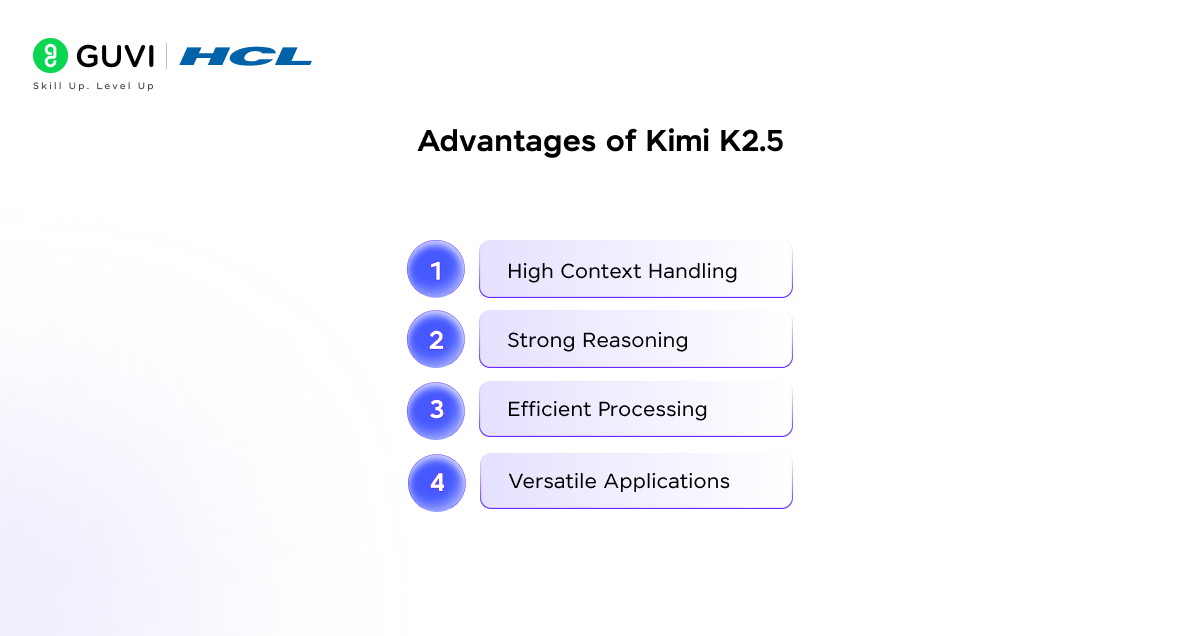
- High Context Handling: Kimi K2.5 is built to process extremely large inputs, making it suitable for analyzing long documents, research papers, and enterprise data without losing context continuity.
- Strong Reasoning: The model delivers structured and logically consistent outputs, which supports use cases that require analytical thinking such as research synthesis, problem solving, and technical explanations.
- Efficient Processing: Kimi K2.5 focuses on optimizing performance for large-scale inputs, helping reduce latency and compute overhead in long-context scenarios compared to traditional models.
- Versatile Applications: The model supports a wide range of use cases including coding support, multilingual communication, and workflow automation across industries.
Build a strong foundation in Generative AI and understand advanced models like Kimi K2.5 in real-world contexts. Download HCL GUVI’s GenAI eBook to learn practical AI workflows, prompt strategies, and how modern multimodal models work across coding and enterprise use cases.
Limitations of Kimi K2.5
- Availability Limitations: Access to Kimi K2.5 may be restricted depending on region, platform support, or API availability, which can limit adoption.
- Ecosystem Maturity: Compared to established players, Kimi K2.5 has a relatively smaller developer ecosystem, fewer integrations, and limited third-party tooling.
- Comparison with Established Models: Models like Claude Opus 4.5 and GPT-5.2 offer broader capabilities, stronger ecosystem support, and more proven deployment at scale.
Kimi K2.5 vs Claude Opus 4.5 vs GPT-5.2 vs Gemini 2.0
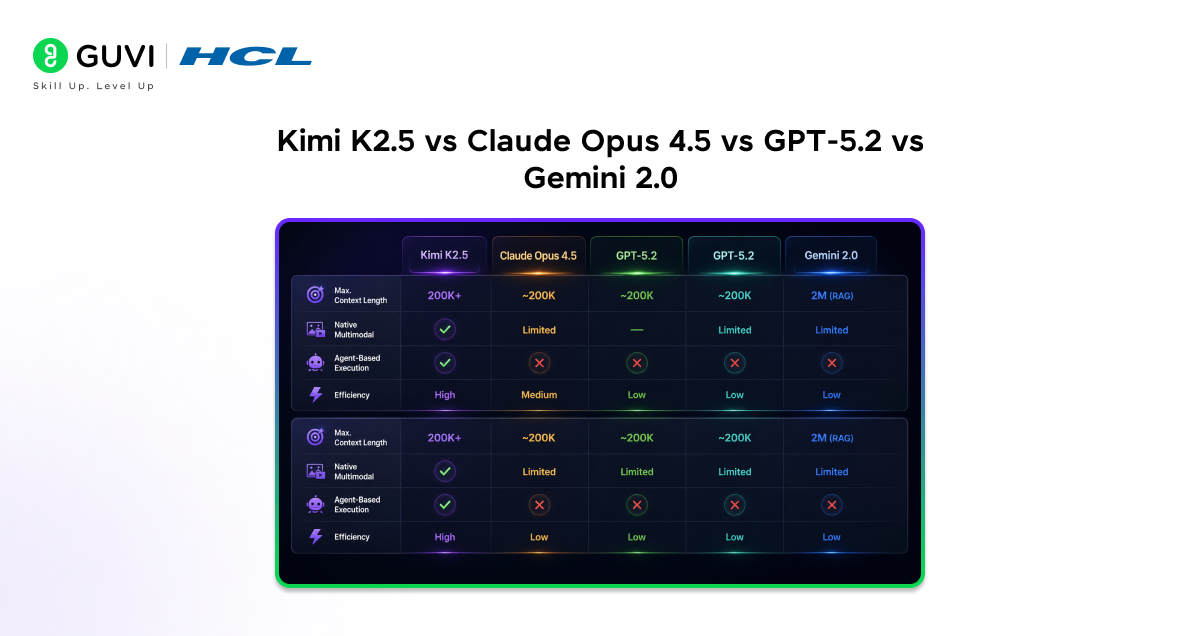
| Feature | Kimi K2.5 | Claude Opus 4.5 | GPT-5.2 | Gemini 2.0 |
| Core Strength | Long context processing | Deep reasoning & safety | Balanced intelligence + ecosystem | Multimodal + Google integration |
| Context Length | Very high (long-doc focus) | Very high | High | High |
| Reasoning Ability | Strong | Very strong | Very strong | Strong |
| Coding Capability | Good | Strong | Very strong | Strong |
| Multilingual | Strong | Strong | Very strong | Very strong |
| Multimodal | Limited | Limited | Advanced | Advanced |
| Speed & Efficiency | Optimized for large inputs | Moderate | Fast + scalable | Fast |
| Best Use Case | Document-heavy workflows | Complex analysis | General + enterprise AI | Search + multimodal apps |
Quick Comparison:
- Kimi K2.5 → Best for long documents and context-heavy tasks
- Claude Opus 4.5 → Best for deep reasoning and safe outputs
- GPT-5.2 → Best all-rounder (coding + ecosystem)
- Gemini 2.0 → Best for multimodal + Google ecosystem
Conclusion
Kimi K2.5 by Moonshot AI demonstrates strong capability in long-context processing and agent workflows. Its architecture and benchmark performance indicate readiness for real-world deployment in research, coding, and enterprise automation. As models evolve, Kimi K2.5 positions itself as a focused solution for high-context and multi-step reasoning tasks.
FAQs
1. Is Kimi K2.5 free?
Kimi K2.5 offers free access through its web platform with usage limits. It is also available for local deployment via open-source release. API pricing is relatively lower compared to leading models, with input and output token costs designed for cost-efficient scaling in production environments.
2. Is Kimi K2.5 open source?
Yes, Kimi K2.5 is released under a Modified MIT License. Developers can download model weights from platforms like Hugging Face and deploy it using frameworks such as vLLM or SGLang. Commercial use may require attribution beyond certain scale thresholds.
3. Is Kimi a Chinese company?
Yes, Kimi K2.5 is developed by Moonshot AI. The company focuses on building large language models with strong long-context capabilities and supports multilingual use across global applications.
4. Does Kimi K2.5 support coding tasks?
Yes, Kimi K2.5 supports code generation, debugging, and technical explanations across multiple programming languages.
5. Is Kimi K2.5 better than ChatGPT?
Kimi K2.5 and GPT-5.2 serve different strengths. Kimi K2.5 performs well in long-context tasks, agent-based workflows, and cost efficiency. GPT-5.2, which powers ChatGPT, shows strong performance in general reasoning and ecosystem integration. The better choice depends on the use case.
Success Stories

About the Author
Vaishali
I'm a seasoned writer with four years of experience across technical, non-technical, and just about every genre or niche you can imagine. Adaptable and curious, I enjoy exploring new topics and making information engaging and easy to understand. Fueled by a steady stream of tea, I approach each project with creativity, reliability, and genuine enthusiasm for storytelling.
View all posts by Vaishali
Connect with me @








Did you enjoy this article?