


Electric Vehicle Articles
What is Vehicle-to-Grid Technology : How EVs Can Power the Grid
What is a Battery Management System? BMS Working, Uses & EV Role
EV Infrastructure in India: Best Components, Charging Network, Challenges & Future (2026 Guide)


Get In Touch For Details! Request More Information
Basics of Electric Vehicle Simulations Using ANSYS (2026 Guide)
May 02, 2026 13 Min Read 1445 Views
(Last Updated)
Imagine you are an engineer tasked with building a battery pack for an electric car. You cannot afford to build fifty prototypes just to discover which one fails and which one lasts for years. So what do you do? You simulate it. That is exactly what Electric Vehicle Simulations Using ANSYS is all about, testing your designs inside a computer so thoroughly that by the time you build the real product, you already know it will perform as expected.
This blog is your friendly starting point into the world of Electric Vehicle Simulations Using ANSYS. It avoids heavy jargon and does not assume prior knowledge. Instead, it offers a clear and honest walkthrough of what this technology is, why every major EV company relies on it, what each tool inside ANSYS does, and how a complete beginner can start learning it today. Let us dive in.
Quick Answer
Electric Vehicle Simulations Using ANSYS is the process of using ANSYS software to virtually test how an electric vehicle’s components, such as the battery, motor, chassis, and electronics, will behave in real world conditions before anything is physically built. It helps save time, reduce costs, and allows engineers to identify and fix problems early, when they are much easier and more affordable to resolve.
Table of contents
- What is ANSYS?
- Why Electric Vehicle Simulations Using ANSYS Matters More Than Ever in 2026
- What Makes ANSYS Special Compared to Other Software
- Key Areas Where Electric Vehicle Simulations Using ANSYS Is Used
- Keeping the Battery From Overheating
- Making the Electric Motor as Efficient as Possible
- Making Sure the Car Survives a Crash
- Cutting Drag to Improve Range
- Controlling Electrical Interference
- ANSYS Tools Used in Electric Vehicle Simulations Using ANSYS at a Glance
- How a Beginner Can Start Learning Electric Vehicle Simulations Using ANSYS
- Step 1: Build a Basic Understanding of Physics First
- Step 2: Download the Free ANSYS Student Edition
- Step 3: Get Comfortable With ANSYS Workbench
- Step 4: Follow EV-Specific Tutorials
- Step 5: Build Your First Personal Project
- Tips for Mastering Electric Vehicle Simulations Using ANSYS
- 💡 Did You Know?
- How Electric Vehicle Simulations Using ANSYS Is Opening Doors for Engineers in India in 2026
- Conclusion
- FAQs
- What is Electric Vehicle Simulations Using ANSYS in simple terms?
- Which ANSYS tool should a beginner start with for EV simulations?
- Is ANSYS really free for students?
- Do I need to know coding to use ANSYS?
- What kind of jobs can I get by learning Electric Vehicle Simulations Using ANSYS?
What is ANSYS?

Before we talk about Electric Vehicle Simulations Using ANSYS, let us answer the most basic question first. ANSYS is a software company founded in 1970 in the United States, and it makes engineering simulation software. In plain English , it is a computer-aided engineering (CAE) tool that lets engineers test how physical things will behave, without building those things in real life first.
Originally, the word ANSYS came from:
- AN → Analysis
- SYS → Systems
So it loosely meant “Analysis Systems”, but now just a brand name.
Think of ANSYS like a flight simulator for pilots. A pilot learns to fly and practices emergency situations inside a simulator — not in a real plane over a real city. ANSYS does the same thing for engineers. It creates a virtual version of a product, applies real physics to it, and shows the engineer exactly what will happen before a single part is manufactured.
Today, ANSYS software is used in aerospace, defence, automotive, electronics, energy, and healthcare , by companies like Boeing, Tesla, Samsung, and NASA. When this same software is applied to electric cars and their components, the result is what the industry calls Electric Vehicle Simulations Using ANSYS.
What Does ANSYS Actually Do?
At its core, ANSYS takes a 3D model of a part or system, divides it into thousands of tiny pieces called mesh elements, and then solves physics equations across every single one of those pieces simultaneously. The result is a detailed prediction of how that part will behave like how hot it gets, how much it bends, how air flows around it, or how magnetic energy moves through it. This is exactly the process at work in Electric Vehicle Simulations Using ANSYS, applied to batteries, motors, chassis, and electronics.
- It solves real physics equations: ANSYS uses established mathematical equations such as heat transfer, fluid dynamics, electromagnetics, structural mechanics etc to calculate accurate predictions rather than rough estimates.
- It works from 3D models: Engineers import a 3D CAD model of their design into ANSYS, and the software uses that geometry as the starting point for every simulation it runs.
- It shows results in colour: After a simulation runs, ANSYS displays results as colour-coded maps like blue for cool areas, red for hot ones , making it easy to spot problems at a glance without deep analysis experience.
- It handles many types of physics: ANSYS is not limited to one kind of simulation. It handles heat, airflow, structural stress, electromagnetics, acoustics, and more.
- It is trusted by the biggest names: Over 50,000 companies and institutions worldwide use ANSYS software. In the EV space, Electric Vehicle Simulations Using ANSYS is how most of the world’s leading automakers validate their designs before production.
Thought to ponder: If a pilot can train for years without ever crashing a real plane, what does that tell you about how powerful good simulation software can be and why engineers trust it with products that millions of people use every day?
Hint: The key is that a good simulation replicates reality closely enough that the skills and insights you gain from it transfer directly to the real world. For a pilot, that means muscle memory and decision-making. For an engineer using Electric Vehicle Simulations Using ANSYS, it means knowing exactly how a battery or motor will behave before it is built, so the real product works correctly the first time.
Why Electric Vehicle Simulations Using ANSYS Matters More Than Ever in 2026
Think about the last time you played a video game where your character walked into fire and nothing happened. That is a bad simulation. Now imagine the opposite ; a simulation so accurate that engineers trust it with their lives, their products, and billions of rupees in manufacturing investment. That is Electric Vehicle Simulations Using ANSYS.
The EV industry in 2026 is moving faster than ever. Different types of electric vehicles are launched every few months, safety standards are getting stricter, and customers want more range, faster charging, and lower prices all at once. Building and crashing a physical car every time you want to test a new idea simply does not work anymore as it takes too long and costs too much.
Electric Vehicle Simulations Using ANSYS solves this by letting engineers test thousands of design ideas inside a computer. They can check if the battery overheats, if the motor is efficient enough, or if the car body crumbles correctly in a crash — all without touching a single physical part. Teams using Electric Vehicle Simulations Using ANSYS can compress what used to take a year of prototyping into a few weeks of simulation.
Thought to ponder: If a computer can predict exactly how a battery behaves in a crash or a heatwave, does an engineer still need to physically crash a car to know if it is safe?
Answer: In many cases, no — not as many times as before. Regulatory bodies in several countries now accept simulation results alongside physical tests, which means fewer real cars need to be destroyed. However, physical tests are still required for final certification. Electric Vehicle Simulations Using ANSYS dramatically reduces how many physical tests you need , from dozens of destructive runs to just a few confirming ones at the end.
What Makes ANSYS Special Compared to Other Software
There are many simulation tools out there. So why do the world’s top EV companies keep coming back to ANSYS? The answer is simple; ANSYS does not just simulate one thing at a time , it simulates everything together, just like the real world works.
Think of it this way: when a battery heats up, that heat puts stress on the metal around it, which changes how electricity flows through it, which affects how far the car can travel. In the real world, all of this happens at the same time. Electric Vehicle Simulations Using ANSYS models all of it together in one connected system, not as separate isolated experiments.
- Everything works together: In Electric Vehicle Simulations Using ANSYS, heat, stress, electricity, and airflow are all connected — change one and the others update automatically, just like they would in a real car.
- AI helps find the best design: ANSYS optiSLang uses artificial intelligence to test thousands of design variations automatically and tell you which one performs best, saving weeks of manual guesswork.
- Used by real EV companies: Lucid Motors used Electric Vehicle Simulations Using ANSYS to develop the Lucid Air, which holds a range record of over 837 km on a single charge.
- One home for all your tools: ANSYS Workbench connects every tool — Fluent, Maxwell, Mechanical, and more so your data flows smoothly from one analysis to the next without any manual copying or file transfers.
Key Areas Where Electric Vehicle Simulations Using ANSYS Is Used
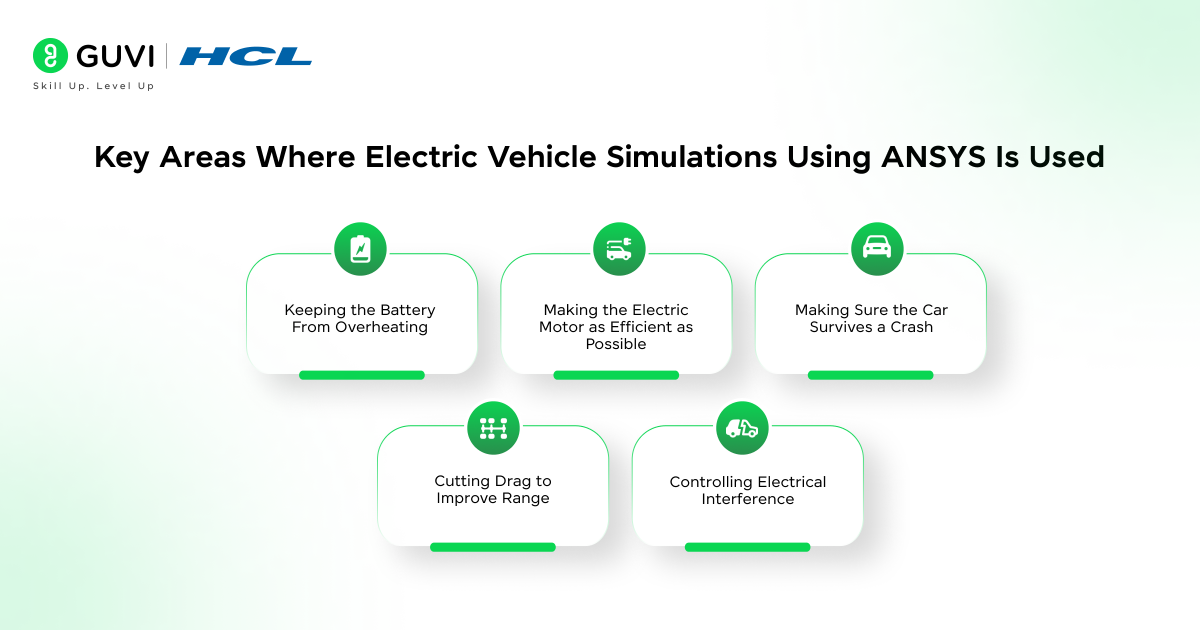
Electric Vehicle Simulations Using ANSYS is not just one thing you run and get an answer from. It covers several very different areas of a vehicle, each with its own tools and techniques. Here are the main ones every beginner should know.
1. Keeping the Battery From Overheating
Here is an important fact: if a lithium ion battery gets too hot, it can trigger a chain reaction known as thermal runaway, which may lead to a fire. If it gets too cold, its driving range drops. This means engineers must maintain the electric vehicle battery within a precise temperature range at all times, which is extremely difficult to achieve without simulation.
Electric Vehicle Simulations Using ANSYS uses a tool called ANSYS Fluent to model how heat moves through a battery pack in detail. Engineers can identify where hotspots develop, evaluate whether a liquid cooling plate is effective, and compare different cooling designs, all without building a single physical battery module.
- ANSYS Fluent finds hotspots: The primary CFD tool in Electric Vehicle Simulations Using ANSYS shows you exactly where heat is building up inside a battery pack, so you can fix the problem before it becomes dangerous.
- Electrothermal analysis: This is a method that links the electrical behaviour of the battery with its thermal behaviour, making it one of the most important workflows in Electric Vehicle Simulations Using ANSYS, as it allows both aspects to be studied simultaneously.
- Testing cooling designs virtually: Instead of building five different cooling systems to find out which one works best, Electric Vehicle Simulations Using ANSYS lets you test them all on a computer in a fraction of the time and cost.
- From one cell to the full pack: Engineers start by simulating a single battery cell, then scale up to the full module and pack, catching problems at each level before moving to the next.
- Faster answers with ROM: A technique called Reduced-Order Modelling speeds up battery simulations by up to ten times, so engineers do not have to wait days for results when hours will do.
Brain teaser: A battery heats up when you drive hard and also when you charge it fast. Can you think of a cooling design that handles both situations at the same time without getting in the way of either?
Clue: Think about liquid cooling with a thermostatically controlled pump. When the battery generates heat, whether during charging or discharging, the pump circulates coolant through channels in the cold plate at a higher rate, removing heat more effectively. The challenge lies in designing the channels so that coolant reaches every cell evenly, not just those closest to the inlet. Electric Vehicle Simulations Using ANSYS, specifically ANSYS Fluent, helps engineers identify the optimal channel layout through virtual testing, allowing them to evaluate hundreds of configurations without building a single physical prototype.
2. Making the Electric Motor as Efficient as Possible
The electric motor is what actually makes the wheels spin. The more efficient it is, the less battery power it wastes, and the farther the car can travel. Designing a high performance motor is not simple, as it involves magnetic fields, heat, mechanical forces, and sound all at the same time.
Electric Vehicle Simulations Using ANSYS provides EV engineers with a powerful set of tools to design and test motors entirely in a virtual environment. They can model how magnetic energy flows through the motor, identify where energy is lost as heat, and even analyze how much noise the motor will produce, all before a single physical motor is built.
- ANSYS Maxwell models magnetic fields: The primary electromagnetic tool in Electric Vehicle Simulations Using ANSYS, it shows engineers exactly how magnetic energy moves inside the motor and where energy is lost as heat or noise.
- ANSYS Motor-CAD for quick motor design: This dedicated tool lets engineers rapidly test different motor shapes and sizes, comparing how efficiently each one converts electricity into movement across different speeds and loads.
- Finding where energy is wasted: Electric Vehicle Simulations Using ANSYS pinpoints exactly which part of the motor is losing energy at different speeds, giving engineers a clear target for improvement.
- Listening to the motor before it exists: Results from the simulation feed into a tool called ANSYS Sound, which lets engineers actually hear what the motor will sound like at different speeds which is a surprisingly useful way to catch annoying noise problems early.
- AI finds the best motor shape: ANSYS optiSLang automatically tests thousands of different motor designs and highlights the one that gives the best combination of power, efficiency, and low noise.
3. Making Sure the Car Survives a Crash
This is perhaps the most dramatic application of Electric Vehicle Simulations Using ANSYS. In an EV crash, the top priority is keeping the battery pack intact. If the battery gets punctured or crushed, it can catch fire within seconds. Designing a car body that protects the battery in a crash, while still keeping the vehicle light enough for efficient movement, is one of the toughest challenges in EV engineering.
ANSYS LS-DYNA, a crash simulation tool within Electric Vehicle Simulations Using ANSYS, allows engineers to virtually crash a car thousands of times. They can closely analyze how the body deforms, check whether the battery enclosure remains secure, and understand what happens to the battery cells during impact, all through simulations without destroying real vehicles or putting human lives at risk.
- ANSYS LS-DYNA simulates the crash: The crash simulation tool inside Electric Vehicle Simulations Using ANSYS shows engineers frame-by-frame how the car body and battery housing deform during impact, at millisecond time resolution.
- Predicting battery fires from crashes: Electric Vehicle Simulations Using ANSYS connects the crash physics with battery thermal physics, so engineers can predict whether a crushed cell will overheat and cause a fire before putting a real car on the road.
- Testing at every scale: The simulation starts at the level of a single battery cell and scales up to the full vehicle crash, catching dangerous weak points at every stage of the design.
- Accepted by safety regulators: Crash results from Electric Vehicle Simulations Using ANSYS are accepted alongside physical crash tests in many countries, which means fewer real cars need to be destroyed during the certification process.
- Virtual abuse testing: Drop tests, vibration, and crush scenarios are all run virtually to verify the battery pack’s durability against international safety standards.
Thought to ponder: A car crash happens in less than a second, but a battery fire triggered by that crash can unfold over hours. How do you design a simulation that captures both?
Answer: Engineers use two different simulation tools linked together. ANSYS LS-DYNA handles the crash at millisecond resolution, capturing how the battery enclosure deforms on impact. Those deformation results are then handed to a thermal and electrochemical model that simulates what happens to the cells over the next minutes and hours. It is like handing a baton in a relay race ; one solver finishes its job and passes the result to the next one. This multi-solver approach is one of the most powerful capabilities inside Electric Vehicle Simulations Using ANSYS.
4. Cutting Drag to Improve Range
Here is a simple truth about electric vehicles ; the more air resistance your car fights, the more battery power it burns, and the less range you get. Aerodynamics matters enormously for EVs, and getting it right requires detailed simulation of how air flows around and under the car.
Electric Vehicle Simulations Using ANSYS uses ANSYS Fluent to model airflow around the entire vehicle body. Engineers can test different car shapes, bumper designs, and underbody panels virtually and see exactly how much drag each design creates ,without booking expensive wind tunnel time.
- Measuring drag virtually: ANSYS Fluent within Electric Vehicle Simulations Using ANSYS calculates how much air resistance a car design creates at different speeds, letting engineers compare body shapes quickly and cheaply.
- Optimising underbody airflow: The space under the car has a huge effect on both drag and cooling . Electric Vehicle Simulations Using ANSYS models this area in detail to find designs that improve both at the same time.
- Designing better cooling ducts: Internal airflow paths that cool the battery and motor are modelled virtually to confirm they work without adding too much weight or blocking other air channels.
- Aerodynamics and cooling linked together: Because Electric Vehicle Simulations Using ANSYS connect all its analyses, a change to the car’s shape automatically updates the cooling simulation too , so engineers always see the full picture at once.
5. Controlling Electrical Interference
This one surprises a lot of beginners. Electric vehicles have enormous amounts of electricity flowing through them at high voltage and high frequency. That electricity creates invisible electromagnetic waves, and if those waves are not carefully controlled, they can interfere with the car’s own sensors, GPS, Bluetooth, and charging systems.

Electric Vehicle Simulations Using ANSYS uses tools called ANSYS HFSS and ANSYS SIwave to simulate these electromagnetic waves and make sure they stay within safe limits. This process is called EMI/EMC testing — checking that electrical parts do not interfere with each other.
- ANSYS HFSS checks for interference: Used in Electric Vehicle Simulations Using ANSYS to model the invisible electromagnetic waves that power electronics create, identifying which ones could disrupt the car’s own sensors or communication systems.
- ANSYS SIwave checks circuit boards: This tool analyses the electronic circuit boards inside the car’s power systems, finding design issues that could cause signal problems or regulatory compliance failures.
- Testing in two ways at once: Electric Vehicle Simulations Using ANSYS runs electromagnetic analysis in both frequency and time domains, giving a complete picture of any interference risks across the full operating range.
- Planning where cables go: High-voltage cables are modelled to understand how much electromagnetic noise they emit, helping engineers decide where to route them through the car body to minimise interference.
ANSYS Tools Used in Electric Vehicle Simulations Using ANSYS at a Glance
Before you start learning, this helps to know which tool does what. Think of each ANSYS tool like a specialist doctor where each one is an expert in one area of the car.
| ANSYS Tool | What It Does in Simple Terms |
| ANSYS Fluent | Simulates heat and airflow that’s used for battery cooling and aerodynamics |
| ANSYS Maxwell | Models magnetic fields inside electric motors |
| ANSYS Motor-CAD | Designs and tests electric motors quickly across all operating conditions |
| ANSYS Mechanical | Checks if parts are strong enough and how they handle stress and vibration |
| ANSYS LS-DYNA | Simulates crash scenarios and battery abuse testing |
| ANSYS Twin Builder | Builds a virtual copy of the full EV powertrain system |
| ANSYS optiSLang | Uses AI to find the best design out of thousands of options automatically |
| ANSYS HFSS / SIwave | Checks for electromagnetic interference in electronics |
| ANSYS Sound | Lets engineers hear what a motor will sound like before it is built |
How a Beginner Can Start Learning Electric Vehicle Simulations Using ANSYS
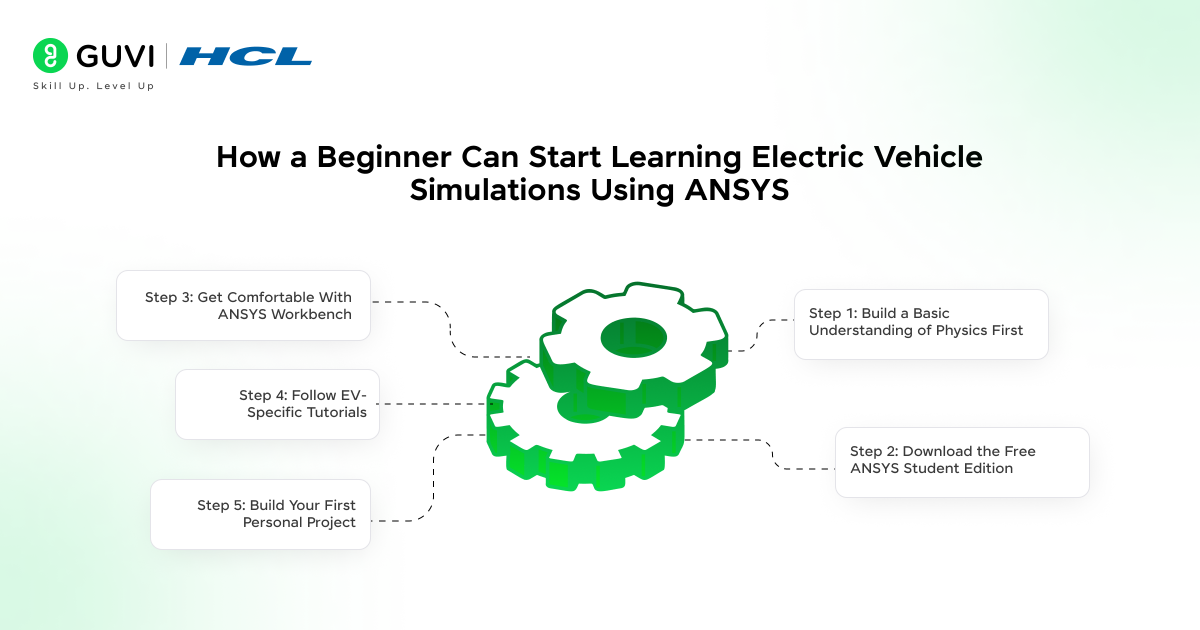
Here is the good news , you do not need a job at a car company or an expensive laboratory to start. ANSYS offers a completely free Student Edition, and there are structured tutorials available online right now. Here is a simple, honest roadmap for getting started with Electric Vehicle Simulations Using ANSYS in 2026.
Step 1: Build a Basic Understanding of Physics First
ANSYS is a tool that solves physics equations , so if you do not understand the basic physics, you will not know whether your results make sense. You do not need to be an expert, but you need the fundamentals.
- Heat transfer basics: Learn how heat moves through solids, liquids, and air.Tthis is the foundation of every battery and motor thermal simulation in Electric Vehicle Simulations Using ANSYS.
- Basic electromagnetics: Understand how magnetic fields work and what happens inside a coil of wire when electricity flows through it. This will make ANSYS Maxwell much easier to learn.
- Simple fluid mechanics: Know what air pressure, flow rate, and drag mean , this background will help you understand ANSYS Fluent results when you start aerodynamics and cooling simulations.
- Basic structural mechanics: Understand stress, strain, and what it means for a material to fail — this is what ANSYS Mechanical and LS-DYNA are solving under the hood.
Step 2: Download the Free ANSYS Student Edition
ANSYS offers a fully free Student Edition in 2026 that includes real professional tools. It has some limits on model size, but it is more than enough for learning and personal projects in Electric Vehicle Simulations Using ANSYS.
- It is completely free: Register with your university or college email on the official ANSYS website and download the Student Edition at no cost , it includes Fluent, Maxwell, Mechanical, Motor-CAD, and more.
- What is included: The Student Edition gives you access to the core tools used in Electric Vehicle Simulations Using ANSYS , which is everything you need to run battery, motor, and structural simulations for learning.
- Model size limits: The student version handles up to 512,000 mesh cells in Fluent and nodes in Mechanical which is plenty for the beginner and intermediate projects you will start with.
- What computer you need: A Windows 10 or 11 laptop with at least 8 GB of RAM and a dedicated graphics card will run the Student Edition comfortably.
Step 3: Get Comfortable With ANSYS Workbench
ANSYS Workbench is the main screen you see when you open ANSYS. It is where you set up your project, connect different analysis tools together, and manage your results. Think of it as the control room for your entire simulation.
- The project schematic: This is the main canvas where you drag and drop simulation tools, connect them together, and tell ANSYS what order to run them in.This is the starting point of every Electric Vehicle Simulations Using ANSYS project.
- Setting up inputs: You define things like the material your part is made of, what temperature it starts at, or how fast air is flowing — these are called boundary conditions, and getting them right is everything.
- Connecting tools together: In Electric Vehicle Simulations Using ANSYS, you often need one tool to feed its results into another — Workbench makes this as simple as drawing a line between two boxes on the screen.
- Running and checking results: Once you click Solve, Workbench manages the calculation and shows you results in colour-coded maps — learning to read these visualisations is one of the most satisfying parts of the journey.
Step 4: Follow EV-Specific Tutorials
ANSYS publishes free tutorials and webinars specifically about EV topics. These are the fastest way to build real knowledge in Electric Vehicle Simulations Using ANSYS without having to figure everything out alone.
- Battery thermal tutorial: The best first tutorial in Electric Vehicle Simulations Using ANSYS — ANSYS Fluent’s battery pack electrothermal tutorial walks you through setting up a simple lithium-ion module with a liquid cooling plate from scratch.
- Motor design tutorial: The ANSYS Motor-CAD tutorial shows you how to set up a basic electric motor, run an efficiency analysis, and see where the motor loses energy which is a great introduction to the motor side of Electric Vehicle Simulations Using ANSYS.
- ANSYS Innovation Courses: Free beginner-to-intermediate courses at innovationspace.ansys.com cover Fluent, Mechanical, and Maxwell with step-by-step guidance , this is the most structured and accessible entry point into Electric Vehicle Simulations Using ANSYS.
- YouTube and ANSYS webinars: The official ANSYS YouTube channel has free recorded webinars on battery simulation, motor design, and crash safety that walk through real EV problems in an approachable way.
Step 5: Build Your First Personal Project
Once you have finished a few tutorials, the best thing you can do is pick one real EV problem and solve it yourself. A personal project proves to employers and yourself that you can actually use Electric Vehicle Simulations Using ANSYS, not just follow instructions.
- Beginner battery project: Model a simple four-cell battery module with a cooling plate in ANSYS Fluent which is a classic first Electric Vehicle Simulations Using ANSYS project and test how changing the coolant speed affects the maximum temperature.
- Beginner motor project: A great first Electric Vehicle Simulations Using ANSYS motor task is to set up a basic permanent magnet motor in Motor-CAD and create an efficiency map showing how the motor performs at different speeds and power levels.
- Crash safety project: Try a simple crush test on a single battery cell in ANSYS LS-DYNA and observe how the structure deforms under load — a straightforward introduction to the safety side of Electric Vehicle Simulations Using ANSYS.
- Write it up properly: Document your Electric Vehicle Simulations Using ANSYS project with a clear write-up covering what you simulated, what assumptions you made, what results you got, and what you learned , this becomes your first portfolio piece.
Tips for Mastering Electric Vehicle Simulations Using ANSYS
- Keep your geometry simple at first: Do not try to simulate a full car on day one. Start with a single cell or a simple motor shape . Simple models are faster, easier to debug, and teach you just as much.
- Always check your results make sense: Before trusting any simulation output, ask yourself if the answer is physically reasonable. If your battery simulation says the temperature is 5000°C, something has gone wrong and that is okay, debugging is how you learn.
- Mesh quality matters more than you think: The mesh is the invisible grid ANSYS uses to divide your model into tiny pieces for calculation. A bad mesh gives wrong answers , so spend time learning how to create a clean one before anything else.
- Master one tool before jumping to the next: Learn Fluent well before you try Maxwell, and learn Maxwell well before you try to connect them together. Rushing into complexity before the basics are solid is the most common beginner mistake in Electric Vehicle Simulations Using ANSYS.
- Write down every assumption you make: Every simulation requires you to make choices — what material is this, how hot is the environment, how fast is the coolant. Writing these down makes your work professional and reproducible.
- Use the ANSYS Learning Hub: ANSYS has a dedicated online learning platform with structured courses specifically designed for Electric Vehicle Simulations Using ANSYS which is free for students and a fantastic place to build skill systematically.
- Connect with other learners: The ANSYS Student Community online is active in 2026, full of people learning Electric Vehicle Simulations Using ANSYS at the same level as you — ask questions, share projects, and learn from others who have already made the mistakes you are about to make.
Do check out HCL GUVI’s Advanced Electric Vehicle Technology Course with IIT Delhi, a 6-month course covering EV fundamentals like batteries, power electronics, and charging systems with hands-on learning and certification, ideal for building a career in the EV industry.
Also read – How Do You Choose the Right Electric Vehicle Course & Certification in 2026?
💡 Did You Know?
- Lucid Motors used Electric Vehicle Simulations Using ANSYS during development of the Lucid Air, the electric car that holds a range record of over 837 km on a single charge, longer than any other production EV in history.
- The ANSYS Student Edition is completely free and includes Fluent, Maxwell, Mechanical, and Motor-CAD, meaning you can start learning Electric Vehicle Simulations Using ANSYS today without spending a single rupee.
- ANSYS optiSLang, the AI-powered design tool inside Electric Vehicle Simulations Using ANSYS, can evaluate thousands of motor or battery designs automatically overnight, a task that would take a human team months to do manually.
How Electric Vehicle Simulations Using ANSYS Is Opening Doors for Engineers in India in 2026
India’s EV market is growing at a pace that surprised even the most optimistic forecasts. New electric two-wheelers, three-wheelers, buses, and passenger cars are launching every quarter. OEMs from around the world are setting up engineering centres in cities like Pune, Bengaluru, Chennai, Hyderabad and they all need engineers who can run simulations.
The demand for people who understand Electric Vehicle Simulations Using ANSYS is growing faster than colleges can train them. Engineers with hands-on ANSYS skills are being hired for roles in battery development, motor design, structural analysis, and NVH all across India’s rapidly expanding EV ecosystem.
If you are an engineering student or a recent graduate, learning Electric Vehicle Simulations Using ANSYS right now is one of the smartest career moves you can make. The tools are free, the tutorials are online, and the jobs are waiting.
Riddle: An EV company wants to halve its product development time, improve battery safety, and cut testing costs all at once. What is the one investment that achieves all three?
Clue: Think about what all three goals have in common – they all involve reducing the need to build and physically test something before you know if it works.
Answer: A strong Electric Vehicle Simulations Using ANSYS workflow. When you run Electric Vehicle Simulations Using ANSYS, you test battery safety, motor performance, and crash behaviour virtually , spending less time waiting for physical results, catching problems early when they are cheap to fix, and running far fewer destructive tests. All three targets hit at once.
Conclusion
Every electric car you see on the road today was designed and tested inside a computer before it was built in a factory. Electric Vehicle Simulations Using ANSYS is the technology that made that possible and in 2026, it is more accessible than it has ever been.
You do not need a fancy lab, a company budget, or years of experience to begin. You need a laptop, a free student licence, curiosity, and the willingness to start with something small. Every expert in Electric Vehicle Simulations Using ANSYS started exactly where you are right now ; with zero simulations completed and a lot of questions.
Start with one tutorial. Run one simulation. See one result that surprises you. That is how it begins.
FAQs
1. What is Electric Vehicle Simulations Using ANSYS in simple terms?
It is the process of using ANSYS software to test how an electric vehicle’s parts like the battery and motor will perform in the real world, all inside a computer, before anything is physically manufactured.
2. Which ANSYS tool should a beginner start with for EV simulations?
Start with ANSYS Fluent for battery thermal simulations as it has the best beginner tutorials and is one of the most widely used tools in Electric Vehicle Simulations Using ANSYS. The ANSYS Innovation Courses online are a great free starting point.
3. Is ANSYS really free for students?
Yes. The ANSYS Student Edition is completely free and includes Fluent, Mechanical, Maxwell, and Motor-CAD. It is a real, functional version of the software that is perfectly suited for learning Electric Vehicle Simulations Using ANSYS.
4. Do I need to know coding to use ANSYS?
Not at the beginning. ANSYS has a graphical interface that does not require any coding to get started. As you advance in Electric Vehicle Simulations Using ANSYS, learning basic Python scripting helps automate repetitive tasks , but it is not a requirement for beginners.
5. What kind of jobs can I get by learning Electric Vehicle Simulations Using ANSYS?
Roles in battery thermal engineering, electric motor design, vehicle structural analysis, NVH engineering, and EV systems simulation are all actively hiring people with ANSYS skills in India and globally in 2026.
Success Stories

About the Author
Jebasta
I translate the language of data into stories that anyone can understand. As a writer with a data science background, I simplify analytics, AI, and decision-making so beginners and enthusiasts can confidently explore the world of data.
View all posts by Jebasta
Connect with me @










Did you enjoy this article?