


Full Stack Development Articles
Claude for Architecture and Engineering Documentation
Freelancing as a Python Developer: Getting Your First Client


Get In Touch For Details! Request More Information

What Is REST API? How It Works, Methods, Examples & Benefits
Sep 02, 2026 6 Min Read 2629 Views
(Last Updated)
What if every app you use, from ordering food to checking your bank balance, is constantly communicating behind the scenes?
Modern digital experiences rely on seamless data exchange between mobile apps, servers, databases, and third-party services. This communication must be fast and reliable to keep applications running smoothly. REST APIs make this possible by enabling different systems to connect, share data, and work together without exposing internal complexity. Want to understand how REST APIs enable scalable, real-time software? Read the full blog to explore how they work, their architecture, and real-world use cases.
Table of contents
- AI Overview
- REST API at a Glance
- What is a REST API?
- Key Concepts of REST API
- Understanding REST API Methods (HTTP Verbs)
- REST API vs RESTful API
- How REST API Works with a Practical Request Response Example?
- Step 1: Client Sends an HTTP Request
- Step 2: Server Interprets the Request
- Step 3: Server Returns a Structured Representation
- Step 4: Client Processes the Response
- Understanding CRUD Operations in REST
- Real-World Use Cases of REST API
- Tools Used to Test and Work with REST APIs
- Challenges and Limitations of REST APIs
- Best Practices for Designing REST APIs
- REST API vs SOAP API Key Differences
- Future of REST APIs in an AI-Driven Ecosystem
- Conclusion
- FAQs
- How do REST APIs scale in cloud environments?
- Why is JSON the preferred format for REST API responses?
- How is reliability maintained when many services depend on REST APIs?
AI Overview
A REST API (Representational State Transfer API) is a web API that allows applications to communicate using HTTP. It uses resources, URLs, and standard HTTP methods such as GET, POST, PUT, PATCH, and DELETE to perform operations. REST APIs are widely used for web, mobile, cloud, and AI applications because they are simple, scalable, and easy to integrate.
REST API at a Glance
| Feature | REST API |
|---|---|
| Architecture | REST |
| Communication | HTTP/HTTPS |
| Data format | Usually JSON |
| Resources | Identified using URLs |
| Common methods | GET, POST, PUT, PATCH, DELETE |
| State | Stateless |
| Common uses | Web apps, mobile apps, cloud services, AI applications |
What is a REST API?
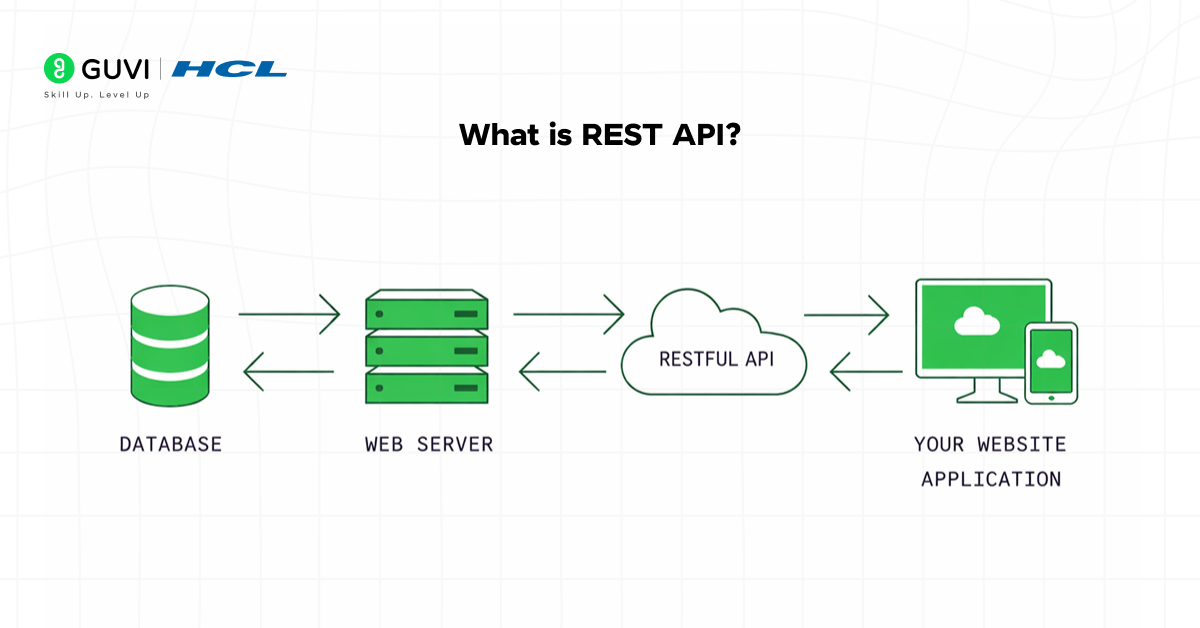
A REST API is an architectural interface that allows software systems to communicate over HTTP by exposing data and functionality as addressable resources. Instead of invoking tightly coupled procedures, clients interact with resource endpoints using standardized methods such as GET, POST, PUT, PATCH, and DELETE. Each request is self-contained and carries the context required for processing, which supports stateless operation and simplifies horizontal scaling.
- REST continues to be the most widely used API architecture, with adoption levels exceeding 90% across many development environments.
- Production usage has grown by about 10%, now around 70% of deployed APIs, while GraphQL has increased by roughly 5%.
- Organizational data shows REST at nearly 67% of API architectures versus about 13% for GraphQL.
Key Concepts of REST API
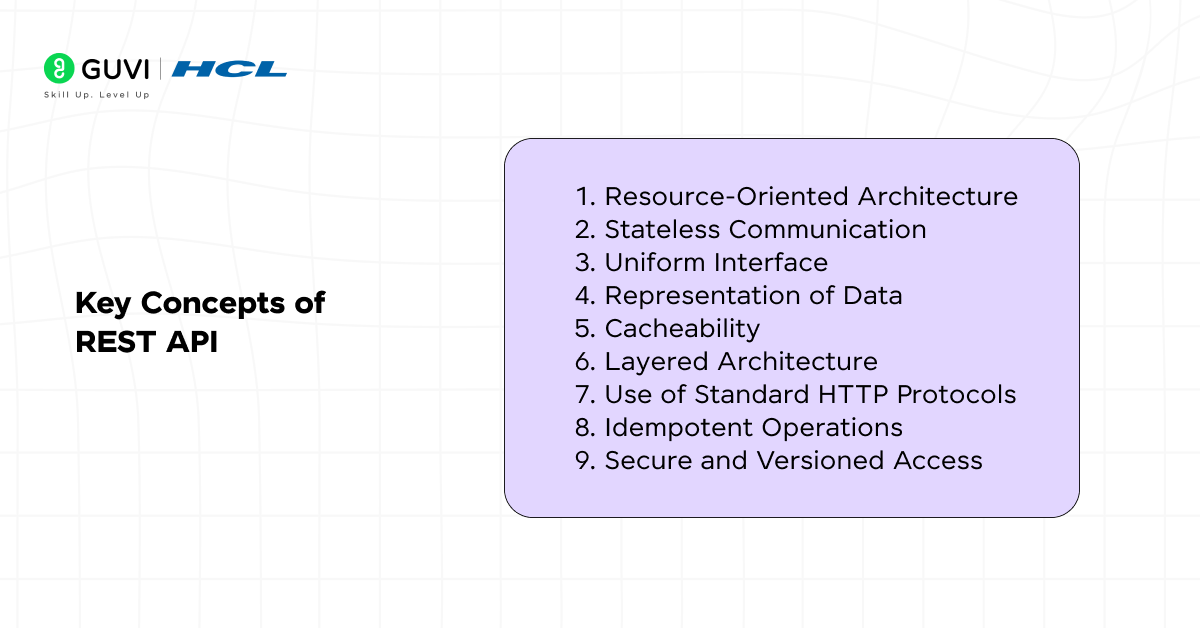
- Resource-Oriented Architecture: REST focuses on resources rather than actions. Each resource such as a user, order, or product is identified by a unique URL. This structure mirrors how the web operates, which makes systems easier to scale and maintain across distributed environments.
- Stateless Communication: Every request contains all required information, and the server does not store session data. This allows requests to be processed independently, which supports horizontal scaling and efficient load distribution in cloud systems.
- Uniform Interface: REST uses standardized HTTP methods like GET, POST, PUT, PATCH, and DELETE. A consistent interaction model reduces integration complexity and allows services to communicate without custom protocols.
- Representation of Data: Servers return structured representations, typically JSON, rather than exposing internal databases. This abstraction protects system design while allowing backend changes without breaking client applications.
- Cacheability: Responses can be cached to reduce repeated processing and latency. Caching improves performance and lowers infrastructure load, especially in high-traffic environments.
- Layered Architecture: REST supports intermediaries such as API gateways, proxies, and security layers. Each layer performs a defined function, which strengthens scalability, monitoring, and access control.
- Use of Standard HTTP Protocols: REST relies on existing web standards and status codes to communicate outcomes. This promotes interoperability across browsers, platforms, and cloud services.
- Idempotent Operations: Methods like GET, PUT, and DELETE produce consistent results even if repeated. This predictability is critical in distributed systems where retries may occur.
- Secure and Versioned Access: Authentication mechanisms such as tokens regulate access, while API versioning allows evolution without disrupting existing integrations. This supports stability in long-term deployments.
Understanding REST API Methods (HTTP Verbs)
| Method | Purpose | Example Use |
| GET | Retrieve data | Fetch user details |
| POST | Create resource | Add new user |
| PUT | Update resource | Modify profile |
| PATCH | Partial update | Change email |
| DELETE | Remove resource | Delete account |
REST API vs RESTful API
The terms REST API and RESTful API are often used interchangeably, but there is a small distinction. REST API generally refers to an API designed around REST principles, while RESTful API describes an API that follows those principles more closely.
In practice, developers commonly use both terms to describe HTTP-based APIs that work with resources and follow REST architectural constraints.
How REST API Works with a Practical Request Response Example?
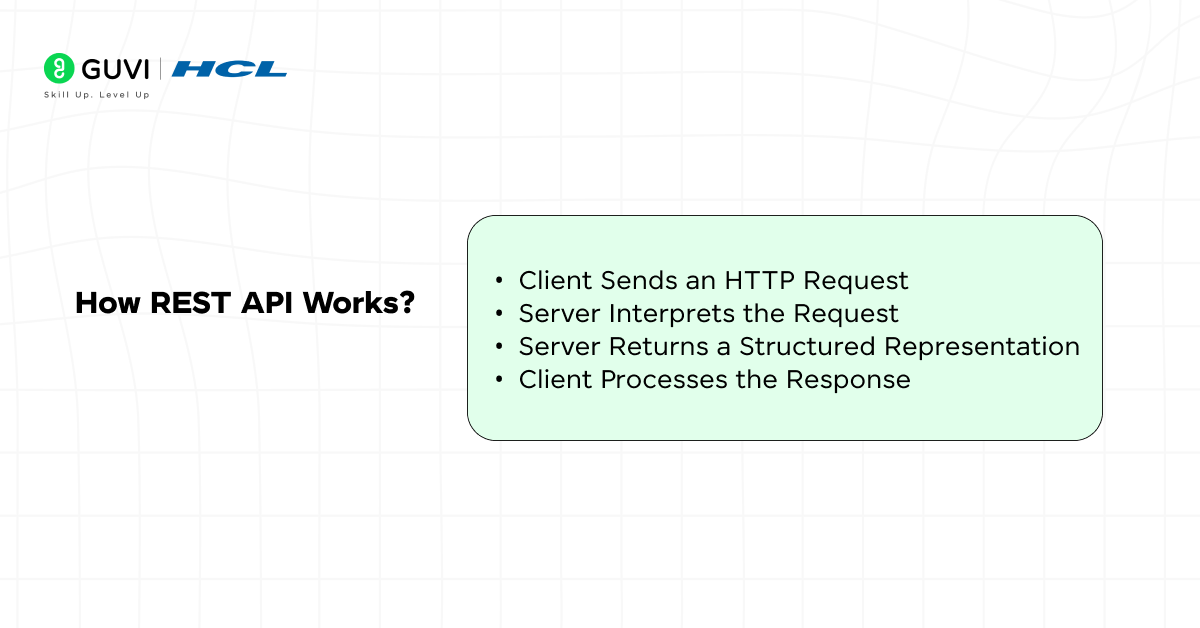
REST APIs operate through a structured exchange between a client and a server using standard HTTP protocols. The client requests a resource. The server processes that request and returns a representation of the data. This interaction follows defined rules that maintain consistency, scalability, and reliability across distributed systems.
Step 1: Client Sends an HTTP Request
A client application, such as a web browser or mobile app, initiates communication by sending an HTTP request to a specific endpoint. The request contains three essential elements:
- Method that defines the action
- URL that identifies the resource
- Headers and an optional body with additional context
Example Request
GET https://api.example.com/users/101
Authorization: Bearer <token>
Content-Type: application/json
Here, the client is requesting details of the user whose ID is 101.
Step 2: Server Interprets the Request
The server validates authentication, checks permissions, and routes the request to the appropriate service. It may interact with a database, business logic layer, or external services to retrieve the required data.
This separation between request handling and data processing allows the system to scale without exposing internal implementation details.
Step 3: Server Returns a Structured Representation
Once processing is complete, the server responds with a standardized HTTP status code and a structured data format, typically JSON.
Example Response
HTTP/1.1 200 OK

Content-Type: application/json

{

  "id": 101,

  "name": "Aarav Sharma",

  "email": "[email protected]",

  "role": "Customer",

  "created_at": "2025-12-01T10:15:30Z"

}
The response provides a representation of the resource rather than exposing how the data is stored internally.
Step 4: Client Processes the Response
The client application reads the response and uses it to update the interface, trigger workflows, or store temporary state. Since REST is stateless, the server does not retain session context. Any future request must provide the required credentials and parameters again. This approach allows requests to be handled by any available server node, which supports load balancing and fault tolerance.
Understanding CRUD Operations in REST
In practical systems, actions such as creating a record, retrieving information, updating details, or removing data are not handled through custom commands. Instead, REST aligns these operations with standard HTTP semantics. This alignment between HTTP semantics and application behavior simplifies development and debugging. It also creates a predictable model where developers can interpret an API’s intent directly from the method and endpoint being used.
The table below illustrates how CRUD operations correspond to HTTP methods, which clarifies how REST structures interactions between clients and servers while strengthening operational control.
| Operation | HTTP Method | Endpoint Example | Purpose |
| Create | POST | /users | Add a new user |
| Read | GET | /users/101 | Retrieve user data |
| Update | PUT or PATCH | /users/101 | Modify existing data |
| Delete | DELETE | /users/101 | Remove a resource |
Real-World Use Cases of REST API
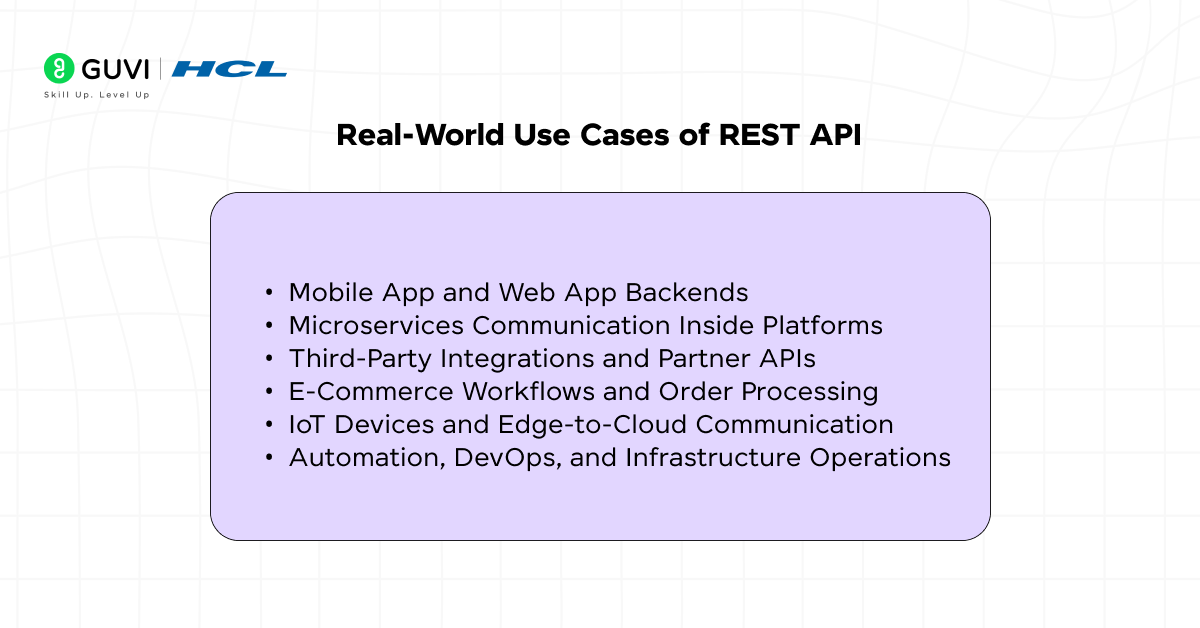
- Mobile App and Web App Backends
REST APIs connect user-facing apps to server-side logic, databases, and authentication systems. When a user logs in, loads a profile, or submits a form, the app sends HTTP requests to REST endpoints that validate access, fetch or update data, and return structured responses, typically JSON. This pattern keeps frontend interfaces lightweight while centralizing core processing on the server.
- Microservices Communication Inside Platforms
In microservices architectures, services often expose REST endpoints to share capabilities like pricing, inventory, user management, or notifications. A single user action can trigger multiple REST calls across services, each responsible for a specific domain. This makes ownership clearer, supports independent deployment, and improves fault isolation when combined with timeouts, retries, and idempotent methods.
- Third-Party Integrations and Partner APIs
Businesses use REST APIs to integrate external systems such as payment gateways, shipping providers, CRM tools, or analytics platforms. REST’s standardized request structure simplifies onboarding and reduces custom integration work. Teams can audit and control data exchange through authentication, rate limits, and structured error responses.

- E-Commerce Workflows and Order Processing
E-commerce platforms rely on REST for core flows such as browsing products, managing carts, applying discounts, and creating orders. Each step maps cleanly to resources like /products, /cart, and /orders, with POST used to create orders and GET used to retrieve order status. This resource-based design supports clear monitoring and easier debugging when issues occur across checkout stages.
- IoT Devices and Edge-to-Cloud Communication
IoT devices often send telemetry such as temperature, location, or device health to cloud endpoints using REST. Devices can POST sensor readings to /telemetry and GET configuration updates from /devices/{id}/config. This model provides a clear contract for device communication and supports monitoring, alerting, and controlled rollout of configuration changes.
- Automation, DevOps, and Infrastructure Operations
Cloud platforms and internal tooling use REST APIs to provision resources, trigger deployments, manage incidents, and retrieve logs. Infrastructure actions like creating a new environment or scaling a service are exposed as resource operations, which makes automation scripts more transparent and auditable. Standard status codes and structured error messages reduce troubleshooting time during operational failures.
Tools Used to Test and Work with REST APIs
- Postman for Functional Testing and Workflow Validation: Postman provides a controlled environment to construct requests, manage authentication tokens, validate responses, and automate regression tests through collections. Teams use it to simulate real client behavior, verify contract stability, and document APIs during development cycles.
- cURL for Command Line Interaction and Automation: URL enables direct interaction with REST endpoints from the terminal, which is useful for scripting, CI pipelines, and quick diagnostics. Its lightweight nature makes it ideal for testing headers, payload structures, and response codes without a graphical interface.
- Swagger and OpenAPI for Contract First Development: OpenAPI specifications define endpoints, schemas, and validation rules in a machine-readable format. Swagger tooling generates interactive documentation and mock servers, allowing teams to validate API design before implementation and maintain alignment across services.
- Insomnia for Debugging and Environment Management: Insomnia offers structured request chaining, environment switching, and advanced debugging capabilities. It is widely used in microservices environments where multiple endpoints must be validated under different configurations.
- JMeter for Load Testing and Performance Validation: Apache JMeter evaluates how REST APIs behave under concurrency and traffic spikes. It measures latency, throughput, and failure patterns, which helps teams identify bottlenecks before production deployment.
Challenges and Limitations of REST APIs
- Over Fetching and Under Fetching of Data: REST endpoints often return fixed data structures, which can lead to clients receiving more or less information than required. This inefficiency can increase bandwidth usage and require additional requests to assemble complete datasets.
- Versioning Complexity in Long-Lived Systems: As APIs evolve, maintaining backward compatibility across versions becomes operationally demanding. Multiple active versions increase maintenance overhead and require strict governance to prevent contract drift.
- Latency from Multiple Network Calls in Distributed Workflows: Complex applications may require several sequential REST calls to complete a single user action. Each round trip adds latency, which can impact performance in microservices architectures without aggregation strategies.
- Limited Real Time Communication Model: REST is fundamentally request-response based. It does not natively support continuous streaming or bidirectional communication, which requires complementary technologies such as WebSockets or event-driven systems for real-time scenarios.
- Security Exposure Through Public Endpoints: Since REST APIs expose accessible URLs, they must be protected against threats such as unauthorized access, injection attacks, and traffic abuse. Strong authentication, validation, and monitoring mechanisms are essential for safe operation.
Best Practices for Designing REST APIs
- Design Around Resources Not Actions: Use clear, noun-based endpoints such as /orders or /customers to reflect domain entities. This improves readability and aligns API structure with business models.
- Apply Proper HTTP Semantics and Status Codes: Correct use of methods and response codes provides predictable behavior and simplifies troubleshooting, observability, and integration across systems.
- Implement Versioning and Backward Compatibility Strategies: Structured versioning, such as URI or header-based approaches, allows APIs to evolve without disrupting existing consumers and supports controlled feature rollout.
- Enforce Strong Authentication and Transport Security: Token-based authorization, HTTPS encryption, and rate limiting protect data integrity while maintaining controlled access across distributed environments.
- Optimize Through Caching, Pagination, and Filtering: Techniques such as response caching, query-level filtering, and paginated datasets reduce payload size and improve performance, particularly in high traffic or analytics-driven applications.
Understanding REST APIs is the first step. Building production-ready APIs is the real skill. Join HCL GUVI’s Full Stack Development Course and master backend architecture, API design, databases, and deployment with expert guidance from 50+ instructors. Get 1:1 doubt clarification, learn alongside 2000+ students, and unlock career opportunities with 1000+ hiring partners.
REST API vs SOAP API Key Differences
Choosing between REST and SOAP depends on architectural priorities such as performance and governance requirements. REST is designed around web standards and resource-based interaction, which makes it suitable for distributed, cloud-native applications. SOAP follows a protocol-driven model with strict messaging rules, often preferred in environments that require formal contracts, transactional reliability, and built-in compliance features.
The comparison below outlines the core distinctions across structure and implementation approach:
| Feature | REST | SOAP |
| Format | JSON or XML | XML only |
| Speed | High | Lower |
| Flexibility | Adaptable | Strict |
| Complexity | Lightweight | Heavy |
| Use Case | Web, mobile, microservices | Enterprise, transactional systems |
Future of REST APIs in an AI-Driven Ecosystem
REST APIs are evolving to support AI workloads that require low-latency inference, high-throughput data exchange, and strict governance over model interactions. AI platforms now expose capabilities such as model inference, vector search, and feature retrieval through REST endpoints that integrate with application and orchestration pipelines. This allows organizations to operationalize machine learning without embedding model logic into core systems.
Emerging architectures use REST to coordinate Retrieval Augmented Generation workflows, linking document retrieval, embeddings, and model responses with traceability and access control. REST continues to serve as a stable contract layer for versioned model access and policy enforcement across hybrid and multi-cloud environments as MLOps matures.
Conclusion
REST APIs have become a foundational communication layer for modern software because they align closely with web standards, distributed system design, and scalable cloud infrastructure. Their resource-oriented structure, stateless operation, and reliance on HTTP semantics allow organizations to build interoperable services that evolve without tightly coupled dependencies. From microservices coordination to AI-driven application workflows, REST provides a stable contract for data exchange and governance.
FAQs
How do REST APIs scale in cloud environments?
REST APIs are stateless, so each request is handled independently. This allows traffic to be distributed across multiple servers, supporting horizontal scaling without changing the API structure.
Why is JSON the preferred format for REST API responses?
JSON is lightweight, easy to parse, and widely supported, which improves performance and simplifies integration between frontend and backend systems.
How is reliability maintained when many services depend on REST APIs?
Reliability comes from idempotent operations, clear error handling, versioning, and monitoring, which allow safe retries, stable updates, and consistent communication across distributed services.
Success Stories

About the Author
Vaishali
I'm a seasoned writer with four years of experience across technical, non-technical, and just about every genre or niche you can imagine. Adaptable and curious, I enjoy exploring new topics and making information engaging and easy to understand. Fueled by a steady stream of tea, I approach each project with creativity, reliability, and genuine enthusiasm for storytelling.
View all posts by Vaishali
Connect with me @






































Did you enjoy this article?