


Electric Vehicle Articles
What is Vehicle-to-Grid Technology : How EVs Can Power the Grid
What is a Battery Management System? BMS Working, Uses & EV Role
EV Infrastructure in India: Best Components, Charging Network, Challenges & Future (2026 Guide)

Get In Touch For Details! Request More Information
How to Become an EV Engineer in 2026?
Mar 02, 2026 4 Min Read 1785 Views
(Last Updated)
Electric vehicles are transforming the automotive industry, and EV engineers are at the center of this shift. With governments pushing clean mobility and companies investing heavily in electric vehicle technology, becoming an EV engineer in 2026 is a smart and future-ready career choice.
This blog explains how to become an EV engineer step by step, covering required skills, educational paths, software and hardware knowledge, and career opportunities. It is written for students, engineers, and professionals who want a clear and practical roadmap into the EV industry.
Quick Answer
To become an EV engineer in 2026, focus on electrical fundamentals, battery technology, and EV systems. Build practical skills through projects and stay updated with emerging electric vehicle technologies to enter this fast-growing field.
Table of contents
- Who Is An EV Engineer?
- What Does An EV Engineer Do?
- Skills Required To Become An EV Engineer
- Educational Roadmap To Become An EV Engineer
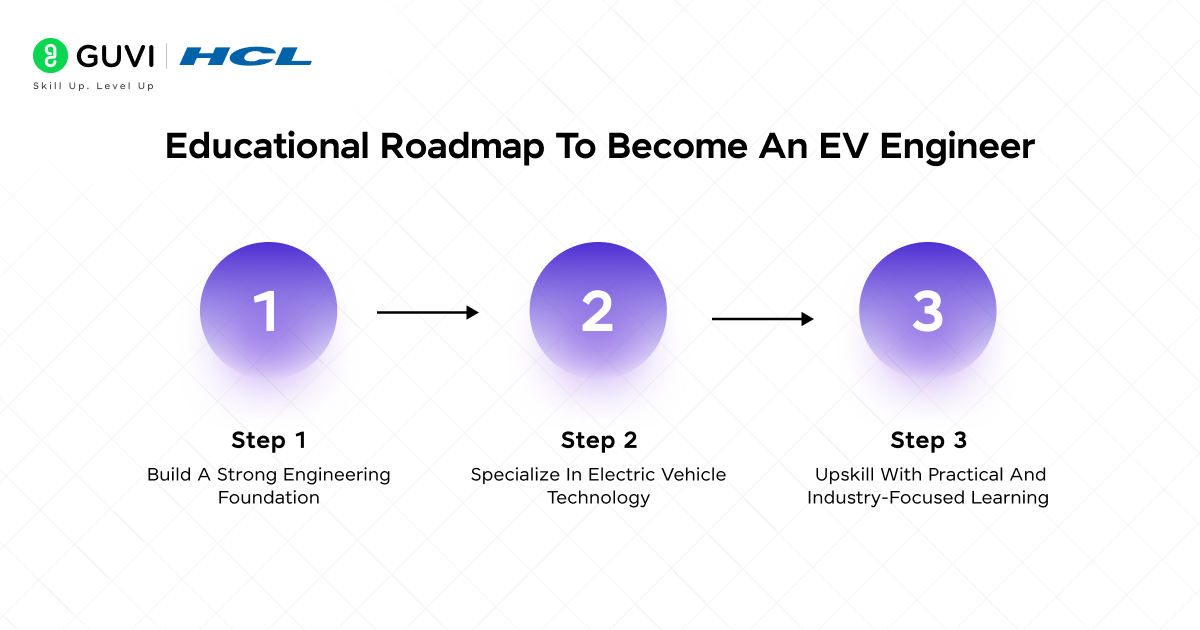
- Step 1: Build A Strong Engineering Foundation
- Step 2: Specialize In Electric Vehicle Technology
- Step 3: Upskill With Practical And Industry-Focused Learning
- EV Engineer Learning Roadmap At A Glance
- Career Opportunities For EV Engineers In 2026
- 💡 Did You Know?
- Conclusion
- FAQs
- What qualifications are needed to become an EV engineer in 2026?
- Is EV engineering a good career choice for the future?
- Can freshers become EV engineers without prior experience?
- What skills are most important for an EV engineer?
- How long does it take to become job-ready as an EV engineer?
Who Is An EV Engineer?
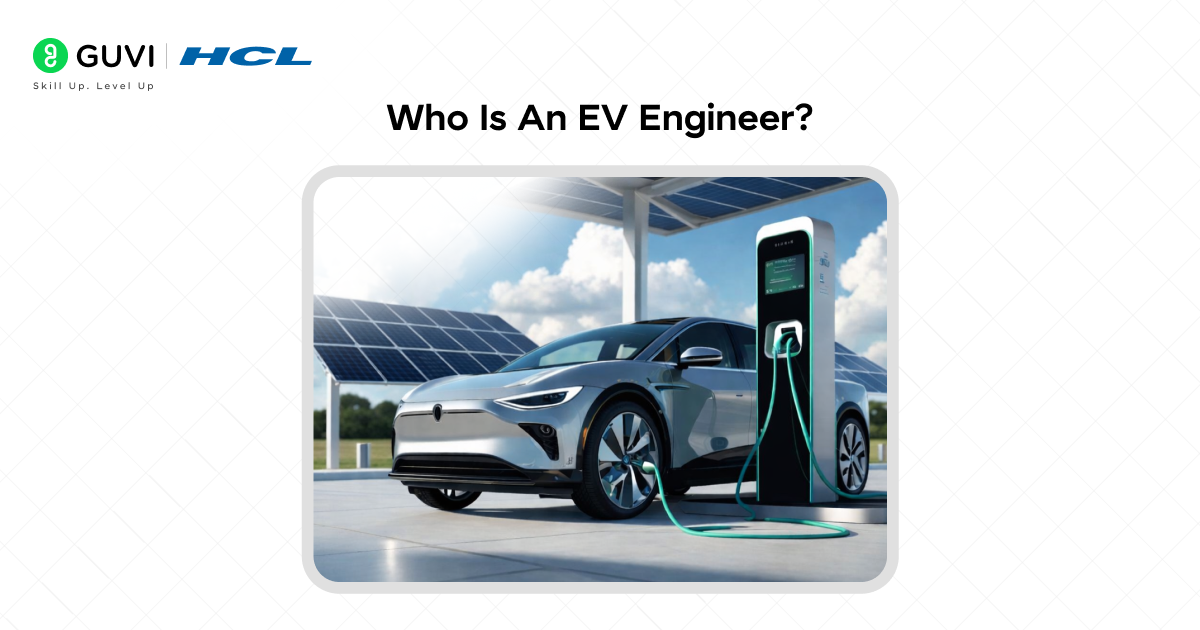
An EV engineer is a professional who works on the design and development of electric vehicles. They handle key systems such as electric vehicle batteries, electric motors, power electronics, charging systems, and vehicle control software. The main goal of an EV engineer is to improve vehicle performance, safety, driving range, and energy efficiency. With the rapid growth of electric mobility, EV engineers play a vital role in building sustainable and future-ready transportation solutions.
What Does An EV Engineer Do?
An EV engineer works on the core technologies that make electric vehicles efficient, safe, and reliable. Their role goes beyond just building vehicles. They focus on developing systems that improve performance, range, charging speed, and overall driving experience. An EV engineer may specialize in one area or work across multiple EV components depending on the project.
Key Responsibilities Of An EV Engineer:
- Battery System Development – Designing and testing EV battery packs, battery management systems, and thermal control to improve range and lifespan.
- Electric Motor And Powertrain Design – Working on motors, inverters, and drivetrains that convert electrical energy into motion efficiently.
- Power Electronics And Control Systems – Developing converters, controllers, and embedded systems that manage power flow inside the vehicle.
- Charging And Energy Systems – Improving fast-charging technologies, onboard chargers, and compatibility with charging infrastructure.
- Testing And Safety Validation – Conducting simulations and real-world tests to ensure EV systems meet safety and performance standards.
Skills Required To Become An EV Engineer
Before learning how to become an EV engineer, it is important to understand the skills this role actually requires. An EV engineer works at the intersection of electrical engineering, electronics, software, and vehicle systems. From batteries and motors to embedded software and testing, these skills together help design, build, and maintain electric vehicles safely and efficiently.
| Skill Category | Skill Area | What You Need To Understand |
| Core Electrical Skills | Electrical Fundamentals | Voltage, current, power, circuits, wiring, sensors, and safety basics used in EVs |
| Power Electronics | Inverters, converters, rectifiers, and how power flows inside an electric vehicle | |
| Battery & Energy Systems | Battery Technology | Lithium-ion batteries, cell types, charging methods, degradation, and safety |
| Battery Management System (BMS) | Cell balancing, SOC, SOH, thermal monitoring, and fault detection | |
| Motor & Drivetrain | Electric Motors | BLDC, PMSM motors, working principles, efficiency, and torque control |
| Motor Drives | Motor controllers, inverters, and speed control techniques | |
| Vehicle Systems | EV Architecture | How battery, motor, controller, charger, and drivetrain work together |
| Thermal Management | Cooling systems for batteries, motors, and power electronics | |
| Embedded & Control | Embedded Systems | Microcontrollers, sensors, actuators, and real-time monitoring |
| Communication Protocols | CAN, LIN, and diagnostics used inside electric vehicles | |
| Software Skills | Programming Basics | C, C++, or Python for control logic, diagnostics, and data handling |
| MATLAB / Simulink | Modeling, simulation, and testing of EV systems | |
| Control Systems | PID control, motor control algorithms, and system stability | |
| Testing & Validation | EV Testing | Performance testing, efficiency checks, safety validation |
| Diagnostics & Troubleshooting | Identifying faults in batteries, motors, and controllers | |
| Industry Tools | Simulation Tools | EV system modeling and performance analysis tools |
| Standards & Safety | EV safety standards, insulation, high-voltage handling |
Do check out HCL GUVI’s Advanced Electric Vehicle Technology Course if you want hands-on exposure to EV systems, battery technology, and power electronics. This program directly complements the skills and career roadmap discussed in this blog and helps you gain industry-ready EV knowledge. It is ideal for learners aiming to become EV engineers in 2026 with practical, job-oriented expertise.
Educational Roadmap To Become An EV Engineer
Before learning how to become an EV engineer, it is important to understand what educational path prepares you for this role. EV engineering combines electrical systems, mechanical design, batteries, and software, so your learning journey should be step-by-step and well-structured.
Step 1: Build A Strong Engineering Foundation
Start with an undergraduate degree that gives you core technical knowledge used in electric vehicles. Common and relevant options include:
- Electrical Engineering
- Electronics and Communication Engineering
- Mechanical Engineering
- Automobile Engineering
- Mechatronics Engineering
These degrees help you understand motors, circuits, power systems, thermodynamics, and vehicle mechanics, which form the base of EV technology.
Step 2: Specialize In Electric Vehicle Technology
Once the basics are clear, move toward EV-specific learning. This can be done through:
- Postgraduate degrees in Electric Vehicle Technology or Automotive Engineering
- Certification programs focused on EV systems
- Specialized courses covering batteries, motors, power electronics, and EV architecture
This step helps you connect core engineering concepts directly to electric vehicles.
Step 3: Upskill With Practical And Industry-Focused Learning
To become job-ready, focus on practical learning such as:
- Battery technology and Battery Management Systems
- Electric motors and motor controllers
- Power electronics and charging systems
- Hands-on EV projects and simulations
Even learners from non-core backgrounds can enter EV engineering by following this structured learning path and focusing on practical skills.

EV Engineer Learning Roadmap At A Glance
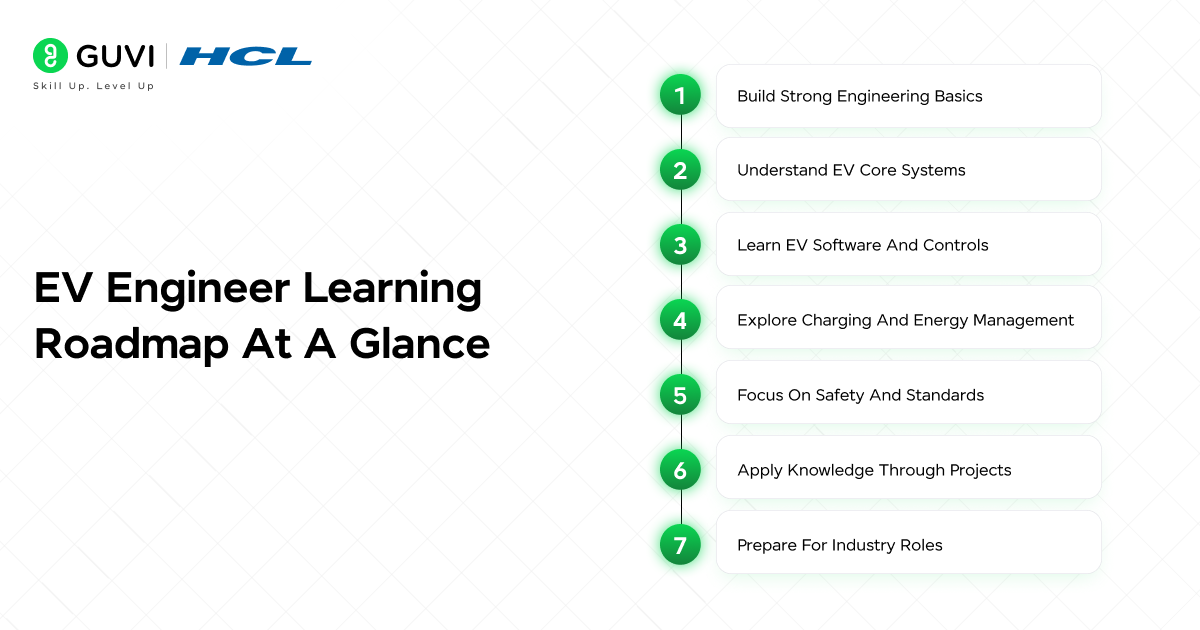
Before jumping into tools, courses, or job roles, it is important to understand how the journey to becoming an EV engineer actually unfolds. Electric vehicle engineering is not something you learn overnight. It requires a structured path that starts with core engineering concepts, gradually moves into EV-specific systems, and finally focuses on real-world application and industry readiness.
This roadmap gives you a clear learning flow that shows what to learn first, what comes next, and how everything connects. It helps beginners avoid confusion, reduces wasted effort, and makes the process of becoming an EV engineer easy to understand at a glance.
Roadmap Steps
- Build Strong Engineering Basics
Learn electrical, electronics, and mechanical fundamentals used in electric vehicles. - Understand EV Core Systems
Study batteries, motors, inverters, and how the drivetrain functions. - Learn EV Software And Controls
Get familiar with embedded systems, control logic, and vehicle communication. - Explore Charging And Energy Management
Understand charging methods, power flow, and efficiency concepts. - Focus On Safety And Standards
Learn EV safety practices, testing methods, and industry regulations. - Apply Knowledge Through Projects
Work on hands-on EV projects to gain practical exposure. - Prepare For Industry Roles
Build a portfolio, gain experience, and get interview-ready.
Career Opportunities For EV Engineers In 2026
Electric vehicle engineering offers a wide range of roles as the industry grows rapidly across design, batteries, power electronics, charging systems, and service domains. Knowing these roles, what they involve, and typical salary ranges helps you plan your EV career path clearly. The following table showcases common EV engineering careers in India, what each role involves, and expected salary.
| Role | Responsibilities | Average Salary (India) |
| Electric Vehicle Engineer | Works on design, testing, and system integration of EV components such as motors, batteries, and controllers. | ~₹2.5 – ₹3 LPA (Glassdoor) |
| EV Service / Field Engineer | Troubleshoots and maintains EV systems, performs repairs, and supports field operations. | ~₹35k/month (Glassdoor) |
| R&D / EV Design Engineer | Designs and develops EV components and systems, collaborates on prototypes and performance improvements. | ~₹6.4 – ₹7 LPA (AmbitionBox) |
| Battery Service / Support Engineer | Tests and services battery systems, supports diagnostics and maintenance activities. | ~₹3 – ₹3.4 LPA (AmbitionBox) |
| EV Battery Design Engineer | Designs battery packs, selects cells, integrates thermal and performance solutions (industry benchmark). | ~₹10 – ₹18 LPA (industry estimates) |
| Battery Thermal / Cooling Engineer | Designs thermal systems to keep batteries within optimal temperatures for safety and performance. | ~₹7 – ₹15 LPA (industry estimates) |
💡 Did You Know?
- EV engineers often work across multiple domains like batteries, power electronics, software, and vehicle integration, not just one fixed area.
- Battery-related roles are among the fastest-growing EV jobs, driven by demand for better range, safety, and fast charging.
- Many EV engineers transition from mechanical, electrical, or electronics backgrounds and upskill specifically for EV systems rather than starting from scratch.
Conclusion
Becoming an EV engineer in 2026 is less about following a single path and more about building the right mix of fundamentals, hands-on skills, and industry awareness. As electric vehicles continue to replace traditional automobiles, engineers who understand EV systems, batteries, power electronics, and software will stay in high demand.
If you are serious about this career, start by strengthening your basics, gain practical exposure through projects or courses, and stay updated with EV trends. With consistent learning and the right preparation, an EV engineering role can be both future-proof and highly rewarding.
FAQs
1. What qualifications are needed to become an EV engineer in 2026?
To become an EV engineer, you usually need a background in engineering such as electrical, mechanical, electronics, or automobile engineering. Knowledge of EV systems, batteries, power electronics, and basic software tools is essential.
2. Is EV engineering a good career choice for the future?
Yes, EV engineering is a strong future-oriented career. With governments and companies shifting toward electric mobility, the demand for skilled EV engineers is expected to grow rapidly in the coming years.
3. Can freshers become EV engineers without prior experience?
Freshers can enter EV engineering by building strong fundamentals, learning industry-relevant skills, and working on practical projects. Internships, certifications, and hands-on training play a key role in getting entry-level roles.
4. What skills are most important for an EV engineer?
An EV engineer should understand electric motors, battery technology, power electronics, vehicle dynamics, and basic programming. Problem-solving ability and system-level thinking are equally important.
5. How long does it take to become job-ready as an EV engineer?
With focused learning and consistent practice, beginners can become job-ready in 6 to 12 months. The timeline depends on your background, learning pace, and hands-on exposure.
Success Stories

About the Author
Jebasta
I translate the language of data into stories that anyone can understand. As a writer with a data science background, I simplify analytics, AI, and decision-making so beginners and enthusiasts can confidently explore the world of data.
View all posts by Jebasta
Connect with me @







Did you enjoy this article?