


Python Articles
How to Install Requirements.txt in Python: A Beginner's Step-by-Step Guide (2026)
How to Check if Python Is Installed on Your Computer


Get In Touch For Details! Request More Information
Ever felt that writing a full Python function is too much work for a tiny task? This is where the lambda function in python becomes useful, allowing you to write small pieces of logic in a clean and compact way without extra code.
This blog is written for beginners who want to clearly understand what a lambda function in python is, why it exists, and how it is used in real programs. As you read further, you will also see when lambda functions are helpful and when regular functions are a better choice.
Quick Answer
A lambda function in python is a small anonymous function written in a single line to perform a simple task. It is mainly used when a short piece of logic is required temporarily without creating a full function. Lambda functions help keep code concise but should be used only for simple and readable operations.
Table of contents
- What Is A Lambda Function In Python
- Why Use Lambda Functions In Python
- Syntax Of Lambda Function In Python
- Where Lambda Functions Are Commonly Used
- Limitations Of Lambda Function In Python
- Lambda Function Vs Normal Function
- 💡 Did You Know?
- Conclusion
- FAQs
- Can a lambda function have multiple expressions?
- Are lambda functions reusable like normal functions?
- Can I use loops inside a lambda function?
- How do lambda functions differ from regular functions in terms of readability?
- When is it better to use a normal function instead of a lambda function?
What Is A Lambda Function In Python
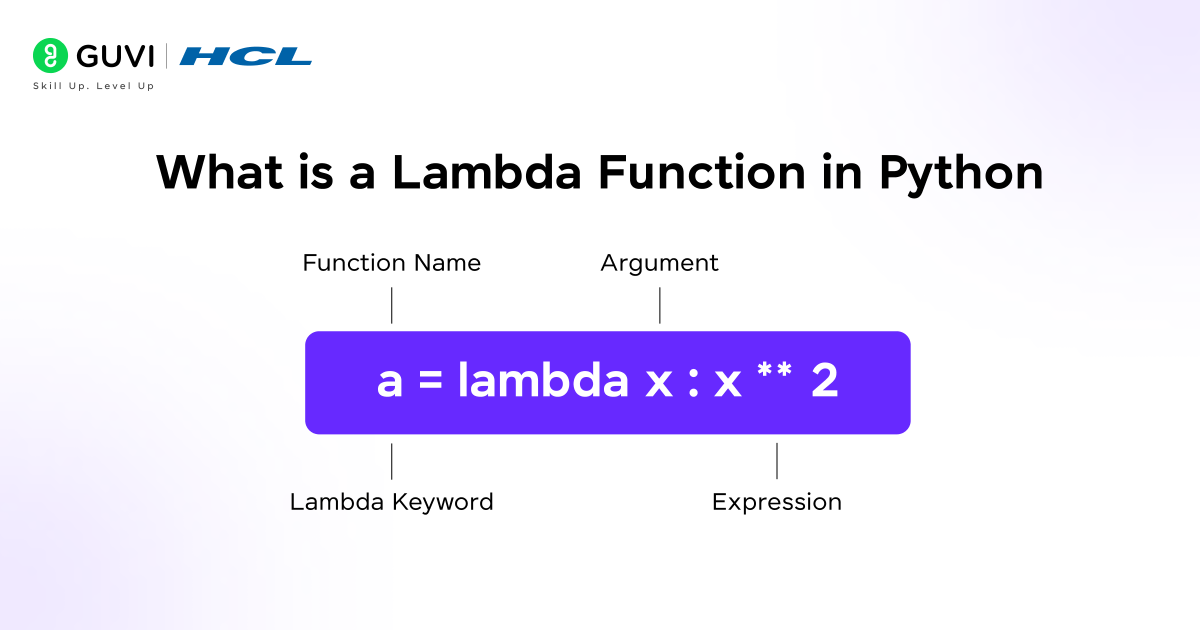
A lambda function in Python is a small, anonymous function used for short and simple operations. It is written in a single line and does not require a function name like normal functions. Lambda functions are commonly used when a function is needed only once and keeping the code concise is more important than reusability. They are often seen with built-in functions like map, filter, and sorted.
Key Points
- Anonymous Function – A lambda function does not have a name and is used directly where it is defined.
- Single Expression Only – It can contain only one expression, which is evaluated and returned automatically.
- Short And Compact Syntax – Lambda functions are written in a single line, making them useful for simple logic.
- No Return Keyword Needed – The result of the expression is returned automatically without using return.
- Used For Temporary Logic – Lambda functions are ideal when a small function is needed for a short time.
Example
add = lambda a, b: a + b
print(add(2, 3))
In this example, the lambda function takes two values a and b and returns their sum. Instead of writing a full function using def, the same logic is written in a single line, making it short and easy to understand.
Do check out HCL GUVI’s Zen Class Python Course to understand core Python concepts like lambda functions through guided, hands-on learning. This course is designed for beginners who want clear explanations, real-world coding practice, and mentor-led support to gain confidence in Python.
Why Use Lambda Functions In Python
Lambda functions in Python are mainly used to keep code short, readable, and focused on logic rather than structure. When a function is required only once or for a very small operation, writing a full function using def can feel unnecessary. Lambda functions solve this by allowing developers to write quick, inline logic without cluttering the code. This makes them especially useful in functional-style programming and data processing tasks.
Key Points
- Reduces Code Length – Lambda functions eliminate the need for full function definitions for small operations.
- Improves Readability For Simple Logic – When used correctly, lambda functions make simple operations easier to understand at a glance.
- Works Well With Built-In Functions – Lambda functions are commonly used with map, filter, and sorted.
- Ideal For One-Time Use – They are best suited when a function is not reused elsewhere in the program.
- Encourages Functional Programming Style – Lambda functions support a more functional and expressive coding approach.
Do check out HCL GUVI’s Python eBook to deepen your understanding of Python fundamentals like lambda functions with clear explanations and examples you can study at your own pace. This ebook is ideal for beginners who want a structured reference guide to revisit key concepts anytime.

Syntax Of Lambda Function In Python
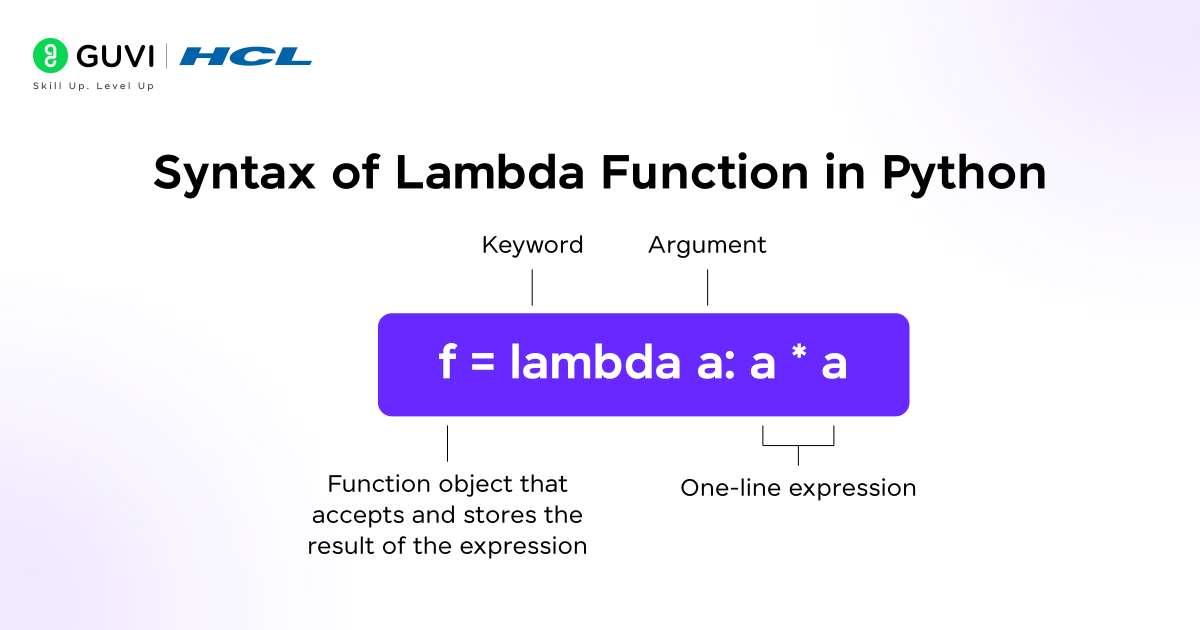
The syntax of a lambda function in Python is minimal and focused only on what is required to perform a small operation. Unlike regular functions, lambda functions do not use the def keyword or a function name. Everything is written in a single line, which makes the syntax easy to read and suitable for short, temporary logic. Understanding each element of the syntax helps beginners clearly see how lambda functions work internally.
Key Elements
- lambda keyword – Indicates the start of a lambda function and tells Python that an anonymous function is being created.
- Parameters – Input values passed to the lambda function, written just like function arguments before the colon.
- Colon (:) – Separates the parameters from the expression that will be executed.
- Expression – A single line of logic that is evaluated and automatically returned by the lambda function.
Example
multiply = lambda x, y: x * y
Here, lambda starts the function, x and y are parameters, the colon separates inputs from logic, and x * y is the expression whose result is returned automatically.
Do check out HCL GUVI’s Python Hub to explore tutorials, practice exercises, and resources that deepen your understanding of Python topics like lambda functions. This hub is ideal for beginners looking to strengthen their skills with clear explanations and practical examples.
Where Lambda Functions Are Commonly Used
Lambda functions are most useful when a small piece of logic is needed for a short time. Instead of defining a full function, lambda functions allow you to write the logic directly where it is used. This keeps the code short and readable when the operation is simple and self-explanatory. They are most commonly seen with built-in functions that work on collections of data.
Key Uses
1. With map() – Used to apply the same operation to every element in a sequence.
Example map(lambda x: x * 2, numbers)
Here, map() goes through each value in the list numbers. The lambda function takes one value at a time (x) and multiplies it by 2. The result is a new sequence where every number is doubled.
2. With filter() – Used to select elements that satisfy a condition.
Example – filter(lambda x: x % 2 == 0, numbers)
In this case, filter() checks each value in numbers. The lambda function returns True only for even numbers. As a result, only the even values are kept and the rest are removed.
3. With sorted() – Used to define custom sorting logic.
Example – sorted(data, key=lambda x: x[1])
Here, data is usually a list of tuples. The lambda function tells sorted() to sort items based on the second value of each tuple (x[1]). This allows sorting by a specific part of the data instead of the entire item.
Do check out HCL GUVI’s IDE to practice Python concepts like lambda functions directly in your browser without any setup. This online IDE helps beginners quickly write, run, and test Python code while understanding how small functions work in real time.
Limitations Of Lambda Function In Python
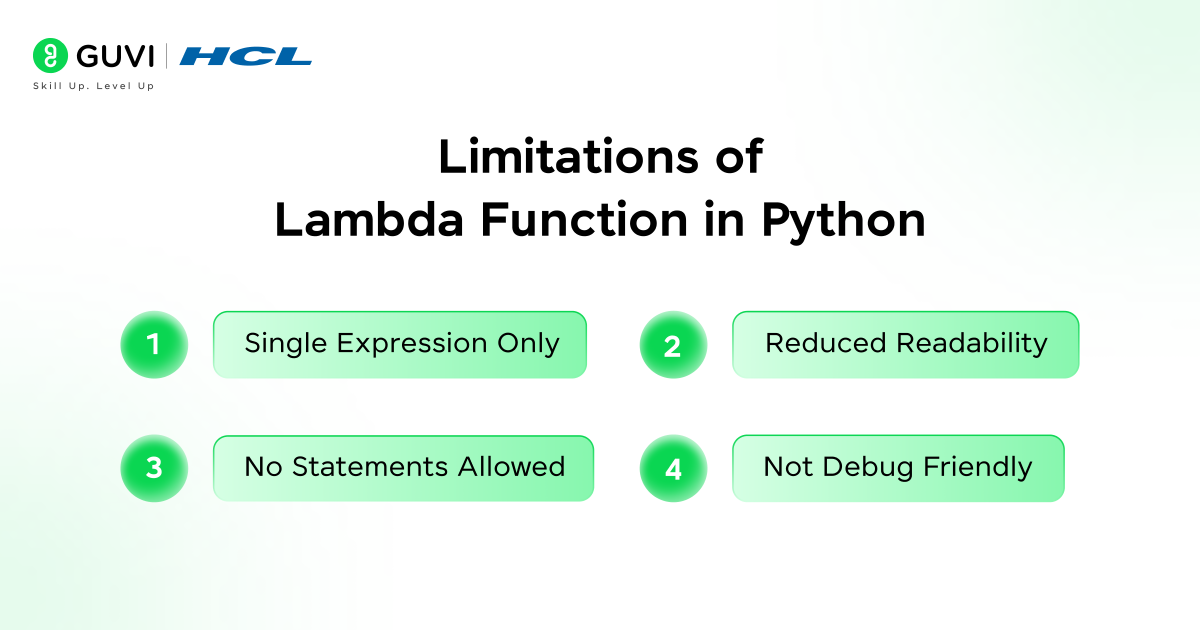
While lambda functions are convenient, they are intentionally limited. They are designed only for simple logic and should not replace normal functions in real applications. Using lambda functions beyond their intended scope can reduce code clarity and make debugging difficult.
Key Limitations
- Single Expression Only – Cannot contain multiple statements, loops, or complex conditions.
- Reduced Readability – Becomes hard to understand when logic grows slightly complex.
- No Statements Allowed – Cannot use assignments, try-except blocks, or loops.
- Not Debug Friendly – Errors inside lambda functions are harder to trace.
Lambda Function Vs Normal Function
Lambda functions and normal functions serve different purposes in Python. Lambda functions focus on brevity, while normal functions focus on clarity and structure. Choosing the right one depends on how complex and reusable the logic is.
Key Differences
- Lambda Function – Best for small, temporary operations written inline.
- Normal Function – Better for complex logic, reusability, and maintainability.
- Readability – Normal functions are easier to read and understand in the long run.
- Scalability – Normal functions scale better as the codebase grows.
💡 Did You Know?
- Lambda functions in Python can take any number of arguments, but they return only one expression.
- They are created at runtime, which makes them ideal for short, one-time operations.
- Overusing lambda functions can reduce code readability, even though they make the code shorter.
Conclusion
Lambda functions in Python provide a concise way to write small, one-time operations without the overhead of defining a full function. They keep code short, readable, and focused on simple logic, making them especially useful with functions like map, filter, and sorted.
However, lambda functions are not designed for complex or reusable logic. When operations become more detailed or need to be reused, normal functions defined with def are always the better choice. Using lambda functions appropriately ensures clean, maintainable, and easy-to-understand Python code.
FAQs
1. Can a lambda function have multiple expressions?
No, a lambda function can only contain a single expression. Multiple statements or complex logic are not allowed.
2. Are lambda functions reusable like normal functions?
Lambda functions are generally meant for one-time use and are not ideal for reusable or complex logic.
3. Can I use loops inside a lambda function?
No, loops cannot be used inside lambda functions. They are limited to a single expression.
4. How do lambda functions differ from regular functions in terms of readability?
Lambda functions are concise but can reduce readability if overused, whereas regular functions are clearer and easier to maintain.
5. When is it better to use a normal function instead of a lambda function?
Whenever the logic is complex, requires multiple statements, or needs to be reused in different parts of the code, a normal function with def should be used.
Success Stories

About the Author
Jebasta
I translate the language of data into stories that anyone can understand. As a writer with a data science background, I simplify analytics, AI, and decision-making so beginners and enthusiasts can confidently explore the world of data.
View all posts by Jebasta
Connect with me @














Did you enjoy this article?