


Python Articles
How to Install Requirements.txt in Python: A Beginner's Step-by-Step Guide (2026)
How to Check if Python Is Installed on Your Computer


Get In Touch For Details! Request More Information
Errors are unavoidable when writing programs, especially when working with user input, files, or external data. Instead of allowing these errors to crash a program, Python provides a structured way to handle them and keep the execution under control.
Exception handling in Python helps developers manage runtime errors gracefully and build reliable applications. This blog explains what exception handling in Python is, why it is important, how it works, and how beginners can use it effectively in real programs.
Quick Answer
Exception handling in Python is a way to manage runtime errors so that a program does not crash when something goes wrong. By using try, except, else, and finally blocks, Python allows developers to catch exceptions, handle them gracefully, and keep the program running smoothly even in unexpected situations.
Table of contents
- What Is Exception Handling In Python
- Why Exception Handling Is Important In Python
- Types Of Exceptions In Python
- ZeroDivisionError
- ValueError
- TypeError
- IndexError
- KeyError
- FileNotFoundError
- How Exception Handling Works In Python
- try Block
- except Block
- else Block
- finally Block
- 💡 Did You Know?
- Conclusion
- FAQs
- What is the difference between Errors and Exceptions in Python?
- Can we handle Multiple Exceptions in a Single try Block?
- Is it mandatory to use finally in Exception Handling?
- What happens if an exception is not handled in Python?
- Can We Create Our Own Exceptions In Python?
What Is Exception Handling In Python
Exception handling in Python is the process of detecting and managing runtime errors using built-in constructs so the program does not terminate abruptly. In simple terms, it allows Python code to respond to errors instead of crashing when an unexpected situation occurs during execution.
Python implements exception handling using specific keywords like try, except, else, and finally, which work together to separate normal logic from error-handling logic. When an error occurs inside the try block, Python immediately transfers control to the matching except block, where the error can be handled safely.
This approach ensures that even if an error happens, the rest of the program can continue running or fail gracefully with meaningful feedback. Exception handling in Python is essential for building robust applications, especially when dealing with user input, files, databases, or external systems.
Key Points
- Defined Error Management Mechanism: Exception handling is Python’s built-in way to manage runtime errors
- Uses Specific Keywords: Implemented using try, except, else, and finally blocks
- Separates Logic From Errors: Keeps error handling separate from normal code flow
- Prevents Abrupt Termination: Allows programs to continue running safely
Common Situations Where Exception Handling Is Used
- Invalid User Input: Handling incorrect or unexpected input values
- Mathematical Errors: Managing division by zero or invalid calculations
- File Operations: Handling missing or inaccessible files
- Type Mismatches: Catching operations applied to incompatible data types
Why Exception Handling Is Important In Python
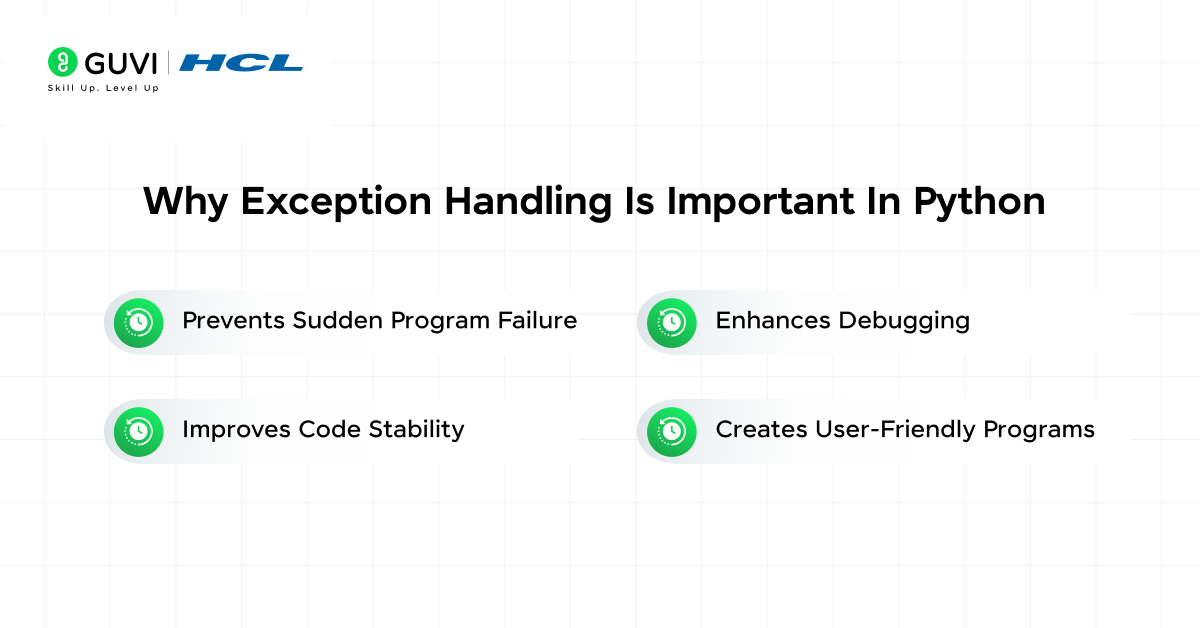
Exception handling in Python plays a critical role in ensuring that programs behave correctly even when unexpected errors occur. Instead of allowing the program to crash abruptly, exception handling provides a controlled way to respond to runtime issues and continue execution safely. This makes Python applications more reliable, easier to debug, and user-friendly. Without proper exception handling, even a small error can stop the entire program.
Key Points
- Prevents Sudden Program Failure: Stops the program from crashing due to runtime errors
- Improves Code Stability: Ensures consistent behavior even in unexpected situations
- Enhances Debugging: Makes it easier to identify and fix errors
- Creates User-Friendly Programs: Displays meaningful messages instead of raw error traces
Why Developers Use Exception Handling
- Error Control: Helps manage known and unknown errors gracefully
- Safe Execution Flow: Allows the remaining code to run even after an error
- Cleaner Code Structure: Separates error-handling logic from main functionality
- Real-World Readiness: Essential when working with user input, files, and external systems
If you want to explore more Python concepts beyond exception handling, do check out HCL GUVI’s Python Hub, which covers beginner to advanced Python topics with clear explanations and practical examples. It’s a useful resource for strengthening your Python fundamentals and improving problem-solving skills.

Types Of Exceptions In Python
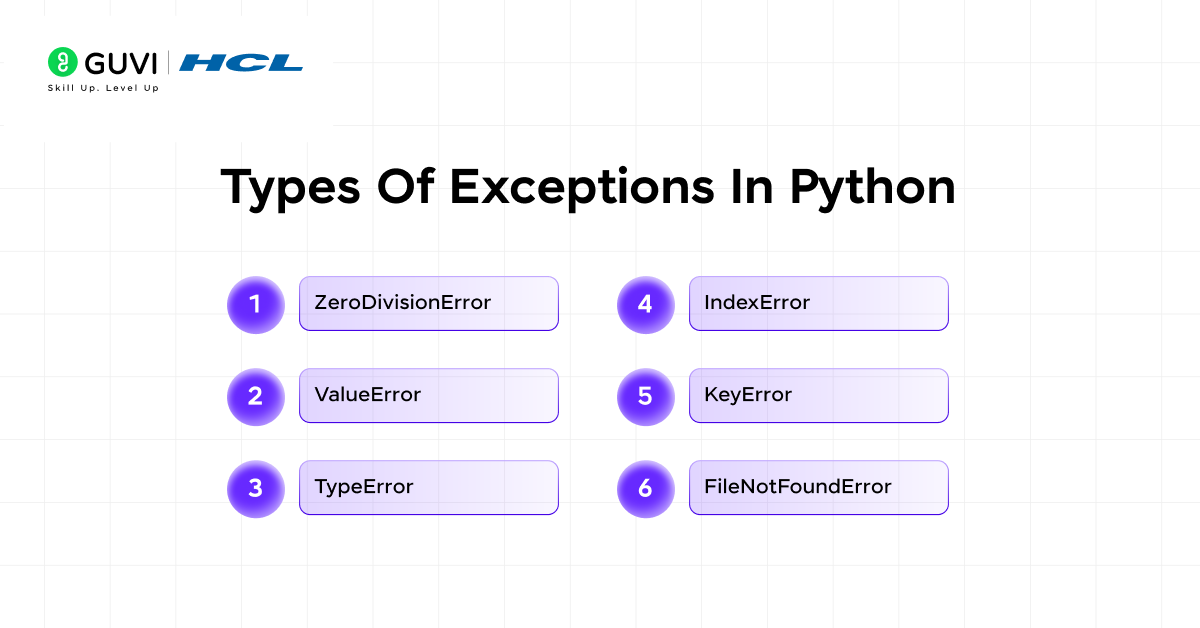
In exception handling in Python, exceptions represent different kinds of runtime errors that interrupt the normal execution of a program. Python provides several built-in exception types, each designed to describe a specific error scenario. Understanding these common exceptions helps developers handle errors more accurately and write safer, more predictable code.
1. ZeroDivisionError
ZeroDivisionError occurs when a program attempts to divide a number by zero. Since division by zero is not mathematically valid, Python immediately raises this exception to stop incorrect execution. This error commonly appears in calculations that rely on user input or dynamic values.
2. ValueError
ValueError is raised when a function receives a value that is inappropriate, even though the data type itself is correct. For example, converting a non-numeric string into an integer results in a ValueError. This exception is often handled during input validation and data processing.
3. TypeError
TypeError occurs when an operation is performed on incompatible data types. For instance, trying to add a string and an integer directly causes this exception. It is common in programs that work with dynamic or mixed data types.
4. IndexError
IndexError is raised when code tries to access an index that is outside the valid range of a list or sequence. This usually happens when loops exceed list boundaries or incorrect index values are used. Handling this exception prevents unexpected crashes in iterative logic.
5. KeyError
KeyError occurs when a program tries to access a dictionary key that does not exist. Since dictionaries depend on unique keys, referencing a missing key raises this exception. It is common when working with external data or user-generated inputs.
6. FileNotFoundError
FileNotFoundError is raised when a program attempts to open a file that does not exist at the specified path. This exception is common in file handling operations and is important to manage to ensure programs fail gracefully instead of crashing.
For a deeper dive into Python programming, including exception handling and other essential concepts, do check out HCL GUVI’s Python eBook. It provides clear explanations, examples, and exercises to help you master Python step by step.
How Exception Handling Works In Python
Exception handling in Python works by wrapping risky code inside specific blocks so errors can be caught and handled without crashing the program. Python uses try, except, else, and finally to control how errors are detected, managed, and cleaned up. Together, these blocks define what should run when an error occurs and what should run when everything works fine.
1. try Block
The try block contains the code that might raise an exception. Python executes this block first and watches for runtime errors. If an exception occurs here, Python immediately stops executing the remaining code inside try and moves to the corresponding except block.
try:
    result = 10 / 0
    print(result)
In this example, dividing by zero raises an exception inside the try block.
2. except Block
The except block catches and handles the exception raised in the try block. Instead of terminating the program, Python executes the code inside except. You can handle specific exceptions or use a general handler.
try:
    result = 10 / 0
except ZeroDivisionError:
    print("You cannot divide by zero")
Here, the program handles the error gracefully and continues execution.
3. else Block
The else block runs only when no exception occurs in the try block. It is used to define logic that should execute when the operation is successful.
try:
    result = 10 / 2
except ZeroDivisionError:
    print("Error occurred")
else:
    print("Result is:", result)
Since no error occurs, the else block executes.
4. finally Block
The finally block always executes, regardless of whether an exception occurs or not. It is commonly used for cleanup operations like closing files or releasing resources.
try:
    file = open("data.txt", "r")
    content = file.read()
except FileNotFoundError:
    print("File not found")
finally:
    print("Execution completed")
Even if the file does not exist, the finally block still runs.
Do check out HCL GUVI’s Python Course if you want to build strong Python fundamentals and clearly understand concepts like exception handling in real-world coding scenarios. The course focuses on hands-on practice, error handling techniques, and industry-ready Python skills.
💡 Did You Know?
- Python allows you to handle multiple exception types in a single except block, making error handling more concise.
- You can create your own custom exceptions in Python to handle application specific errors more clearly.
- Exception handling in Python helps improve program performance by avoiding repeated checks for error conditions before execution.
Conclusion
Exception handling in Python is a core concept that helps developers manage runtime errors without breaking the flow of a program. By using structured blocks like try, except, else, and finally, Python makes it possible to detect errors, respond to them properly, and keep applications stable even in unexpected situations.
Learning exception handling in Python is essential for writing clean, reliable, and real-world ready code. Whether you are working with user input, files, or complex logic, proper error handling ensures better debugging, smoother execution, and a more professional coding approach.
FAQs
1. What is the difference between Errors and Exceptions in Python?
Errors are issues like syntax mistakes that prevent a program from running, while exceptions are runtime problems that occur during execution. Exceptions can be handled using exception handling in Python, allowing the program to continue instead of crashing.
2. Can we handle Multiple Exceptions in a Single try Block?
Yes, Python allows handling multiple exceptions in a single try block by using multiple except blocks or by grouping exceptions together. This helps manage different error scenarios efficiently.
3. Is it mandatory to use finally in Exception Handling?
No, the finally block is optional. It is mainly used when certain code must execute regardless of whether an exception occurs, such as closing files or releasing resources.
4. What happens if an exception is not handled in Python?
If an exception is not handled, Python stops program execution and displays an error message along with a traceback. This can cause the application to crash unexpectedly.
5. Can We Create Our Own Exceptions In Python?
Yes, Python allows developers to create custom exceptions by defining new exception classes. This is useful for handling application specific errors in a clear and structured way.
Success Stories

About the Author
Jebasta
I translate the language of data into stories that anyone can understand. As a writer with a data science background, I simplify analytics, AI, and decision-making so beginners and enthusiasts can confidently explore the world of data.
View all posts by Jebasta
Connect with me @














Did you enjoy this article?