


Interview Articles
Top 30 Microsoft Excel Interview Questions and Answers
My Full Stack Developer Interview Experience: What Nobody Tells You
My Digital Marketing Interview Experience: What They Don't Tell You [2026]
How Long Does Technical Interview Preparation Take? An Expert's Reality Check


Get In Touch For Details! Request More Information
Google Interview Experience 2026: Complete Process, Questions, Salary & Preparation Guide
Mar 25, 2026 5 Min Read 1265 Views
(Last Updated)
What separates a good software engineer from someone who meets Google’s hiring bar? Well, the Google interview experience is designed to evaluate far more than coding speed. It tests structured problem solving, depth of computer science fundamentals, system design clarity, and the proficiency to reason under ambiguity.
As a global technology company operating products used by billions, Google hires engineers who can write scalable, maintainable, and performance-conscious systems. This guide breaks down the Google interview process, evaluation criteria, difficulty level, and preparation strategy so you can prepare with clarity and intent rather than guesswork.
Quick Answer: The Google interview experience consists of 4 to 6 structured rounds designed to assess algorithmic depth and long-term engineering judgment. Candidates typically go through resume screening, recruiter discussion, coding interviews, a Googliness round, and an independent hiring committee review. Technical rounds focus heavily on data structures, optimization, and clear complexity analysis. Experienced candidates are evaluated on scalable system design and architectural trade-offs. The full process usually takes four to eight weeks and emphasizes structured reasoning and measurable impact over memorized problem patterns.
Table of contents
- Google: Company Overview
- Complete Google Interview Process (Step-by-Step Breakdown)
- Resume Screening
- Recruiter Phone Screen
- Online Assessment (Role Dependent)
- Technical Coding Interviews (2 to 3 Rounds)
- System Design Interview (Experienced Roles)
- Googliness and Leadership Round
- Hiring Committee Review
- Team Matching (If Applicable)
- Offer and Compensation Discussion
- Timeline Overview
- Top Skills Required to Crack the Google Interview
- Top Concepts to Practice for a Strong Google Interview Experience
- Arrays and Hashing
- Trees and Graphs
- Recursion and Backtracking
- Binary Search and Optimization Problems
- Dynamic Programming
- System Design (For Experienced Roles)
- Common Mistakes in the Google Interview
- Top Tips to Crack the Google Interview
- Wrapping Up
- FAQs
- How many rounds are there in the Google interview?
- Is Google interview harder than Amazon?
- Does Google ask system design for freshers?
- What is Google L3 salary in India?
Google: Company Overview
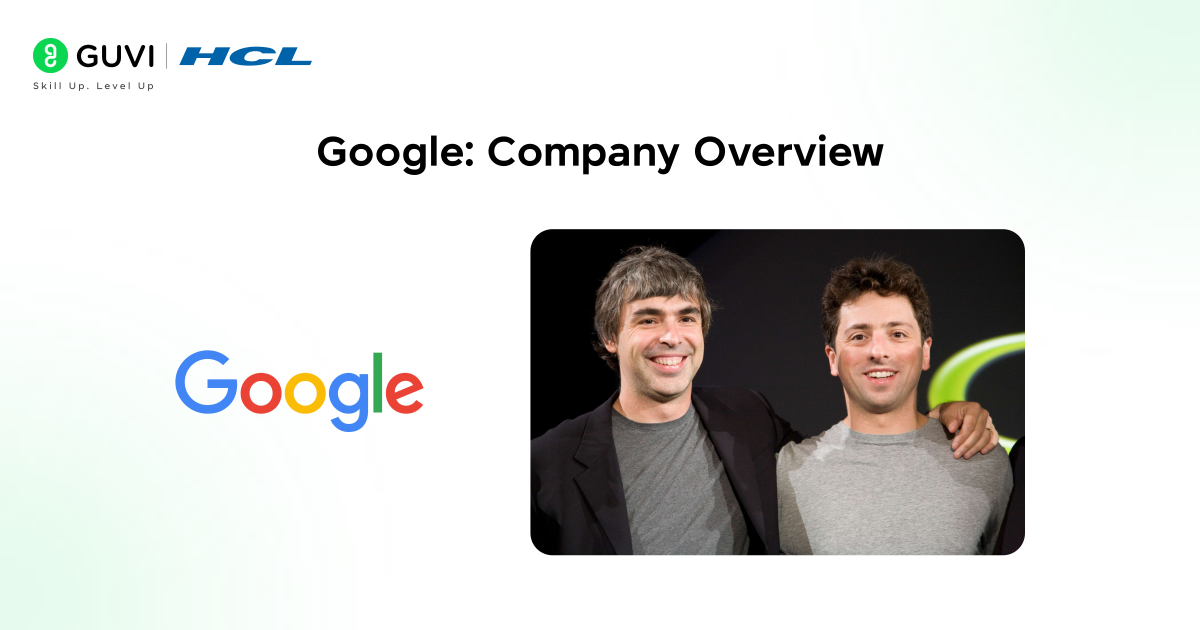
Google, founded in 1998 by Larry Page and Sergey Brin, is one of the world’s largest technology companies and operates under its parent organization, Alphabet Inc. Headquartered in Mountain View, California, Google builds and maintains products across search, cloud computing, artificial intelligence, advertising technology, Android, YouTube, and enterprise software.
The company serves billions of users globally through platforms such as Google Search, YouTube, Gmail, Google Maps, and Google Cloud. Google Search alone processes billions of queries every day, making it one of the most heavily used digital systems in the world.
- The First Google Server Used Lego: Larry Page and Sergey Brin built their first server housing from Lego bricks to easily expand storage.
- Google Processes Billions of Searches Daily: It operates one of the largest distributed computing systems in the world.
- Google Owns 200+ Companies: Acquisitions include YouTube, Android, and DeepMind.
Complete Google Interview Process (Step-by-Step Breakdown)
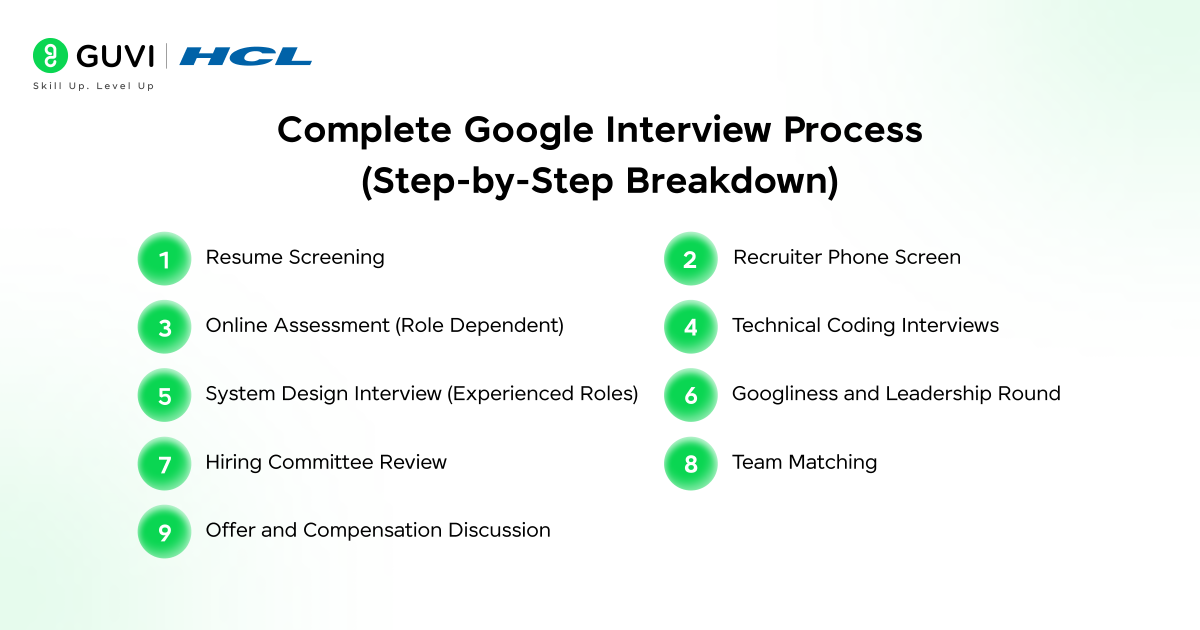
Google’s interview process is structured, multi-layered, and calibration-driven. No single interviewer makes the final hiring decision. Each stage evaluates a specific dimension of engineering capability, and feedback is reviewed independently by a hiring committee.
1. Resume Screening
The process begins with resume evaluation by a recruiter or hiring team. Screening focuses on:
- Strong computer science fundamentals
- Impact-driven project experience
- Measurable outcomes such as latency reduction or scale handled
- Internship or prior product engineering exposure
Resumes that demonstrate structured problem-solving and technical depth progress to the next stage.
2. Recruiter Phone Screen
This is typically a 20 to 30-minute conversation. It covers:
- Role alignment and location preference
- Experience summary
- High-level technical background
- Compensation expectations
The recruiter explains the interview structure and sets expectations for upcoming rounds.

3. Online Assessment (Role Dependent)
For many entry-level or early-career roles, candidates complete an online coding assessment.
- Duration: 60 to 90 minutes
- 1 to 2 algorithmic problems
- Medium to hard difficulty
Evaluation focuses on correctness, optimization, and structured reasoning.
Note: Not all experienced candidates undergo this step.
4. Technical Coding Interviews (2 to 3 Rounds)
These are live interviews conducted virtually or onsite.
Each round typically includes:
- One or two coding problems
- Real-time problem solving
- Time and space complexity discussion
Common topics:
- Arrays and hashing
- Trees and graphs
- Recursion
- Dynamic programming
- Binary search
Interviewers assess:
- Problem clarification
- Logical approach
- Code structure
- Optimization attempts
- Communication clarity
Candidates are expected to think aloud and refine solutions when prompted.
5. System Design Interview (Experienced Roles)
For candidates with 3 or more years of experience, a system design round is standard.
Discussion areas may include:
- Designing scalable APIs
- Distributed systems architecture
- Database choices
- Caching strategies
- Load balancing
- Consistency models
Evaluation focuses on:
- Architectural clarity
- Scalability reasoning
- Trade-off analysis
- Reliability considerations
For entry-level L3 roles, this round is usually not deeply technical.
6. Googliness and Leadership Round
This round evaluates cultural alignment and collaboration capability.
Common areas explored:
- Handling ambiguity
- Conflict resolution
- Leadership experience
- Ownership mindset
- Learning from failure
Structured, outcome-driven answers are expected.
7. Hiring Committee Review
Google’s hiring committee independently reviews interviewer feedback.
Key aspects:
- No single interviewer makes the decision
- Feedback is calibrated for consistency
- Strong hire, hire, or no hire recommendations
- Leveling discussion determines L3, L4, L5, etc.
This step differentiates Google from many other companies.
8. Team Matching (If Applicable)
If the candidate clears the hiring committee, they may go through team matching.
- Discussion with potential managers
- Alignment of skillset and team needs
- Final offer preparation
Some candidates may wait weeks at this stage depending on team availability.
9. Offer and Compensation Discussion
Once matched, compensation details are finalized.
Compensation typically includes:
- Base salary
- Performance bonus
- Restricted stock units
The recruiter handles negotiation and documentation.
10. Timeline Overview
The complete Google hiring process typically takes four to eight weeks. Timelines may be extended due to interviewer availability, hiring committee review cycles, or delays during the team-matching phase.
Aiming to crack Google-level technical interviews in 2026? Master DSA, problem-solving, system design fundamentals, and structured interview strategies with HCL GUVI’s Interview Preparation Course built to help you perform confidently in coding rounds and high-pressure technical discussions.
Top Skills Required to Crack the Google Interview
Google places heavy emphasis on algorithmic depth. Candidates must demonstrate clarity in arrays, hashing, trees, graphs, recursion, binary search, and dynamic programming. The ability to optimize solutions and justify time and space complexity is essential.
- Structured Problem Decomposition
Interviewers expect candidates to break complex problems into smaller components before coding. Clear assumption validation and logical sequencing reflect engineering maturity.
- Optimization and Trade-off Analysis
A correct solution is not sufficient. Candidates should refine brute-force approaches, compare alternatives, and explain performance implications under scale.
- System Design Fundamentals
For experienced roles, candidates must understand scalable architecture, API design, database modeling, caching strategies, and consistency models. Discussion should include trade-offs and reliability considerations.
- Clean and Maintainable Coding Practices
Code should be modular, readable, and logically structured. Proper variable naming, edge-case handling, and defensive programming improve evaluation outcomes.
Top Concepts to Practice for a Strong Google Interview Experience
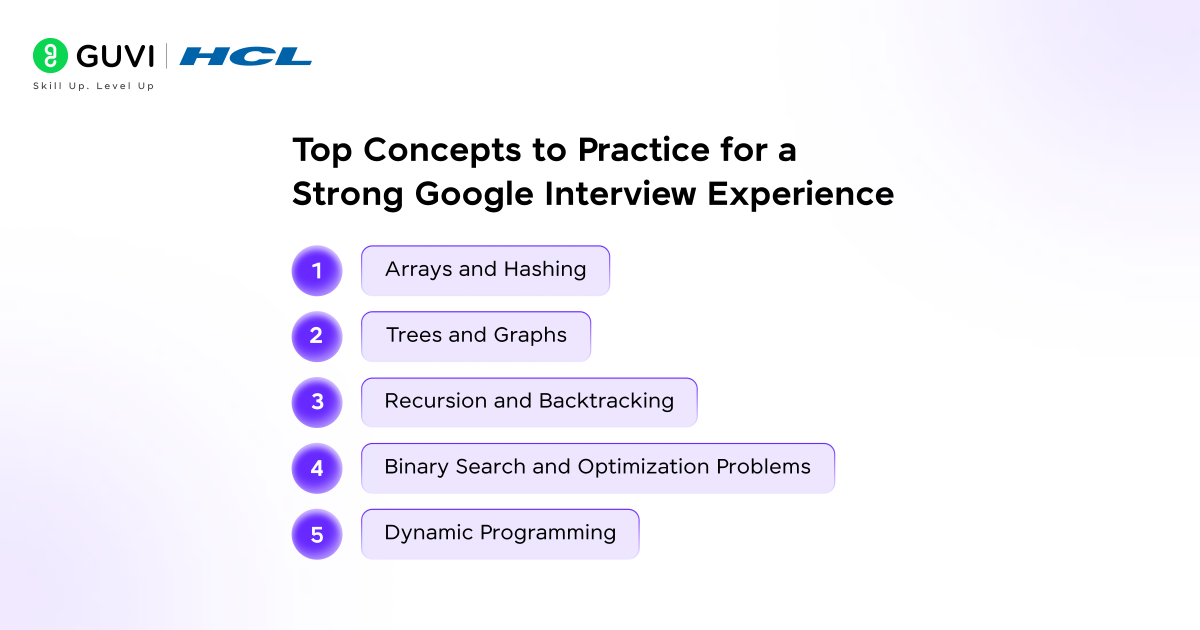
Google’s interview process prioritizes algorithmic clarity, optimization depth, and structured reasoning. Preparation should focus on mastering core problem patterns rather than memorizing solutions.
1. Arrays and Hashing
- Two Sum and its variations
- Longest Substring Without Repeating Characters
- Subarray Sum Equals K
- Product of Array Except Self
- Merge Intervals
- Top K Frequent Elements
2. Trees and Graphs
- Binary Tree Level Order Traversal
- Lowest Common Ancestor of a Binary Tree
- Validate Binary Search Tree
- Clone Graph
- Course Schedule using topological sort
- Number of Islands using DFS or BFS
3. Recursion and Backtracking
- Generate Parentheses
- Subsets and Subsets II
- Combination Sum
- Word Search
- Permutations
4. Binary Search and Optimization Problems
- Search in Rotated Sorted Array
- Find Peak Element
- Koko Eating Bananas
- Minimum Time to Complete Tasks
5. Dynamic Programming
- Longest Increasing Subsequence
- Coin Change
- Longest Common Subsequence
- House Robber
- Decode Ways
6. System Design (For Experienced Roles)
- Design a URL Shortener
- Design a Distributed Cache
- Design a Messaging System
- Design a Rate Limiter
- Design a File Storage System
Targeting Google in 2026? Your preparation must go beyond theory. Practice real coding problems daily with HCL GUVI’s Code-Kata platform, sharpen your DSA skills, improve speed and accuracy, and build the problem-solving confidence required for top-tier technical interviews.
Common Mistakes in the Google Interview
- Jumping Into Code Without Clarifying the Problem: Many candidates begin coding immediately without confirming constraints, assumptions, or edge cases. This often leads to incorrect solutions or unnecessary rework when new conditions are introduced.
- Ignoring Edge Cases: Failure to consider null inputs, large datasets, duplicate values, or boundary conditions signals incomplete problem analysis. Google interviewers expect defensive and thorough reasoning.
- Weak Complexity Analysis: Providing a working solution without clearly explaining time and space complexity is treated as incomplete. Candidates must justify performance trade-offs explicitly.
- Stopping After the First Correct Solution: Submitting a brute-force solution without attempting optimization weakens evaluation. Interviewers often expect refinement toward a more efficient approach.
- Overengineering Simple Problems: Introducing unnecessary abstractions or complex patterns for straightforward problems reflects poor judgment rather than sophistication.
Top Tips to Crack the Google Interview
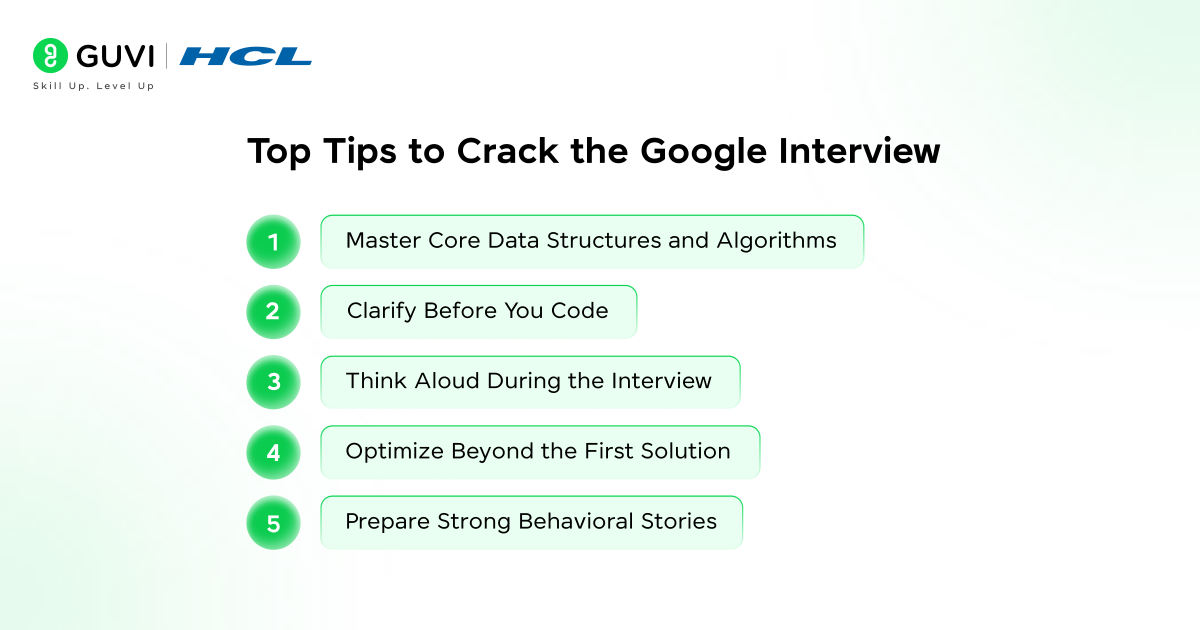
- Master Core DSA: Google’s coding interviews heavily test problem-solving fundamentals. Build strong command over arrays, hashing, trees, graphs, recursion, binary search, and dynamic programming. Focus on optimization clarity and be ready to justify time and space complexity.
- Clarify Before You Code: Do not rush into implementation. Ask clarifying questions about constraints, input size, edge cases, and expected output. Structured problem framing reflects engineering maturity.
- Think Aloud During the Interview: Interviewers evaluate reasoning as much as correctness. Explain your approach, trade-offs, and alternative solutions clearly. Silence while coding reduces visibility into your thinking process.
- Optimize Beyond the First Solution: Present a working approach, then refine it. Discuss brute-force versus optimized methods. Demonstrating iterative improvement signals depth of understanding.
- Prepare Strong Behavioral Stories: Google evaluates “Googliness” and collaboration ability. Use structured examples from real projects. Highlight ownership, measurable impact, and conflict resolution.
Wrapping Up
The Google interview process identifies engineers with strong computer science fundamentals and scalable system thinking. Success depends not on memorized patterns but on clear problem decomposition, optimization discipline, and thoughtful trade-off analysis. The hiring bar remains high because Google builds systems used by billions, where performance and reliability are critical. Focused preparation, disciplined execution, and measurable project experience turn this rigorous process into an achievable benchmark.
FAQs
How many rounds are there in the Google interview?
Typically, Google’s interview process includes 4 to 6 rounds. This may involve a recruiter screen, an online assessment for some roles, 2 to 3 technical coding interviews, a Googliness or behavioral round, and a final hiring committee review.
Is Google interview harder than Amazon?
Google is generally considered more rigorous in algorithmic depth and structured reasoning, while Amazon often emphasizes leadership principles alongside technical strength. Both are challenging, but Google’s hiring bar is widely regarded as more selective.
Does Google ask system design for freshers?
For entry-level roles such as L3, system design is usually not deeply tested. The focus remains on data structures, algorithms, and problem-solving clarity. High-level design discussion may occur but is not a primary evaluation area.
What is Google L3 salary in India?
Google L3 (entry-level software engineer) compensation in India typically ranges between ₹30 LPA and ₹45 LPA total compensation, including base salary, bonus, and stock components, based on recent public compensation reports.
Success Stories

About the Author
Vaishali
I'm a seasoned writer with four years of experience across technical, non-technical, and just about every genre or niche you can imagine. Adaptable and curious, I enjoy exploring new topics and making information engaging and easy to understand. Fueled by a steady stream of tea, I approach each project with creativity, reliability, and genuine enthusiasm for storytelling.
View all posts by Vaishali
Connect with me @










Did you enjoy this article?