


Full Stack Development Articles
My Full Stack Developer Interview Experience: What Nobody Tells You
What Is CRUD? A Complete Guide to Create, Read, Update, Delete in Modern Applications
How to Build Your First ML Powered Web App (Even If You're Not a Data Scientist)
How to Stay Valuable as a Web Developer in The Era of AI [2026]

Get In Touch For Details! Request More Information

Best Full Stack Developer Resume Example 2026
Mar 11, 2026 4 Min Read 1700 Views
(Last Updated)
Did you know that according to the U.S. Bureau of Labor Statistics, demand for software developers is projected to grow by 25% between 2021 and 2031. Is it much faster than the average for all occupations? With such rapid growth, competition in the tech industry is fierce, and standing out requires more than just coding skills. A powerful resume can be the key that opens the door to your next big opportunity.
In this blog, we’ll walk you through what makes the best Full-Stack Developer resume in 2026. Read on to discover more:
Table of contents
- Best Full-Stack Developer Resume Guide
- Best Full-Stack Developer Resume Example
- Technologies to Mention in a Full-Stack Developer Resume
- Tips for a Strong Full-Stack Developer Resume
- Common Mistakes to Avoid in a Full-Stack Developer Resume
- Tools That Strengthen a Full-Stack Developer Resume
- Conclusion
- FAQs
- Q1. What are the skills required to mention in a full-stack developer resume?
- Q2. What is the role of a full-stack developer in a CV?
- Q3. How do I write a full-stack developer resume?
Best Full-Stack Developer Resume Guide
There are various ways through which you can learn full-stack development. And when you become industry-ready, you can build a resume that fits into the organization’s needs. Let’s talk about some of the major pointers you must mention in a Full-Stack Developer Resume:
- Header: At the top of your resume, provide a clear and concise header that includes your full name, contact information, and links to your professional profiles (LinkedIn, GitHub). Make sure your email address and phone number are up to date.
- Summary: Craft a compelling summary that encapsulates your professional journey and aspirations. Highlight your proficiency in both front-end and back-end technologies. Use this section to showcase your passion for solving complex problems and your commitment to staying updated with the latest industry trends.
- Skills: List your technical and soft skills. Tailor this section to match the specific requirements of the job you’re applying for. Include a mix of both front-end and back-end technologies, as well as any additional skills such as version control, cloud services, or agile methodologies.
- Experience: Detail your work experience in reverse chronological order. For each position, include your job title, the company’s name, and the duration of your employment. Use bullet points to describe your responsibilities and achievements. Emphasize the impact of your work, quantifying results whenever possible.
- Projects: Highlight key projects that showcase your technical prowess. Provide details about the technologies used, your role, and the impact of the project. If possible, include links to the project’s GitHub repository or a live demo.
- Education: Include your educational background, starting with the most recent degree. Mention the institution’s name, your degree, major, and graduation date.
- Certifications: If you hold relevant certifications, showcase them in a dedicated section. Certifications in specific technologies or methodologies can bolster your credibility.
- Professional Development: Demonstrate your commitment to continuous learning by mentioning any workshops, conferences, or online courses you’ve attended. This underscores your dedication to staying current with industry trends.
You must also attend some webinars and workshops for full-stack development which can be mentioned in your Full-Stack Developer Resume, thereby increasing your chance of getting into top companies. - Additional Sections (Optional): Depending on your profile, you might consider adding sections such as awards, publications, or languages spoken. These can provide additional insights into your skills and achievements.
- References: End your resume by stating that references are available upon request. Ensure that you have obtained permission from your references before including their contact information.
Turn your resume into a job-winner by mastering front-end, back-end, and deployment with our Full Stack Development Course, complete with real projects, expert mentorship, global certification, and placement support. Enroll today!
Best Full-Stack Developer Resume Example
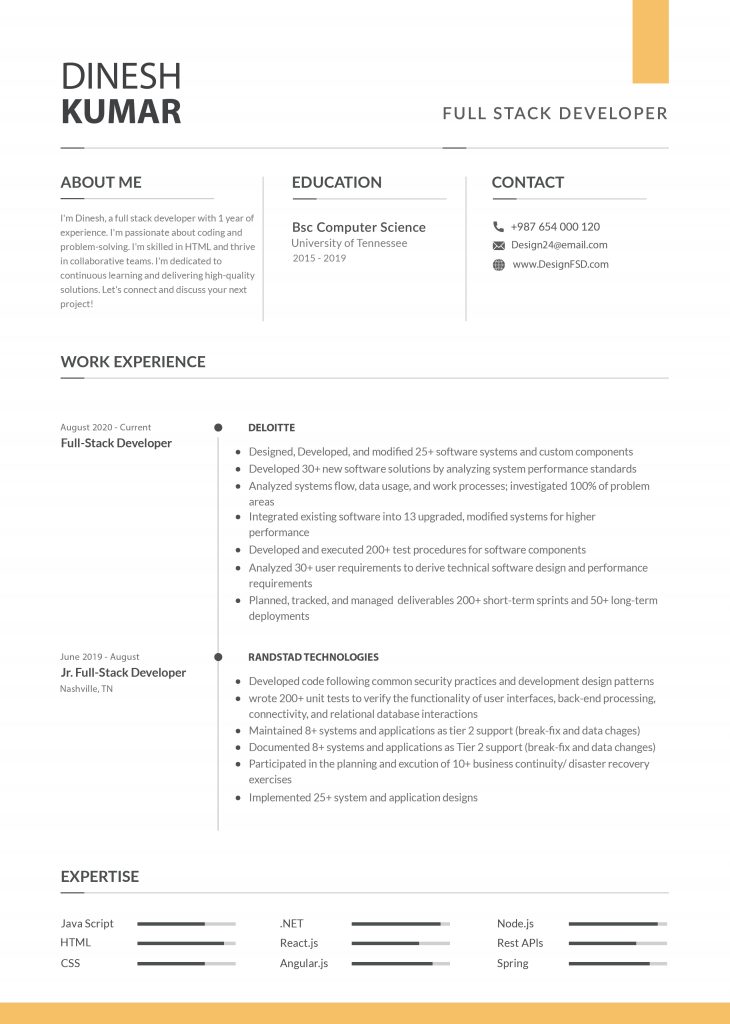
Now, that we have talked about the important elements, let’s have a look at a Full-Stack Developer Resume Example to make you understand better:
Are you looking for a platform where you can sharpen your skills and solve questions related to full-stack development? We have one for you, WebKata where you can learn Web development skills by a series of tasks. This cloud-based module will enable you to practice Front-end skills without setting up a local environment.
If you want to build your resume in minutes and also check the ATS score for it, then use HCL GUVI’s Free Resume Builder Tool – Create and Check ATS Score For Free

Technologies to Mention in a Full-Stack Developer Resume
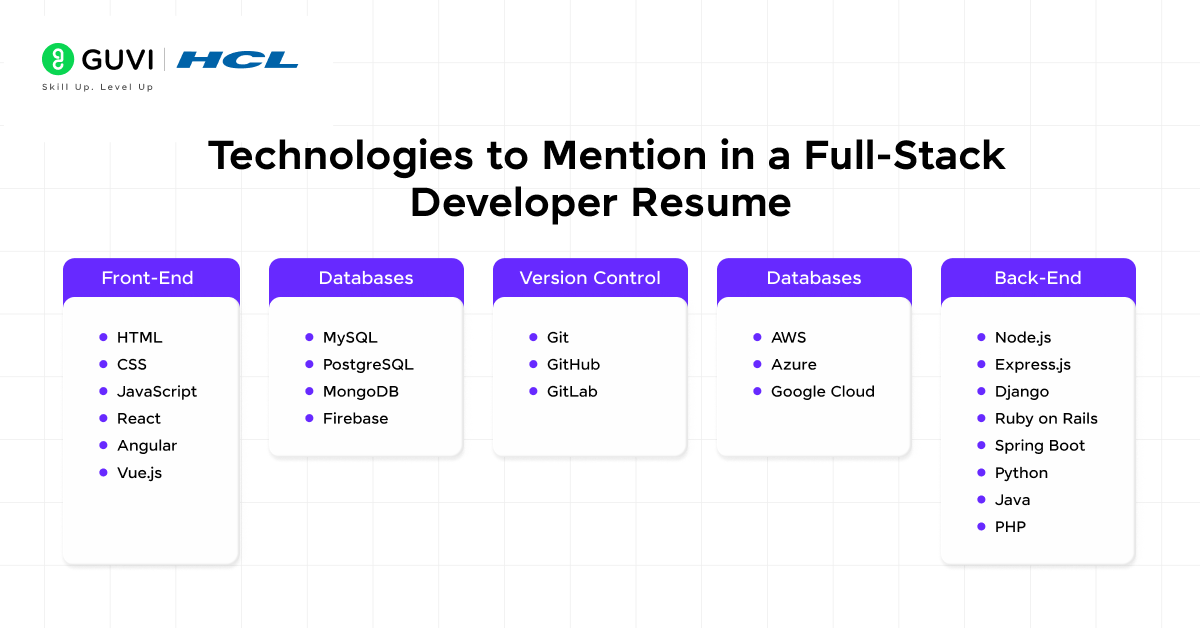
- Front-End: HTML, CSS, JavaScript, React, Angular, or Vue.js. These show your ability to build interactive and user-friendly interfaces.
- Back-End: Node.js, Express.js, Django, Ruby on Rails, or Spring Boot. Listing frameworks and languages such as Python, Java, or PHP demonstrates server-side expertise.
- Databases: MySQL, PostgreSQL, MongoDB, or Firebase. Including both relational and non-relational options shows flexibility in handling data.
- Version Control: Git and GitHub or GitLab signal teamwork and structured code management.
- Cloud Services: AWS, Azure, or Google Cloud skills highlight your ability to deploy and scale applications.
- Other Tools: Docker for containerization and Jenkins for continuous integration illustrate readiness for modern workflows.
Tips for a Strong Full-Stack Developer Resume
- Tailor Keywords: Use terms from the job description so your resume passes applicant tracking systems and speaks the same language as recruiters.
- Highlight Achievements: After aligning keywords, show impact through measurable results such as reduced load times or increased efficiency.
- Keep Layout Clean: A clear design supports those achievements by making them easier to notice. Consistent fonts and spacing guide the reader through your content.
- Limit Length: Concise formatting ensures the layout remains sharp. One to two pages give enough space to present skills and results without overwhelming detail.
- Update Regularly: A shorter resume is easier to maintain. Add new projects or certifications soon after completion so your profile stays current.
- Proofread Carefully: The final step strengthens all your effort. Correct grammar and spelling show attention to detail and professionalism.
Common Mistakes to Avoid in a Full-Stack Developer Resume
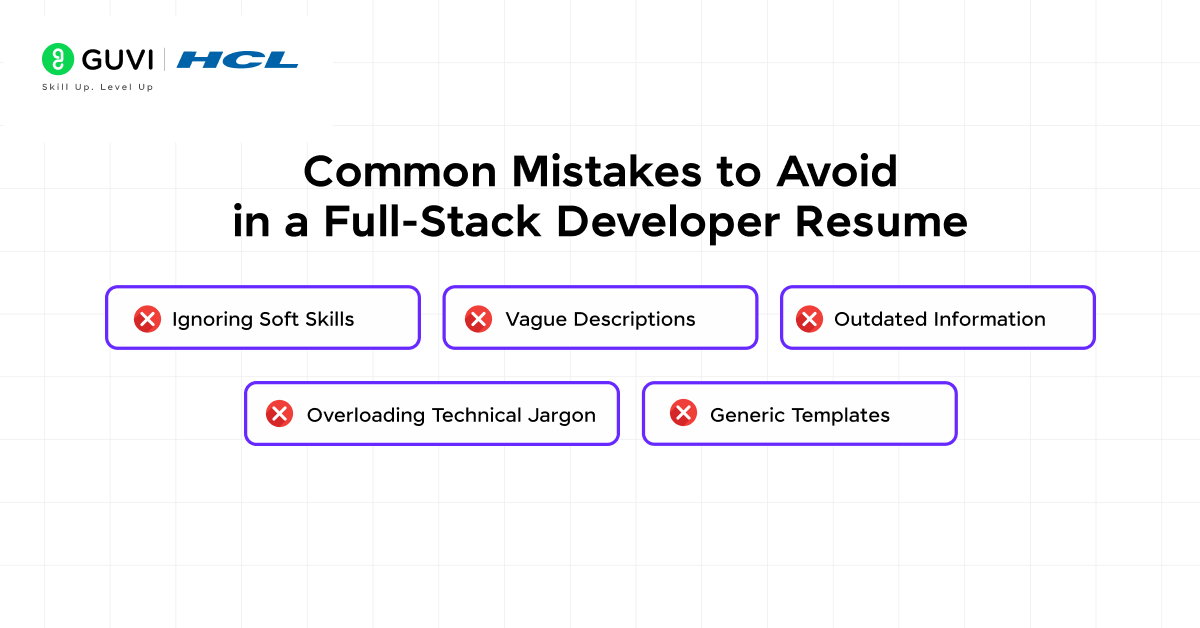
- Overloading Technical Jargon: Listing every tool or framework you have tried once makes the resume look inflated. Focus on the technologies you can use with confidence.
- Ignoring Soft Skills: Technical skills matter, but teamwork, communication, and problem-solving often influence hiring decisions. Clearly mention them.
- Vague Descriptions: Writing “worked on backend” tells little about your contribution. Be specific about the problem you solved or the improvement you delivered.
- Outdated Information: Including very old technologies or irrelevant coursework makes the resume look unfocused. Keep the content aligned with today’s requirements.
- Generic Templates: A copy-paste resume without customization signals low effort. Adapt the format and content to reflect the role you are applying for.
Tools That Strengthen a Full-Stack Developer Resume
- Code Repositories: GitHub and GitLab showcase your projects. Adding links to active repositories gives recruiters proof of your coding standards and consistency.
- Portfolio Builders: Platforms like GitHub Pages or Netlify help you create a personal site. A portfolio with live demos adds weight to your resume.
- Design and Layout: Canva or Novoresume make it easier to build clean templates. A polished format improves readability without heavy design skills.
- Skill Verification: HackerRank and LeetCode profiles highlight problem-solving ability. Sharing scores or badges can support your technical credibility.
- Learning Platforms: Coursera, HCL Guvi, and freeCodeCamp provide certifications. Including these certificates shows steady growth and initiative.
Conclusion
A well-crafted Full-Stack Developer resume is your ticket to landing the job of your dreams. Tailor your resume to the specific requirements of each position, showcase your achievements, and let your passion for coding shine through. In the competitive landscape of 2026, a standout resume is your key to unlocking exciting opportunities in the ever-evolving world of technology.
FAQs
Q1. What are the skills required to mention in a full-stack developer resume?
Some of the top skills required to mention in a full-stack developer resume:
HTML, CSS, and JavaScript
Front-end and Back-end Frameworks
Databases
APIs
Git
Q2. What is the role of a full-stack developer in a CV?
The role of a full-stack developer in a CV includes:
Designing, developing, and maintaining a relational database system for the storage, retrieval, and manipulation of data.
Develop different components of an application using languages and frameworks such as JavaScript, PHP, React, Angular, and Node.js.
Q3. How do I write a full-stack developer resume?
Write a compelling profile summarizing your qualifications.
Add an accomplishment-driven professional experience section.
Include relevant education and certifications.
List pertinent key technical skills.
Success Stories

About the Author
Isha Sharma
I’m a versatile technical content writer with over 3.5 years of experience in technical writing and 1 year of experience in web development. My specialized domains are web development, AWS, cloud computing, etc. I have written over 250+ SEO-optimized technical articles.
View all posts by Isha Sharma
Connect with me @
























Did you enjoy this article?