


Artificial Intelligence and Machine Learning Articles
Finance Manager to Data Analytics: Career Growth, Salary and Seniority
How to Evaluate LLM Outputs in Production Deployments
AI/ML Skills Gap 2026: Why Companies Can't Find Job-Ready Talent
20 AI/ML Interview Questions Recruiters Can Use Without a Tech Background - Best Guide
Get In Touch For Details! Request More Information

AI in Automotive Industry: How Artificial Intelligence is Redefining Mobility and Safety
Sep 08, 2026 5 Min Read 2220 Views
(Last Updated)
What if the vehicles we drive could think and respond with precision beyond human ability? Artificial intelligence is reshaping the automotive industry in ways that stretch from advanced safety systems to connected mobility ecosystems. It is no longer limited to research labs or concept designs. Instead, AI is now embedded across engineering and on-road performance. The story of AI in automotive industry is one of innovation that redefines safety and trust.
To understand the technologies, benefits, and challenges shaping this shift, read the full blog below.
Table of contents
- What is AI in the Automotive Industry?
- What Technologies Enable Autonomous Vehicles to Navigate Complex Driving Challenges?
- Benefits of AI in the Automotive Industry
- Road Safety and Risk Reduction
- Operational Efficiency Across the Value Chain
- Reliability and Lifecycle Management
- Sustainability and Environmental Impact
- Customer Experience and Trust
- Top Applications of AI in the Automotive Industry
- Advanced Driver Assistance Systems (ADAS)
- Smart Manufacturing
- In-Vehicle Personalization
- Fleet and Logistics Optimization
- Connected Vehicle Intelligence
- Concerns and Considerations for AI in the Automotive Industry
- Top Companies Driving AI in the Automotive Industry
- Future of AI in Automotive Industry
- Conclusion
- FAQs
- How does AI affect the cost of vehicle ownership?
- What role does AI play in regulatory and ethical decision-making?
- How will AI change the relationship between drivers and vehicles in the future?
- How should I evaluate AI & ML certifications before enrolling?
What is AI in the Automotive Industry?
Artificial intelligence in the automotive industry refers to the use of computational systems. They replicate human cognitive functions such as perception and decision logic within vehicle technologies and industrial operations. It involves algorithms that process multimodal data from sensors and telemetry to generate insights in real time. These systems depend on neural networks and probabilistic models that allow vehicles to interpret complex environments with precision. AI contributes to simulation frameworks that evaluate structural integrity and safety compliance under varied conditions within engineering workflows.
What Technologies Enable Autonomous Vehicles to Navigate Complex Driving Challenges?
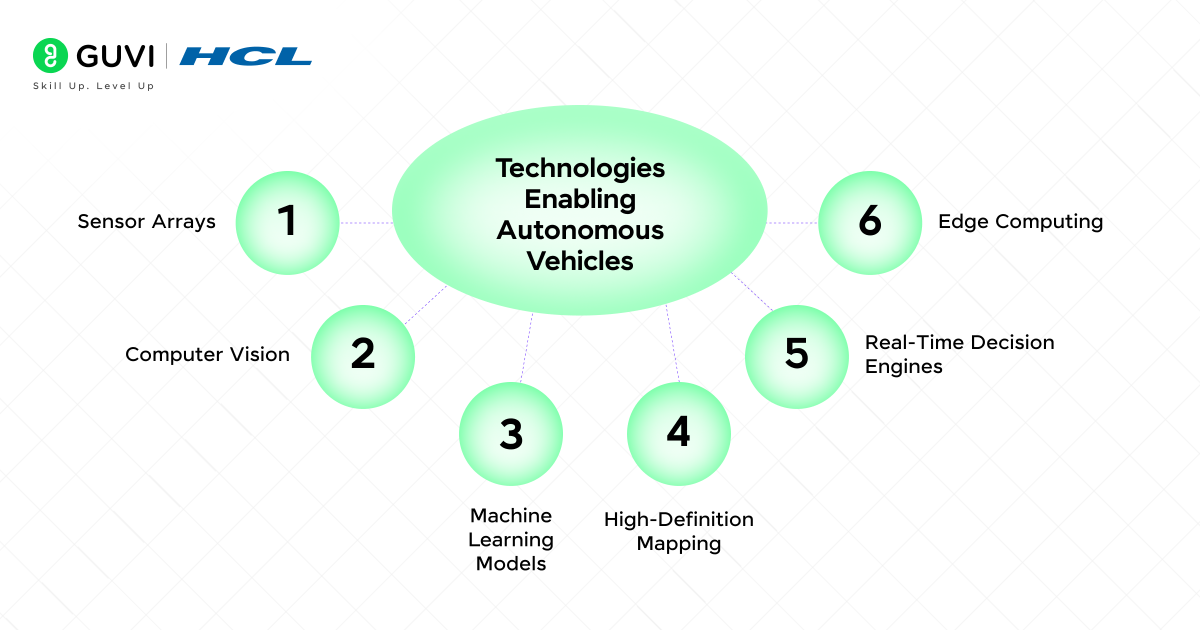
Autonomous vehicles depend on a fusion of advanced technologies that allow them to interpret their surroundings and respond with precision. The relationship between varied technological layers is what gives vehicles the proficiency to operate safely in real-world environments:
- Sensor Arrays: Cameras and lidar collect visual and spatial data that form a real-time representation of the road. Each sensor contributes unique strengths, such as depth accuracy from lidar and weather resilience from radar.
- Computer Vision: Image recognition algorithms identify lanes, signs, lights, and road boundaries. They also track moving objects to predict potential risks.
- Machine Learning Models: Deep learning and reinforcement learning algorithms predict the behavior of other road users, such as when a pedestrian may cross or when another car might change lanes.
- High-Definition Mapping: Vehicles use AI-supported maps that provide detailed road layouts. It includes elevation changes and traffic signal positions. These maps are continuously updated through cloud-based systems.
- Real-Time Decision Engines: Autonomous driving requires systems that evaluate inputs and select actions within milliseconds. These engines balance acceleration and steering to maintain safety in complex traffic.
- Edge Computing: Onboard processors analyze vast data streams locally. It reduces latency and ensures that decisions are made quickly without waiting for cloud processing.
Benefits of AI in the Automotive Industry
1. Road Safety and Risk Reduction
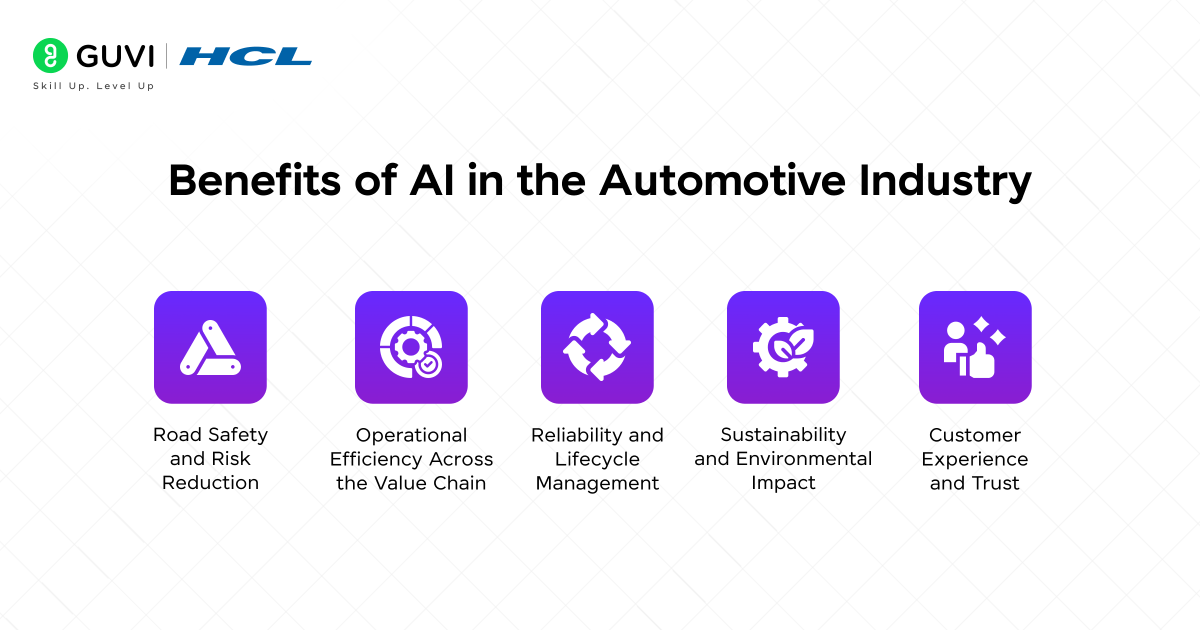
AI contributes to fewer accidents through faster reaction times and more consistent performance, which supports human drivers. The benefits emerge through automated responses that reduce reaction delays and risk assessment systems that evaluate surrounding traffic behavior.
2. Operational Efficiency Across the Value Chain
AI reshapes how manufacturers and fleet operators manage resources. Efficiency gains appear in production and daily operations, which lowers cost while maintaining quality. These outcomes are supported by AI-driven forecasting that aligns production with market demand and optimization systems that streamline logistics and reduce idle time. Process monitoring further reduces waste and improves throughput.
3. Reliability and Lifecycle Management
Vehicles that rely on AI maintain consistent performance through proactive monitoring and predictive maintenance. This leads to higher uptime and reduced unplanned breakdowns. Benefits in this area arise from algorithms that identify early signs of component fatigue and maintenance scheduling that prevents costly disruptions.
Also, read: The Ultimate Guide to Applications of Artificial Intelligence in 2025
4. Sustainability and Environmental Impact
AI contributes to sustainability by supporting the efficient use of energy and raw materials. Whether in electric vehicles or manufacturing plants, the technology reduces waste and improves energy balance. Optimized battery management helps extend range and durability, and energy-efficient production planning that lowers emissions. Intelligent routing further helps decrease unnecessary fuel consumption.
5. Customer Experience and Trust
AI creates a closer connection between drivers and vehicles through personalization and reliability. Trust grows when vehicles adapt to user needs while consistently delivering safe and efficient performance. These benefits are supported by adaptive comfort features that adjust to user behavior and consistent safety feedback that reassures drivers and passengers.
Drive your career forward with AI in automation! Enroll in our Artificial Intelligence & Machine Learning Course with Intel Certification and shape the future of automotive and intelligent systems.
Top Applications of AI in the Automotive Industry
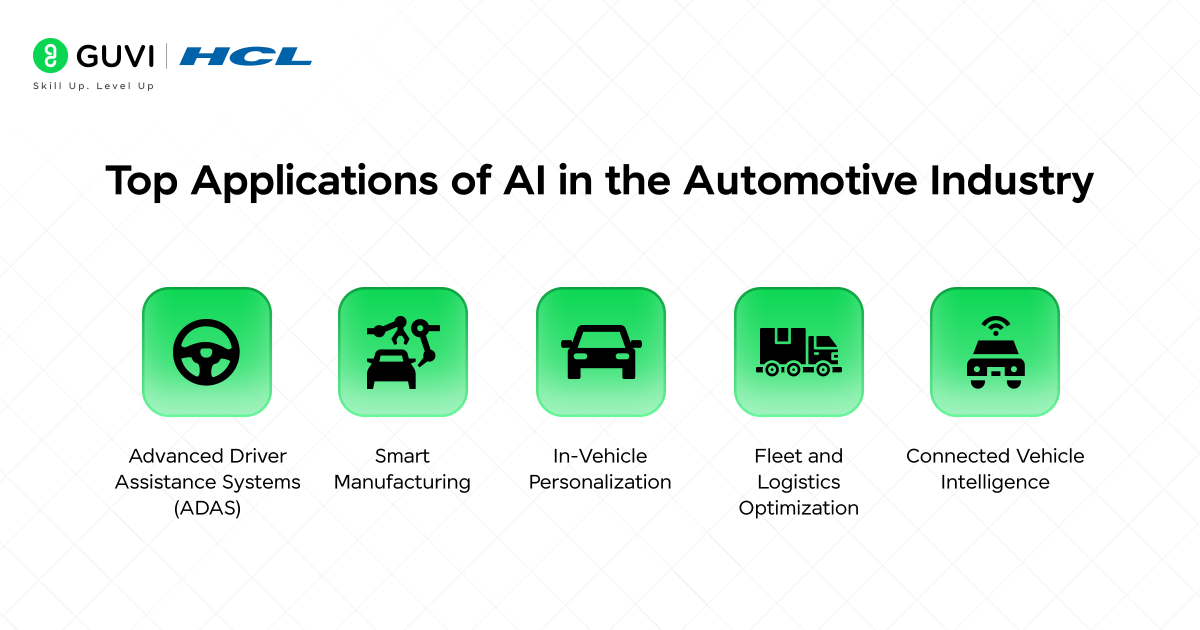
1. Advanced Driver Assistance Systems (ADAS)
AI forms the backbone of ADAS, where data from cameras and radar is processed to support driver safety. These systems react faster than human reflexes and provide features such as adaptive cruise control and collision warnings. The main components that support this application are:
- Sensor fusion that combines input from radar and cameras into a single model.
- Computer vision that identifies lanes, pedestrians, and other vehicles.
- Real-time control systems that adjust braking and acceleration instantly.
2. Smart Manufacturing
AI extends beyond the vehicle to the factory floor, where it redefines how cars are built. Production lines equipped with AI-driven robotics and vision systems achieve higher accuracy and fewer defects. The integration of intelligence into manufacturing shortens cycles and reduces waste. Its technological core includes:
- Vision systems that detect flaws during assembly in real time.
- Robotic platforms that adjust to design specifications with adaptive control.
- Predictive analytics that forecast demand and optimize supply chains.
3. In-Vehicle Personalization
AI enriches the driving experience by tailoring the cabin environment to each user. Systems learn preferences over time and adapt controls and comfort features. This personalization strengthens the bond between driver and vehicle through continuous adaptation. The supporting layers are:
- Natural language processing that refines voice-based commands.
- Preference learning systems that adjust entertainment and climate controls.
- Biometric sensors that respond to fatigue, stress, or alertness levels.
Read: Real-World Machine Learning Applications
4. Fleet and Logistics Optimization
AI optimizes transport fleets by improving fuel efficiency and route planning. Logistics firms rely on these models to reduce operational costs and improve delivery reliability. The core technologies operate through:
- Algorithms that calculate routes under changing traffic conditions.
- Predictive systems that balance driver allocation with delivery demand.
- Data integration platforms that track fleet health and performance.

5. Connected Vehicle Intelligence
AI reaches its fullest potential when vehicles communicate with each other and with surrounding infrastructure. This exchange of information coordinates traffic flow and prepares cities for smarter mobility ecosystems. The technological aspects include:
- Vehicle-to-vehicle systems that manage lane changes and cooperative braking.
- Vehicle-to-infrastructure platforms that connect with traffic signals and road sensors.
- Cloud-based systems that process shared data to enhance transport planning.
Concerns and Considerations for AI in the Automotive Industry
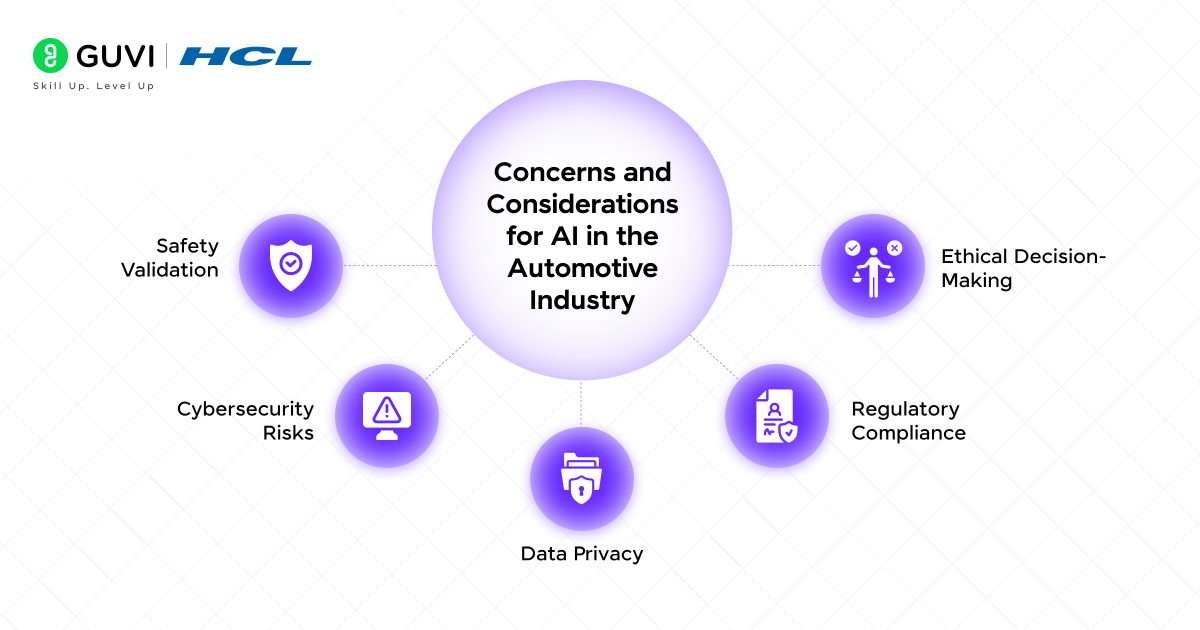
The adoption of AI in the automotive industry raises important questions about safety and accountability. These considerations extend beyond technology into ethics and long-term sustainability:
- Safety Validation
AI-driven systems must perform consistently across varied weather and traffic conditions. Testing environments often fail to capture every possible scenario, which makes validation a major challenge.
- Cybersecurity Risks
Connected vehicles rely on constant data exchange, which creates opportunities for malicious interference. Protecting communication networks and onboard systems from intrusion is a critical concern.
- Data Privacy
Autonomous and connected cars generate detailed travel and behavioral data. Proper governance is required to prevent misuse and to protect driver privacy.
- Regulatory Compliance
Global differences in traffic laws and safety standards make it difficult to design AI systems that operate seamlessly across regions. Regulators and automakers must align frameworks to avoid fragmented deployment.
- Ethical Decision-Making
AI systems may face situations where avoiding one risk creates another. Designing algorithms that prioritize fairness and accountability remains an ongoing challenge.
Top Companies Driving AI in the Automotive Industry
- Tesla
Tesla applies AI across autonomous driving features, in-vehicle systems, and large-scale data collection. Its vehicles rely on a neural network trained with billions of miles of driving data, which strengthens the accuracy of real-time decisions.
- Waymo
Waymo, a subsidiary of Alphabet, focuses on autonomous driving platforms supported by lidar, radar, and AI-powered mapping. Its test fleets provide insight into how AI handles diverse and complex driving environments.
- NVIDIA
NVIDIA develops AI hardware and software that power autonomous driving systems. Its DRIVE platform provides high-performance processors and simulation tools that allow automakers to design and test AI-based solutions.
- BMW
BMW integrates AI into manufacturing, supply chain planning, and driver assistance features. The company invests in AI research partnerships that connect vehicle performance with predictive maintenance and personalization.
- Toyota
Toyota advances AI through its research institutes, which focus on mobility safety and automated driving. The company’s long-term strategy links AI innovation to both consumer vehicles and future urban mobility solutions.
Future of AI in Automotive Industry
AI use cases in the automotive industry will advance into areas that reshape how vehicles and energy systems interact. The following directions illustrate what lies ahead:
- Vehicle-to-Vehicle Intelligence: Cars will negotiate speed and merging patterns through decentralized AI networks that reduce collisions and optimize flow.
- Quantum-Aided Engineering: AI enriched with quantum-inspired models will accelerate crash testing. It will also level up aerodynamic design and material durability analysis, which reduces development time.
- Human-Centric Monitoring: In-cabin AI will analyze biometrics such as eye movement and stress signals to anticipate fatigue or medical emergencies.
- Edge-Level Decision Systems: Ultra-low latency processors will allow vehicles to process sensor data locally with precision. It will strengthen responses in dense traffic and complex environments.
- Integrated Mobility Ecosystems: AI platforms will link vehicles with smart grids and urban infrastructure. It will also support adaptive energy use and coordinated transport planning with utmost precision.
Conclusion
Artificial intelligence has already reshaped core aspects of the automotive industry, yet its full potential is only beginning to unfold. The technology strengthens safety and constructs the way for mobility systems that integrate seamlessly with cities and energy networks. At the same time, it raises important questions about data and trust that must be addressed for long-term success. The path forward is one of balance, where innovation continues to advance while responsibility keeps pace.
FAQs
1. How does AI affect the cost of vehicle ownership?
AI can reduce long-term ownership costs by predicting maintenance needs and improving energy efficiency, but advanced software and sensors can also increase the upfront cost of vehicles. Over time, however, savings from fewer breakdowns and improved fuel or battery efficiency often offset the higher purchase price.
2. What role does AI play in regulatory and ethical decision-making?
AI raises complex questions for regulators and policymakers. Vehicles equipped with AI must comply with traffic laws that vary across regions, which requires adaptive programming and standardized testing protocols. Ethical dilemmas also emerge, such as how AI should respond when avoiding one hazard creates another. These issues highlight the need for collaboration between automakers and ethics boards to create fair and transparent frameworks.
3. How will AI change the relationship between drivers and vehicles in the future?
AI will redefine how drivers interact with vehicles by shifting the role of humans from direct controllers to supervisors of intelligent systems. In the future, vehicles may adapt to driver health, mood, and preferences in real time while also offering automated driving in certain conditions.
How should I evaluate AI & ML certifications before enrolling?
Evaluate AI & ML certifications based on industry recognition, curriculum relevance, hands-on learning, project experience, and career outcomes. You can also compare what’s included in the HCL GUVI AI & ML Programme before making a decision.
Success Stories

About the Author
Vaishali
I'm a seasoned writer with four years of experience across technical, non-technical, and just about every genre or niche you can imagine. Adaptable and curious, I enjoy exploring new topics and making information engaging and easy to understand. Fueled by a steady stream of tea, I approach each project with creativity, reliability, and genuine enthusiasm for storytelling.
View all posts by Vaishali
Connect with me @










Did you enjoy this article?