


Artificial Intelligence and Machine Learning Articles
Finance Manager to Data Analytics: Career Growth, Salary and Seniority
How to Evaluate LLM Outputs in Production Deployments
AI/ML Skills Gap 2026: Why Companies Can't Find Job-Ready Talent
20 AI/ML Interview Questions Recruiters Can Use Without a Tech Background - Best Guide


Get In Touch For Details! Request More Information
AI in Agriculture: Transforming Farming Around the World
Sep 08, 2026 7 Min Read 3209 Views
(Last Updated)
How can technology as complex as artificial intelligence find its place in something as traditional as farming? At first, it might sound like two worlds apart – one rooted in soil and seasons, the other in algorithms and data.
But as you’ll see, AI is quietly reshaping agriculture across the globe, and especially in India. From predicting crop yields to reducing water usage, AI is not only helping farmers grow more with less but also preparing the sector to face challenges like climate change, rising demand, and resource scarcity.
In this article, you’ll learn how AI is being applied in agriculture, the benefits it brings, real-world examples, and the challenges that lie ahead. Let’s dig in to see how AI in agriculture is sowing the seeds of a smarter future in farming.
Table of contents
- Why is AI a Game Changer for Agriculture?
- Applications of AI in Agriculture
- Precision Farming and Crop Monitoring
- Pest and Disease Management
- Smart Irrigation and Water Management
- Farm Automation and Robotics
- Livestock Monitoring and Management
- Supply Chain and Market Forecasting
- AI in Indian Agriculture: A Closer Look
- Government Initiatives and Policies
- Unique Challenges and the Road Ahead in India
- AI in Global Agriculture: A Wider Perspective
- Conclusion
- FAQs
- How is AI used in agriculture?
- What are the benefits of AI in agriculture?
- What are examples of AI in Indian agriculture?
- What are the challenges of using AI in agriculture?
- What is the future of AI in agriculture?
- How should I evaluate AI & ML certifications before enrolling?
Why is AI a Game Changer for Agriculture?
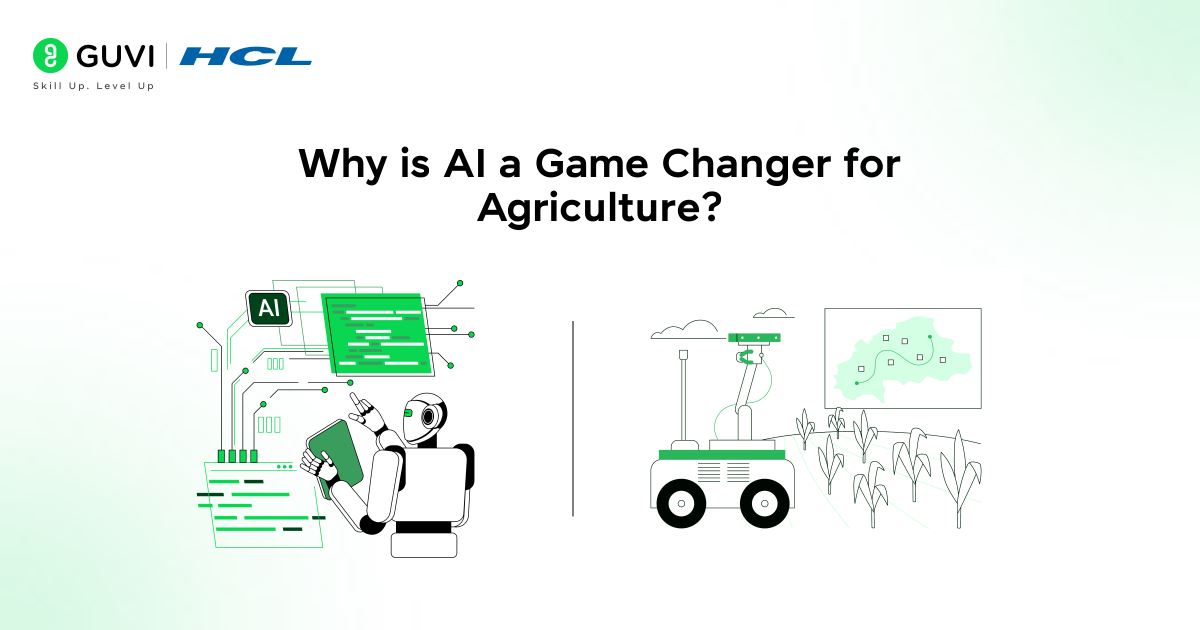
Feeding a growing population is a major challenge for the 21st century. Global food demand is projected to rise by up to 56% by 2050, driven by population growth and changing diets. Traditional farming methods alone may not keep up with this surge. This is where AI comes in.
By analyzing vast amounts of data from weather patterns to soil conditions, AI can help farmers make smarter, faster decisions to maximize yields while minimizing waste.
Challenges in farming, such as unpredictable weather, water scarcity, pest infestations, and supply chain inefficiencies, are especially acute in countries like India. AI offers tools to tackle these problems head-on. For example, machine learning models can crunch climate data to predict droughts or floods, while computer vision can spot crop diseases before they spread.
Applications of AI in Agriculture
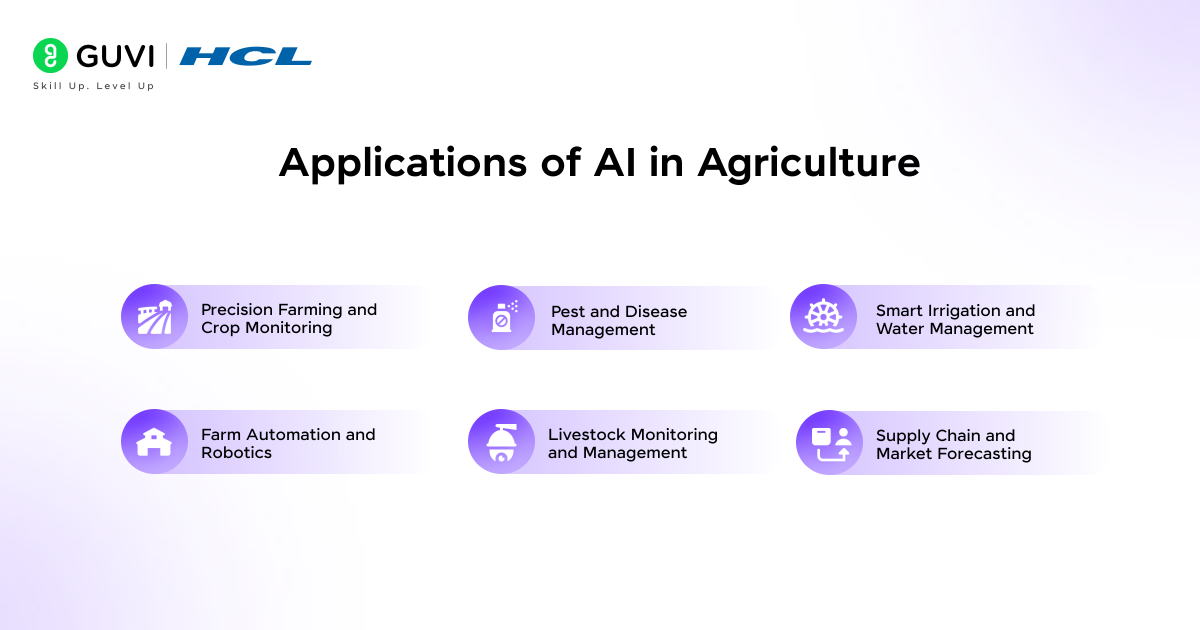
AI isn’t a single tool – it’s a range of technologies and applications. Let’s explore some key areas where AI is making a difference on the farm, from monitoring crop health to harvesting, from saving water to protecting livestock.
By understanding these applications, you’ll see how diverse and impactful AI’s role in agriculture has become.
1. Precision Farming and Crop Monitoring
One of the most important uses of AI in agriculture is precision farming – using data and analytics to make farming more exact and efficient. Instead of treating an entire field uniformly, AI helps farmers treat each portion of the field based on its specific needs.
How does this work? Through a combination of sensors, satellite imagery, drones, and data crunching algorithms.
- Satellite and Drone Imaging: High-resolution images can reveal where crops are thriving and where they are under stress. AI algorithms analyze imagery to detect issues like drought stress or nutrient deficiencies before they’re visible to the naked eye.
- Soil and Weather Sensors: Internet of Things (IoT) sensors in the soil measure moisture, pH, and nutrient levels, while weather stations track local climate conditions. All this data is fed into AI models.
- Decision Support Systems: The result of all this monitoring is actionable insight. AI-driven decision support tools provide farmers with recommendations – for example, which day is optimal for planting or harvesting based on weather and crop models.
2. Pest and Disease Management
Pests and crop diseases have always been farming’s arch-nemesis. A sudden pest outbreak or an unseen disease can ruin an entire season’s harvest. AI is arming farmers with early-warning systems and targeted responses to fight these threats:
- Early Disease Detection: AI-powered image recognition can identify plant diseases from photos of leaves and crops with remarkable accuracy. For example, machine vision can detect apple scab disease with about 95% accuracy, or spot signs of wheat rust in a field before it becomes an outbreak.
- Smart Pest Monitoring: Traditional pest control often relies on routine spraying of pesticides, which is inefficient and harmful if overdone. AI is enabling a shift to precision pest management. One cool example is AI-powered pest traps like the Trapview system, which uses pheromones to lure pests and cameras combined with AI to identify and count them.
- Targeted Spraying with Drones: In some advanced setups, AI-guided drones or robotic sprayers only apply chemicals where pests or diseases are detected, rather than blanketing the whole field.
The benefit of AI in pest and disease management is a win-win: crops are healthier and yields are protected, while farmers spend less on chemicals and cause less ecological harm.
3. Smart Irrigation and Water Management
Water is life in agriculture – and in many regions, it’s a scarce resource. Overwatering wastes water and electricity, but under-watering can ruin a crop. AI is helping farmers walk this tightrope by optimizing irrigation:
- Soil Moisture Sensing and Prediction: Modern irrigation systems use AI to analyze data from soil moisture sensors and weather forecasts. By learning how quickly a particular field dries out after rain, an AI model can predict when the soil will need water next. It can trigger irrigation at the perfect time and turn it off when enough water has been delivered.
- Drip Irrigation and “Per Drop More Crop”: A great example from India is the government’s Per Drop More Crop initiative, which promotes micro-irrigation (drip and sprinkler systems) enhanced by AI. These systems deliver water directly to a plant’s roots in controlled amounts.
- Real-world Savings: The impact can be quite dramatic. We already mentioned one farmer’s experience of saving ~30% water using AI-guided irrigation. Scaling this up, an agritech platform in India analyzed tens of thousands of hectares and found that smarter irrigation advice helped save billions of liters of water in aggregate.
By making every drop count, AI-driven irrigation systems help farmers cope with water scarcity and unpredictable rainfall patterns.
4. Farm Automation and Robotics
When you imagine AI on a farm, you might picture robots driving tractors or drones buzzing over fields – and you’d be right! Automation is an exciting aspect of AI in agriculture, as it can take over repetitive or labor-intensive tasks, allowing farmers to focus on planning and decision-making.
- Autonomous Tractors and Equipment: Companies have begun developing self-driving tractors and robotic farm machines that can plow, seed, and harvest with minimal human intervention. These machines use AI to navigate fields with GPS accuracy and to adapt to field conditions.
- AI-Powered Weeding: Weeding is a laborious task, but AI-driven robots excel at it. A notable innovation is John Deere’s See & Spray technology, which uses computer vision to tell crops and weeds apart. When mounted on sprayers, this system can target weeds individually, reducing herbicide use by up to 90%.
- Drones for Crop Management: Drones aren’t just for aerial pictures; they are becoming farmhands too. Drones can autonomously fly over fields to sow seeds in difficult terrain, distribute biopesticides, or even scare away birds. They can cover large areas faster than a person on foot.
Farm automation through AI can significantly boost productivity and address the problem of rural labor shortages. In places where young people are moving to cities and farms struggle to find workers, robots can fill in the gap for tasks like spraying or harvesting.
5. Livestock Monitoring and Management
AI’s influence in agriculture isn’t limited to crops – it extends to barns and pastures as well. Livestock farming (dairy, poultry, fisheries, etc.) benefits from AI through better animal health monitoring and farm management:
- Health Tracking with Vision and Sensors: Just as AI can identify a sick leaf on a plant, it can also recognize when an animal isn’t feeling well. Computer vision, through cameras installed in barns or grazing fields, can monitor livestock 24/7.
- Feeding and Milk Production: AI-powered sensors can also monitor how much each animal is eating or drinking. In dairy farms, AI models track cows’ eating patterns, milk output, and even their rumination (chewing cud) via smart collars. This data helps in adjusting feed formulas and schedules to keep cows healthy and maximize milk production.
- Breed Management: On large poultry farms or fish farms, computer vision can count animals, check their growth, and even sort them by size. AI can predict weight gain trends and help farmers decide the best time for the market.
Using AI in livestock management leads to healthier animals and more efficient farms. Early illness detection means less spread of disease.
6. Supply Chain and Market Forecasting
Agriculture doesn’t end at harvest. Getting produce from the farm to the consumer – and getting a good price for it – is another area where AI is making inroads. The agricultural supply chain, from post-harvest processing to markets, can be optimized with AI in several ways:
- Yield and Demand Forecasting: AI models can forecast crop yields well before harvest by analyzing weather data, crop health, and historical trends. Knowing how much crop will be produced allows better planning for storage and transportation. Similarly, AI can analyze market data to predict demand and pricing for crops.
- Quality Control: Grading of produce (like sorting fruits by size and quality) can be done faster and more consistently with AI-driven optical sorting machines. These machines use cameras and machine learning to evaluate each item on a conveyor belt.
Overall, AI in the supply chain ensures that the hard work on the farm doesn’t go to waste after harvest. It helps farmers get their products to the right place at the right time for the right price.
Did you know small farmers doubled their income with AI help? In a pilot program in Telangana, India, thousands of chili farmers used an AI-powered advisory (called Saagu Baagu) for 18 months. The results were astounding – on average, farmers doubled their income, with a 21% increase in crop yield, while using less pesticide and fertilizer. This shows AI isn’t just for big industrial farms; it can dramatically benefit smallholders too.

AI in Indian Agriculture: A Closer Look
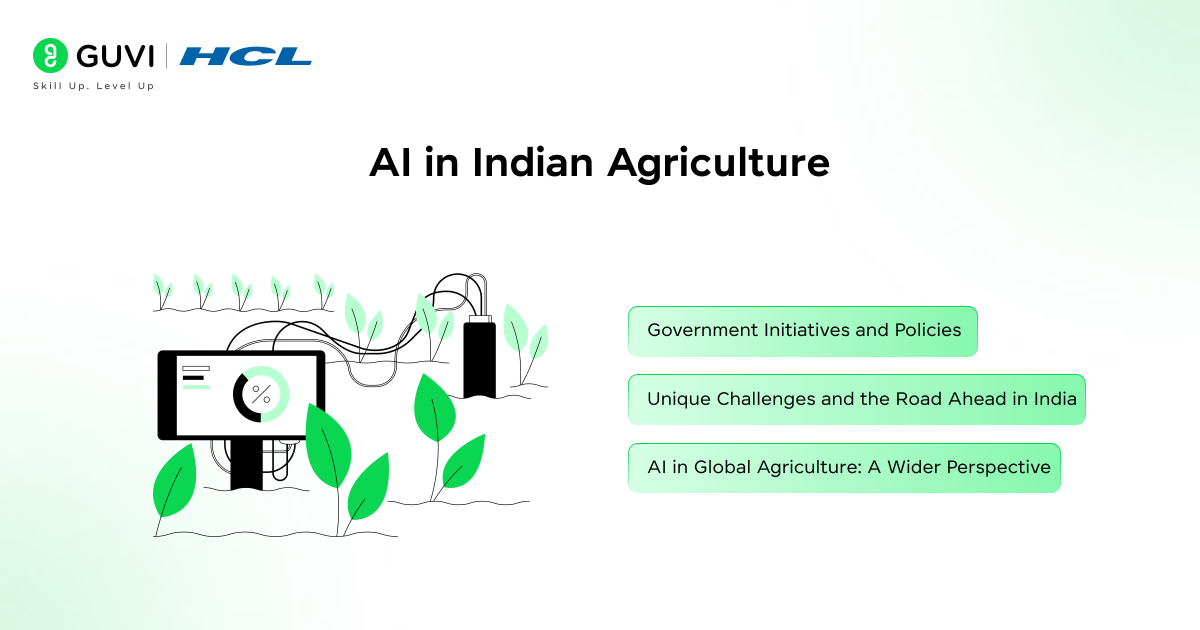
India has a special place in the story of AI in agriculture. As a nation where about 65% of the population is involved in agriculture, the potential impact of AI on livelihoods and food security is enormous. In recent years, India has actively embraced AI to modernize farming, and there are some noteworthy initiatives and successes worth highlighting.
Government Initiatives and Policies
The Indian government recognized the importance of AI in farming early on. In 2018, agriculture was identified as a priority in India’s national AI strategy. What followed was a series of initiatives to integrate technology into farming:
- Digital Agriculture Mission: India launched programs to promote “digital agriculture”, which includes AI, drones, and blockchain in farming. The government even allocated about $300 million for digital agriculture projects in recent budgets.
- National Pest Surveillance: The Ministry of Agriculture set up an AI-powered National Pest Surveillance System. This network uses machine learning to predict pest attacks by analyzing climate and pest data across regions.
- Kisan (Farmer) Bots and Apps: Kisan is the Hindi word for farmer, and India has developed AI-based chatbots and apps to assist kisans. One example is Kisan e-Mitra, a multilingual AI chatbot that helps farmers get information on government schemes, weather, farming techniques, and more.
Unique Challenges and the Road Ahead in India
While the promise of AI in Indian agriculture is high, it’s not without challenges – many of which are learning opportunities for other developing countries as well:
- Digital Literacy & Awareness: A large number of Indian farmers are not yet familiar with advanced tech. Convincing an older-generation farmer to trust an app or sensor can be hard. Bridging this gap requires on-ground training, village meetings demonstrating the tools, and often the involvement of local farming cooperatives to vouch for the tech.
- Connectivity Issues: The good news is that India has seen a boom in rural connectivity – over a billion people have mobile phones, and data is cheap. However, some remote areas still have patchy internet. AI tools need to be built with offline-first or low-bandwidth operation in mind.
- Cost and Scale: Many AI solutions (drones, robots, IoT devices) can be expensive for a small farmer. This is where government subsidies or cooperative models help. The concept of FPOs (Farmer-Producer Organizations) is being promoted so that farmers pool resources to collectively invest in a technology they can share.
India’s journey showcases that while AI can revolutionize agriculture, it needs an ecosystem to take root. The encouraging sign is that all these pieces are coming together. As one expert put it, India is becoming a testbed for agricultural innovation that can be exported to other developing nations.
AI in Global Agriculture: A Wider Perspective
Not only in India, across the globe, AI is redefining how agriculture operates, from large industrial farms in the US to vineyards in Europe and rice paddies in Southeast Asia. In countries like the United States and Brazil, AI-powered precision farming systems use drones, satellite imaging, and smart sensors to monitor soil health and optimize irrigation.
In Europe, companies such as John Deere and Carbon Robotics are rolling out autonomous tractors and AI-guided weeding robots that reduce herbicide use by up to 90%, helping farmers meet stricter sustainability goals.
In Africa, AI-driven mobile platforms are giving smallholder farmers access to real-time weather forecasts, pest alerts, and market prices, bridging the gap between traditional practices and modern technology.
Meanwhile, in Australia, AI tools are being applied to large-scale livestock monitoring, where computer vision tracks the health and movement of cattle across vast ranches. What ties these examples together is the shift from intuition-based farming to data-driven, predictive agriculture, enabling farmers worldwide to grow more food with fewer resources while addressing global challenges like climate change, labor shortages, and food security.
If you’re serious about mastering artificial intelligence and want to apply them in real-world scenarios, don’t miss the chance to enroll in HCL GUVI’s Intel & IITM Pravartak Certified Artificial Intelligence & Machine Learning course. Endorsed with Intel certification, this course adds a globally recognized credential to your resume, a powerful edge that sets you apart in the competitive AI job market.
Conclusion
In conclusion, AI in agriculture is here to stay, and it holds great promise for feeding the world’s growing population sustainably. As you’ve learned, it’s a field where satellites meet soil, where algorithms meet earthworms!
The next time you enjoy a meal, you might wonder: how much of the journey from seed to plate was guided by artificial intelligence? The answer might surprise you, and it’s only set to increase in the future.
FAQs
1. How is AI used in agriculture?
AI is used in agriculture for precision farming, crop monitoring, pest detection, smart irrigation, yield prediction, and supply chain optimization. Technologies like drones, sensors, and machine learning models help farmers make data-driven decisions to improve productivity and reduce waste.
2. What are the benefits of AI in agriculture?
The main benefits include:
– Higher crop yields with accurate predictions
– Reduced water and fertilizer usage
– Early detection of pests and diseases
– Lower costs and improved efficiency
– Better market access through demand forecasting
3. What are examples of AI in Indian agriculture?
In India, startups like Cropin, Fasal, and DeHaat use AI for farm monitoring, irrigation management, and connecting farmers with buyers. Government initiatives like Per Drop More Crop and AI-powered pest surveillance systems are also improving water use and protecting crops.
4. What are the challenges of using AI in agriculture?
Key challenges include high costs of technology, lack of digital literacy among farmers, limited rural connectivity, small fragmented landholdings, and concerns about data privacy. Overcoming these issues is crucial to ensure widespread adoption of AI.
5. What is the future of AI in agriculture?
The future points toward AI-driven smart farms, where autonomous machines, drones, and predictive analytics will make agriculture more sustainable and profitable.
How should I evaluate AI & ML certifications before enrolling?
Evaluate AI & ML certifications based on industry recognition, curriculum relevance, hands-on learning, project experience, and career outcomes. You can also compare what’s included in the HCL GUVI AI & ML Programme before making a decision.
Success Stories

About the Author
Lukesh S
A professional content writer who has experience in freelancing and now working as a Technical Content Writer at HCL GUVI having sound knowledge in Blog Writing and Creative Writing!
View all posts by Lukesh S
Connect with me @










Did you enjoy this article?