


Artificial Intelligence and Machine Learning Articles
AI/ML Skills Gap 2026: Why Companies Can't Find Job-Ready Talent
20 AI/ML Interview Questions Recruiters Can Use Without a Tech Background - Best Guide
How Industry-Backed AI/ML Bootcamps Are Changing the AI/ML Hiring Pipeline - Best Guide 2026
From IT Support to AI Engineer: A Realistic Career Switch Guide 2026


Get In Touch For Details! Request More Information

What is Stacking in Machine Learning? Everything You Can’t Miss Out On
Oct 27, 2025 7 Min Read 1931 Views
(Last Updated)
Machine learning algorithms have revolutionized the field of data analysis by enabling computers to learn from data and make accurate predictions.
One popular technique in machine learning is ensemble learning, which combines the predictions of multiple models to improve overall performance.
Stacking, also known as stacked ensembles or stacked generalization, is a powerful ensemble learning strategy that has gained significant attention in recent years. In this article, we will explore the concept of stacking in machine learning, its benefits, implementation, and best practices.
Table of contents
- What is Stacking in Machine Learning?
- Top Advantages of Stacking in Machine Learning
- 1) Improved Predictive Performance
- 2) Model Diversity
- 3) Flexibility
- 4) Interpretability
- Stacking Best Practices
- 1) Model Diversity
- 2) Data Leakage
- 3) Performance Evaluation
- 4) Meta-Model Selection
- 5) Tuning Hyperparameters
- 6) Ensemble Size
- 7) Consider Domain-Specific Aspects
- Implementing Stacking in Machine Learning: A Real-Life Example
- Step 1: Load the Dataset
- Step 2: Train the Base Models
- Step 3: Make Predictions on the Validation Set
- Step 4: Train the Meta-Model
- Step 5: Make Predictions on New Data
- Applications of Stacking in Real-World Machine Learning Projects
- Healthcare
- Finance
- E-commerce
- Cybersecurity
- Climate and Environmental Studies
- Difference Between Stacking, Bagging, and Boosting
- Future Scope of Stacking in Artificial Intelligence and Data Science
- Conclusion
- FAQs
- What is stacking method in machine learning?
- What is stacking and bagging?
- What is a stacked model?
- Why use stacking machine learning?
- What are the two types of bagging?
What is Stacking in Machine Learning?
Stacking is a machine learning strategy that combines the predictions of numerous base models, also known as first-level models or base learners, to obtain a final prediction.
The main idea behind stacking is to leverage the strengths of different models and combine their predictions to achieve better predictive performance than using a single model alone.
Stacking involves training multiple base models on the same training dataset and then feeding their predictions into a higher-level model, known as a meta-model or second-level model, to make the final prediction.
The process of stacking can be summarized into the following steps:
- Preparing the Data: The first step is to prepare the data for modeling by identifying relevant features, cleaning the data, and dividing it into training and validation sets.
- Model Selection: The next step is to select the base models that will be used in the stacking ensemble. It is important to choose a diverse set of models to ensure they produce different types of errors and complement each other.
- Training the Base Models: Once the base models are selected, they are trained on the training set using different algorithms or sets of hyperparameters to ensure diversity.
- Predictions on the Validation Set: After training the base models, they are used to make predictions on the validation set.
- Developing a Meta Model: The next stage is to develop a meta-model, which takes the predictions of the base models as input and makes the final prediction. Various algorithms such as linear regression, logistic regression, or neural networks can be used to create the meta-model.
- Training the Meta Model: The meta-model is trained using the predictions of the base models on the validation set. The predictions of the base models serve as features for the meta-model.
- Making Test Set Predictions: Finally, the meta-model is used to make predictions on the test set. The predictions of the base models on the test set are fed into the meta-model, which then makes the final prediction.
- Model Evaluation: The final step is to evaluate the performance of the stacking ensemble. This is done by comparing the predictions of the stacking ensemble to the actual values on the test set using evaluation measures such as accuracy, precision, recall, and F1 score.
The goal of stacking is to combine the strengths of various base models by feeding their predictions into a meta-model, which learns how to weigh and combine the predictions to generate the final prediction. This can often result in higher performance than using a single model alone.
Also Read: Supervised and Unsupervised Learning: Explained with detailed categorization.
Top Advantages of Stacking in Machine Learning
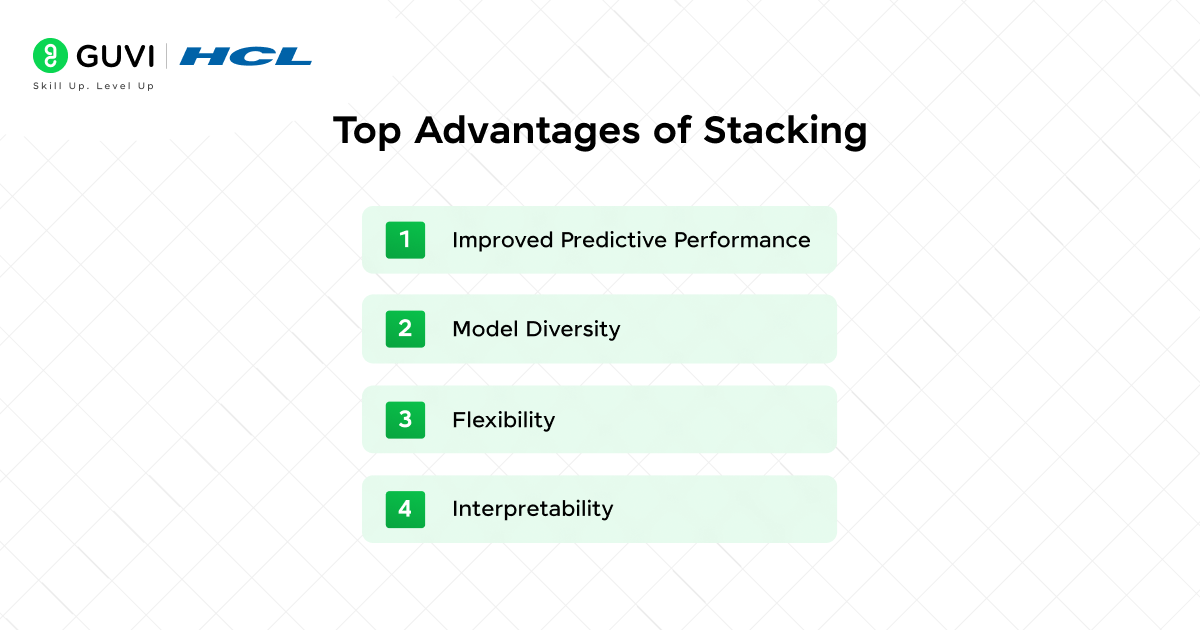
Stacking offers several advantages in machine learning:
1) Improved Predictive Performance
By combining the predictions of multiple base models, stacking can reduce bias and variance in the final prediction, resulting in improved predictive performance.
The meta-model learns from the capabilities of different base models and can capture intricate patterns that individual models may not be able to capture alone.
2) Model Diversity
Stacking encourages the use of diverse base models trained with different algorithms, architectures, and hyperparameter settings.
This diversity helps mitigate the risk of overfitting and makes the stacked ensemble more robust to different types of data.
3) Flexibility
Stacking is a versatile strategy that can be used to solve a variety of machine learning problems, including classification, regression, and time series forecasting.
It can be applied with different base models, such as decision trees, support vector machines, and neural networks.
4) Interpretability
Stacking can provide insights into the significance of different base models and their predictions for the final prediction.
By studying the weights or contributions of each base model in the meta-model, we can gain a better understanding of their relative importance and interpretability.
Stacking Best Practices
To make the most out of stacking in machine learning, it is important to follow some best practices. These practices include:
1) Model Diversity
The strength of stacking lies in the diversity of the base models. It is crucial to use a variety of base models that are likely to make different types of errors. This helps limit the risk of overfitting and improves the performance of the stacked ensemble.
Avoid using similar models or models with similar hyperparameter settings as base models, as this may not result in a significant gain in performance.
2) Data Leakage
Data leakage can occur when information from the validation or test set is used during the training of base models or meta-models. This can lead to over-optimistic performance estimates and poor generalization performance.
To prevent data leakage, ensure that the big data is properly divided into training, validation, and test sets, and that the training data is only used to train the base models and meta-models.
3) Performance Evaluation
It is important to evaluate the performance of the stacking ensemble using appropriate evaluation measures.
Cross-validation or hold-out validation techniques can be used to obtain reliable estimates of the stacked ensemble’s performance.
Comparing the performance of the stacked ensemble to that of the individual base models helps assess whether the stacking ensemble is truly improving predictive performance.
4) Meta-Model Selection
Experiment with different meta-models to determine which one works best for your problem. The choice of the meta-model can have a significant impact on the performance of the stacked ensemble.
Commonly used meta-models include logistic regression, decision trees, and more complex models like neural networks or gradient boosting machines.
Consider the interpretability, complexity, and generalization performance of the meta-model when making a decision.
5) Tuning Hyperparameters
Optimize hyperparameters for both base and meta-models. Hyperparameter tuning can greatly influence the performance of the stacked ensemble.
Experiment with different hyperparameter settings for both the base models and the meta-models to find the best combination for maximizing prediction performance.
6) Ensemble Size
Using too many base models in the stacked ensemble can lead to overfitting and increased computing complexity.
Experiment with different ensemble sizes to determine the appropriate number of base models for optimal performance without sacrificing model interpretability or computational efficiency.
7) Consider Domain-Specific Aspects
Keep domain-specific aspects in mind when using stacking. Different domains may have unique characteristics that can influence the performance of the stacked ensemble.
For example, in image recognition tasks, using base models that capture different types of characteristics (e.g., color, texture, shape) can lead to improved performance.
By following these best practices, you can harness the power of stacking to build more accurate and robust predictive models in machine learning.
Also Read: Supervised and Unsupervised Learning: Explained with detailed categorization.
Implementing Stacking in Machine Learning: A Real-Life Example
To illustrate how stacking can be implemented in machine learning, let’s consider a real-life example of house price prediction. The goal is to predict the median value of owner-occupied homes based on various features such as size, location, number of bedrooms, and bathrooms.
Interesting right? This is just a small gist of what our experts will help you master in our Data Science Course with IIT Certification in Advanced Programming course, so go check it out now!
Step 1: Load the Dataset
We start by loading a dataset that contains information about numerous residences in a specific area, including the target variable (median value of owner-occupied homes) and several features.
# Step 1: Load the Dataset
import pandas as pd
from sklearn.datasets import load_boston
from sklearn.model_selection import train_test_split

# Load the Boston Housing dataset
boston = load_boston()
data = pd.DataFrame(boston.data, columns=boston.feature_names)
data['target'] = boston.target

# Split the data into features and target variable
X = data.drop('target', axis=1)
y = data['target']

# Split the data into training and validation sets
X_train, X_valid, y_train, y_valid = train_test_split(X, y, test_size=0.2, random_state=42)
Step 2: Train the Base Models
Next, we train three different base models: Decision Tree, Random Forest, and Gradient Boosting. These models are chosen to ensure diversity in terms of algorithms and learning strategies.
# Step 2: Train the Base Models
from sklearn.tree import DecisionTreeRegressor
from sklearn.ensemble import RandomForestRegressor, GradientBoostingRegressor

# Initialize base models
base_model_1 = DecisionTreeRegressor(random_state=42)
base_model_2 = RandomForestRegressor(random_state=42)
base_model_3 = GradientBoostingRegressor(random_state=42)

# Train base models
base_model_1.fit(X_train, y_train)
base_model_2.fit(X_train, y_train)
base_model_3.fit(X_train, y_train)
Step 3: Make Predictions on the Validation Set
We use the trained base models to make predictions on the validation set.
# Step 3: Make Predictions on the Validation Set
pred_1 = base_model_1.predict(X_valid)
pred_2 = base_model_2.predict(X_valid)
pred_3 = base_model_3.predict(X_valid)
Step 4: Train the Meta-Model
We combine the predictions of the base models into a single feature matrix and train a meta-model on the combined features and the target values.
# Step 4: Train the Meta-Model
from sklearn.linear_model import LinearRegression

# Create a new feature matrix with predictions from base models
meta_features = pd.DataFrame({'DecisionTree': pred_1, 'RandomForest': pred_2, 'GradientBoosting': pred_3})

# Initialize the meta-model (linear regression in this case)
meta_model = LinearRegression()

# Train the meta-model
meta_model.fit(meta_features, y_valid)
Step 5: Make Predictions on New Data
Finally, we can use the base models and the meta-model to make predictions on new data.
# Step 5: Make Predictions on New Data
# Now, let's use the trained base models and meta-model to make predictions on new data

# Assume 'new_data' is the new set of features for prediction
new_data = pd.DataFrame(...)  # Include the new data for prediction

# Make predictions using base models
new_pred_1 = base_model_1.predict(new_data)
new_pred_2 = base_model_2.predict(new_data)
new_pred_3 = base_model_3.predict(new_data)

# Create a new feature matrix for the meta-model
new_meta_features = pd.DataFrame({'DecisionTree': new_pred_1, 'RandomForest': new_pred_2, 'GradientBoosting': new_pred_3})

# Make predictions using the meta-model
final_predictions = meta_model.predict(new_meta_features)

# 'final_predictions' now contains the stacked predictions for the new data
In this example, we trained three base models (Decision Tree, Random Forest, and Gradient Boosting) and used a linear regression meta-model to aggregate their predictions.
The trained models and meta-model were then used to make predictions on additional, previously unseen data. By combining the strengths of different algorithms, stacking can help improve the accuracy of machine learning models.
Understanding Stacking in Machine Learning? shows just how powerful advanced ML techniques can be and with our AI & ML Course, you don’t just read about them, you apply them. Learn end-to-end AI, deep learning, and ML concepts with Python, build real-world projects, and gain expertise in frameworks like TensorFlow and PyTorch. With mentorship, global certification, lifetime access, and placement support, this program transforms your ML curiosity into a high-demand career. Enroll now and take your machine learning skills to the next level!
Applications of Stacking in Real-World Machine Learning Projects
Stacking in machine learning is not restricted to academic experiments and data analysis. It plays a role in industries where reliable predictions influence critical decisions:
1. Healthcare
Stacked ensembles support medical imaging analysis and patient monitoring. Models focusing on different aspects of diagnostic data, such as MRI scans and lab results, are combined to reduce diagnostic errors. Hospitals also apply stacking to predict treatment responses, which helps allocate resources more effectively.
2. Finance
Financial institutions use stacking to strengthen credit scoring models. One model may capture long-term repayment history while another captures short-term spending behavior. Combined through a meta-model, the system provides more balanced credit risk evaluations. Fraud detection also improves because stacked systems identify rare anomalies and frequent transaction irregularities in parallel.
3. E-commerce
Stacking enhances product recommendation engines. A collaborative filtering model captures user-to-user similarities and a content-based model tracks product attributes. By combining them, e-commerce platforms deliver recommendations that reflect both customer behavior and product features. Marketing teams also benefit because stacked ensembles help segment customers with more precision, which supports targeted campaigns.
4. Cybersecurity
Stacked ensembles are being used to detect cyber threats more accurately. One model analyzes network traffic patterns, and another identifies irregular login behavior. A meta-model combines its outputs to detect intrusions with higher precision, which reduces false alerts that burden security teams.
5. Climate and Environmental Studies
Researchers apply stacking to climate forecasting and pollution prediction. Models focusing on temperature and wind patterns are blended with models trained on historical pollution data. This combination improves predictions of extreme weather events and air quality levels, which helps governments and organizations prepare better policies.
Difference Between Stacking, Bagging, and Boosting
Ensemble methods often look similar at first glance. Their key differences become clear in how they address prediction errors:
| Technique | Primary Goal | How It Works | Example Use Case |
| Bagging | Reduce variance | Builds several models in parallel and averages predictions | Random Forest for image classification |
| Boosting | Reduce bias | Trains models in sequence where each one improves upon errors made earlier | XGBoost for tabular datasets |
| Stacking | Improve predictive performance | Combines diverse base models through a meta-model that learns how to best weigh predictions | Blended algorithms in Kaggle competitions |
This breakdown shows that bagging and boosting focus on error reduction in different ways. Stacking adds another layer because it learns how to integrate multiple models. It usually produces results that surpass both bagging and boosting in tasks requiring adaptability.
Future Scope of Stacking in Artificial Intelligence and Data Science
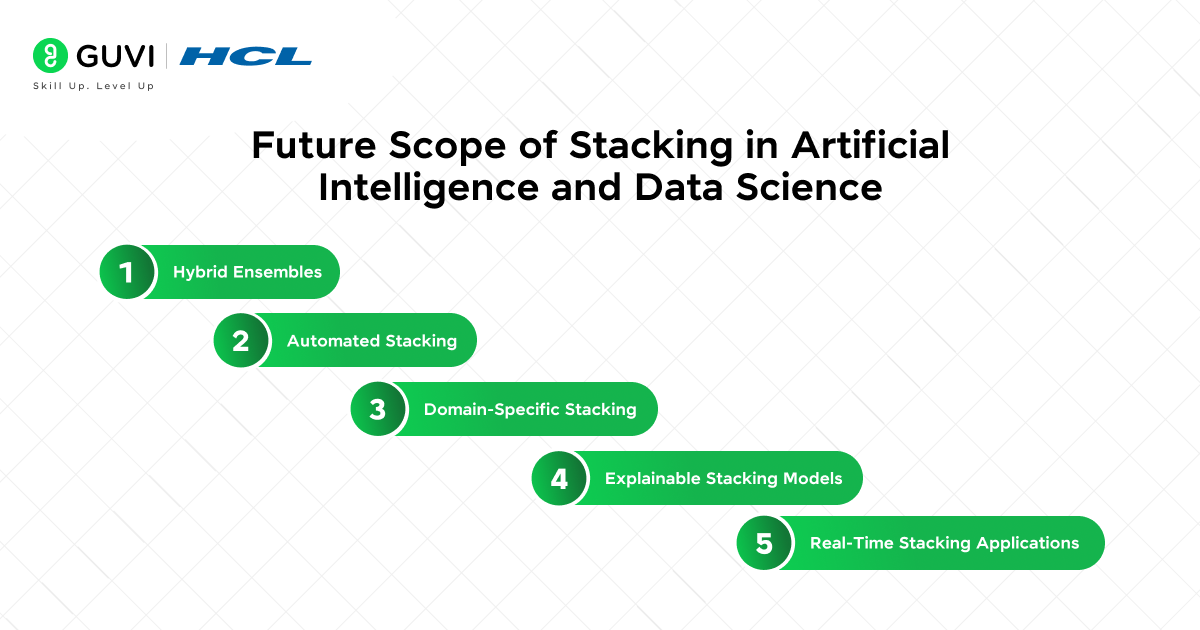
The potential of stacking in machine learning is expanding with advances in machine learning research and enterprise applications. Here are the most promising directions:
- Hybrid Ensembles: Researchers are building stacked systems that integrate convolutional neural networks with gradient boosting models. These hybrids improve performance in areas such as medical image analysis and sentiment classification.
- Automated Stacking: AutoML tools are increasingly capable of constructing stacked ensembles without heavy manual input. They test diverse base learners, generate out-of-fold predictions, and select meta-models. This reduces human error and accelerates adoption in business environments.
- Domain-Specific Stacking: Industries are beginning to design custom stacking frameworks. In supply chain forecasting, separate models capture seasonality, logistics constraints, and external market signals before being combined. The result is more accurate forecasting of inventory needs and delivery schedules.
- Explainable Stacking Models: Research is moving toward meta-models that not only combine predictions but also show why certain base models receive more weight. This helps professionals in regulated industries such as healthcare and finance meet compliance requirements while keeping trust in AI decisions.
- Real-Time Stacking Applications: With the rise of streaming data, stacking is being adapted for scenarios where predictions must be updated instantly. Online learning techniques are integrated with stacked ensembles to support fraud detection in payment systems and real-time demand forecasting in retail.
Conclusion
We’ve all heard about the leaps in tech due to machine learning and stacking is a powerful ensemble learning strategy in machine learning that combines the predictions of multiple base models to improve overall predictive performance.
By leveraging the strengths of different models and learning how to weigh and combine their predictions, stacking can reduce bias and variance, increase model diversity, and enhance interpretability.
To implement stacking effectively, it is important to follow best practices such as selecting diverse base models, avoiding data leakage, evaluating performance accurately, tuning hyperparameters, and considering domain-specific aspects.
By following these practices, you can harness the full potential of stacking and build more accurate and robust predictive models.
Remember, stacking is just one of many ensemble learning strategies available in machine learning. If you want to explore more, check out our other articles on ensemble learning techniques such as bagging and boosting.
FAQs
What is stacking method in machine learning?
The stacking method in machine learning involves combining multiple models to improve predictive performance.
What is stacking and bagging?
Stacking and bagging are ensemble learning techniques. Stacking combines predictions from multiple models, while bagging averages predictions from diverse models.
What is a stacked model?
A stacked model is created by combining the predictions of multiple individual models, enhancing overall predictive accuracy.
Why use stacking machine learning?
Stacking is employed to boost model performance by leveraging the strengths of diverse algorithms, leading to more accurate predictions.
What are the two types of bagging?
The two types of bagging are Bootstrap Aggregating (Bagging) and Random Subspace Method. Bagging involves training models on different subsets of the dataset, while the Random Subspace Method trains models on different subsets of features.
Success Stories

About the Author
Jaishree Tomar
A recent CS Graduate with a quirk for writing and coding, a Data Science and Machine Learning enthusiast trying to pave my own way with tech. I have worked as a freelancer with a UK-based Digital Marketing firm writing various tech blogs, articles, and code snippets. Now, working as a Technical Writer at GUVI writing to my heart’s content!
View all posts by Jaishree Tomar
Connect with me @













Did you enjoy this article?