


VLSI Design Articles
Why Chips Fail: A Basic Guide to Chip Defects and IC Failure Analysis
Fun Facts About the Semiconductor Industry
Why Are Semiconductor Chips Expensive? Manufacturing Cost Explained
Instruction Set Architecture: How ISA Shapes Modern Chip Design


Get In Touch For Details! Request More Information
Semiconductors Explained: A Complete Guide to Modern Technology(2026)
May 22, 2026 3 Min Read 1072 Views
(Last Updated)
Table of contents
- Introduction
- What Is a Semiconductor?
- How Semiconductors Work: The Science Behind It?
- Components Built Using Semiconductors
- A Brief History of Semiconductors
- Supercomputers: The Ultimate Showcase of Semiconductor Power
- The Future of Semiconductors
- 1. Smaller and Denser Chips
- 2. New Materials
- 3D Chip Stacking & Chiplets
- 4. AI & Edge Computing
- Quantum Semiconductors
- Challenges in the Semiconductor Industry
- Conclusion
- Fundamentals of Semiconductors
- Resources on Semiconductors
- FAQ'S
- What is a semiconductor?
- Why is silicon widely used in semiconductors?
- What is doping in semiconductors?
- What is a PN junction?
- What are the main components made from semiconductors?
- How do semiconductors power modern devices?
- What is Moore’s Law?
- What is the role of semiconductors in AI and edge computing?
Introduction
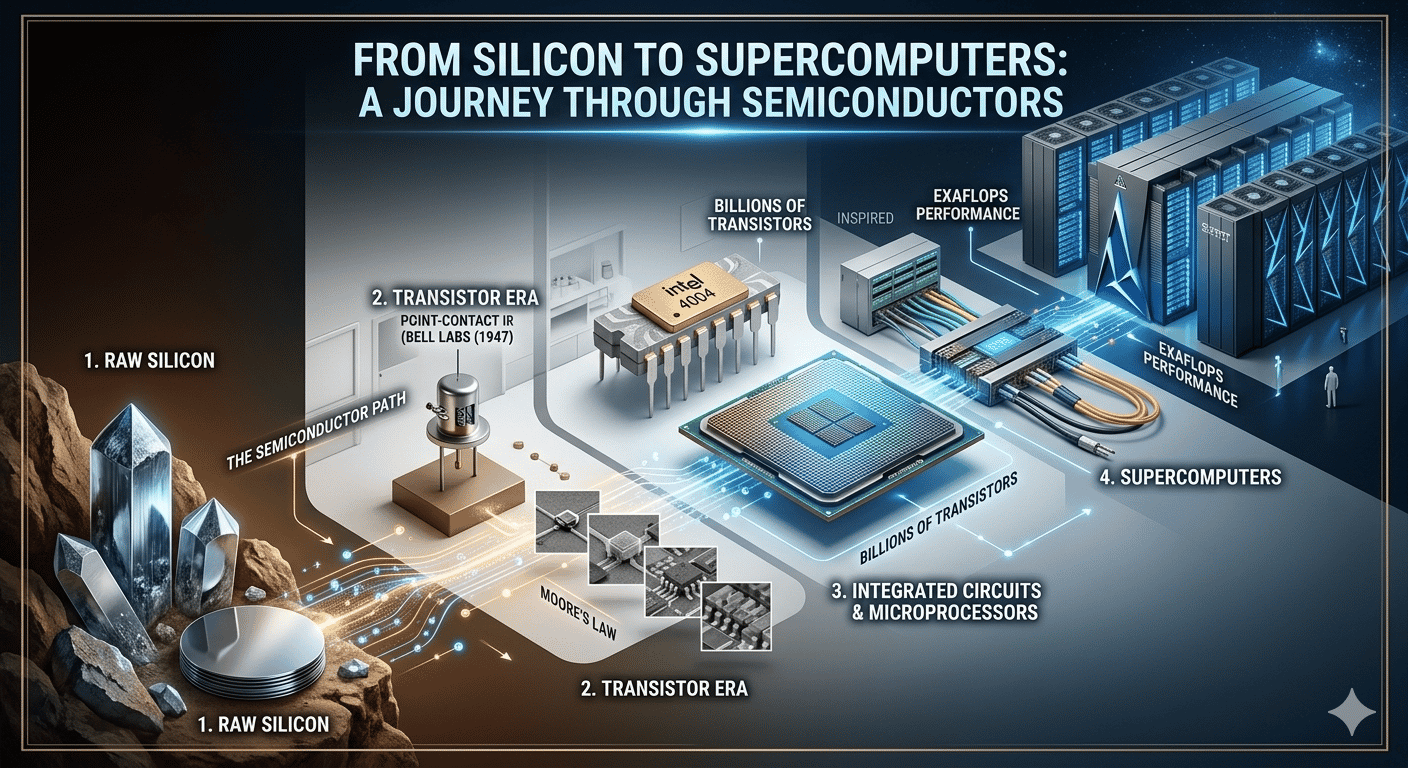
Semiconductors are the invisible force behind smartphones, artificial intelligence, electric vehicles, and cloud computing. Often called the “brains” of modern electronics, these tiny chips drive innovation, economic growth, and technological advancement worldwide. But how did a simple material like silicon evolve into the backbone of supercomputers and intelligent systems?
In today’s rapidly advancing digital era, these components sit at the core of every major breakthrough. From powering everyday devices to enabling complex AI computations, their role continues to expand.
What Is a Semiconductor?
A semiconductor is a material whose electrical conductivity lies between that of a conductor (like copper) and an insulator (like rubber). This unique property allows it to control the flow of electric current, making it a perfect candidate for building electronic components.
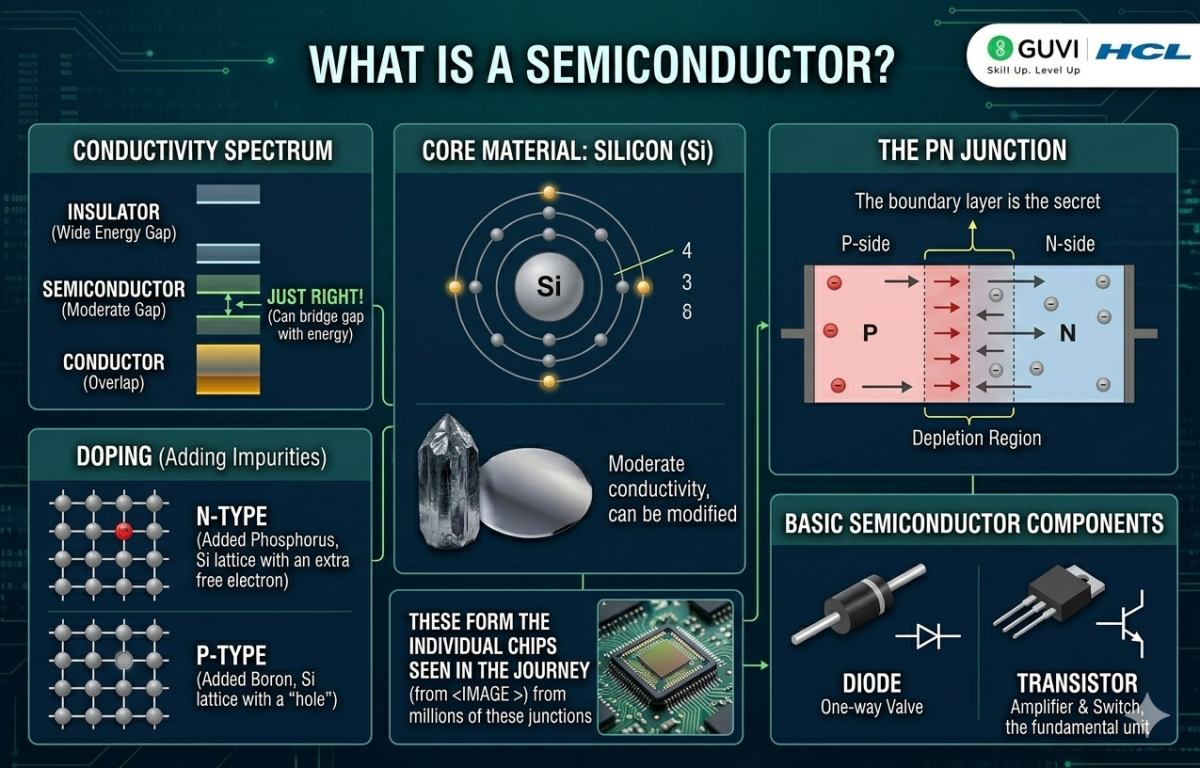
The most common semiconductor material is silicon (Si) due to its:
- Natural abundance in Earth’s crust
- Stable crystalline structure
- Ability to form a reliable oxide layer for transistor gates
How Semiconductors Work: The Science Behind It?
- N-type (Negative): Doped with elements like phosphorus or arsenic that add extra electrons.
- P-type (Positive): Doped with elements like boron or gallium that create “holes” — spaces for electrons to move into.
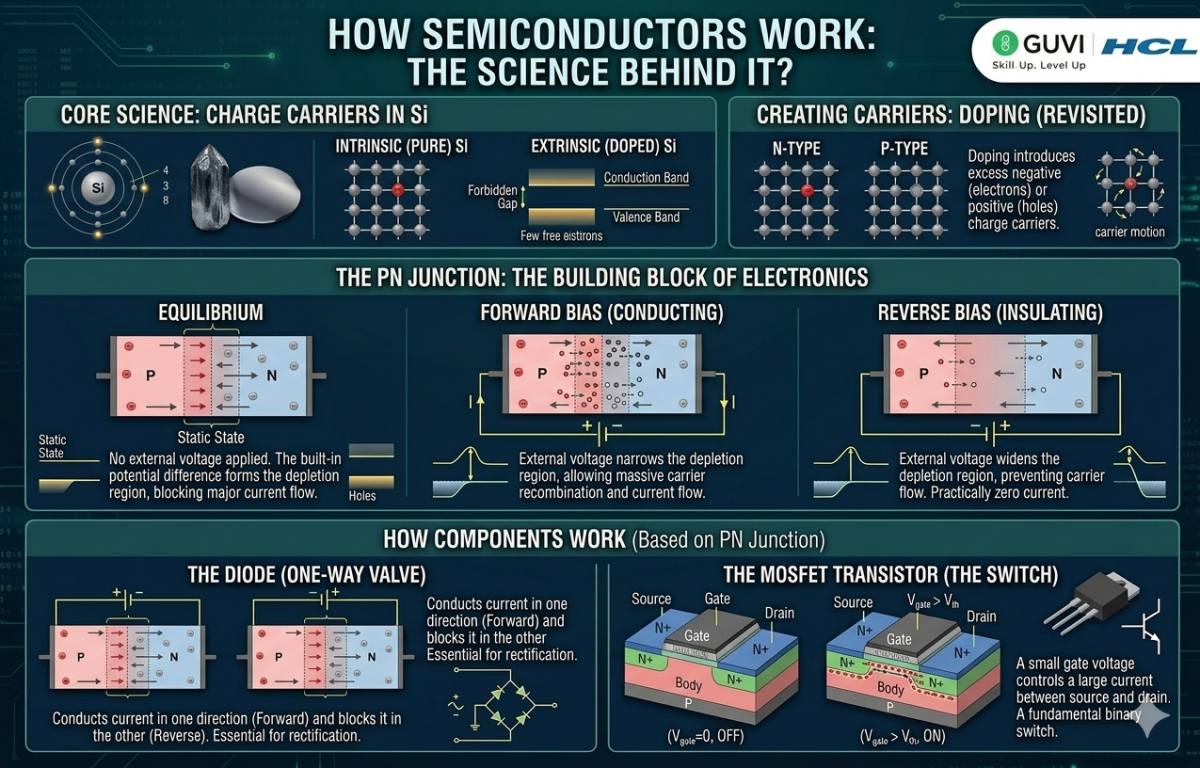
When these two types of materials are joined, they form a PN junction, a critical component in diodes, transistors, and logic gates. By controlling how current flows through these junctions, we can build logic circuits, memory, and switching systems — the foundation of all computing.
Components Built Using Semiconductors
Semiconductors are the base materials for:
Semiconductors are used to build:
- Transistors – switching & amplification
- Diodes – one-way current flow
- Integrated Circuits (ICs) – compact circuits
- Microprocessors & Microcontrollers – computing brain
- Memory Chips (RAM, ROM, Flash) – data storage
A Brief History of Semiconductors
| Year | Milestone |
| 1947 | First transistor invented at Bell Labs |
| 1958 | First integrated circuit created by Jack Kilby (TI) |
| 1971 | Intel 4004: World’s first commercial microprocessor |
| 1980s | Semiconductor fabrication entered sub-micron era |
| 2000s | Rise of system-on-chip (SoC) for mobile computing |
| 2020+ | Entry into 3nm and 2nm technology, quantum experimentation |
Each generation of semiconductor evolution has shrunk chip size, improved efficiency, and dramatically increased processing power — all guided by Moore’s Law.
Semiconductors in Everyday Life
Semiconductors are in everything around you:
| Sector | Application |
| Consumer Tech | Smartphones, tablets, TVs, smartwatches |
| Automotive | EVs, ADAS (Advanced Driver Assistance Systems), infotainment |
| Healthcare | Wearable monitors, MRI/CT scan devices, diagnostic equipment |
| Industrial | Smart manufacturing, automation, predictive maintenance |
| Defense & Space | Secure communication, missile systems, satellite electronics |
| Energy | Solar panels, smart grids, battery management |
Supercomputers: The Ultimate Showcase of Semiconductor Power
Supercomputers like Frontier (USA) and Fugaku (Japan) use millions of semiconductor-based cores that work in parallel to deliver petaflops (quadrillions of calculations per second) of performance.
These machines are used in:
- Climate change simulations
- Drug discovery and genomics
- Nuclear research
- Artificial Intelligence training
- Space mission planning
Each supercomputer chip is a marvel of semiconductor engineering — built with extreme precision in nanometer-scale factories called fabs.
The Future of Semiconductors
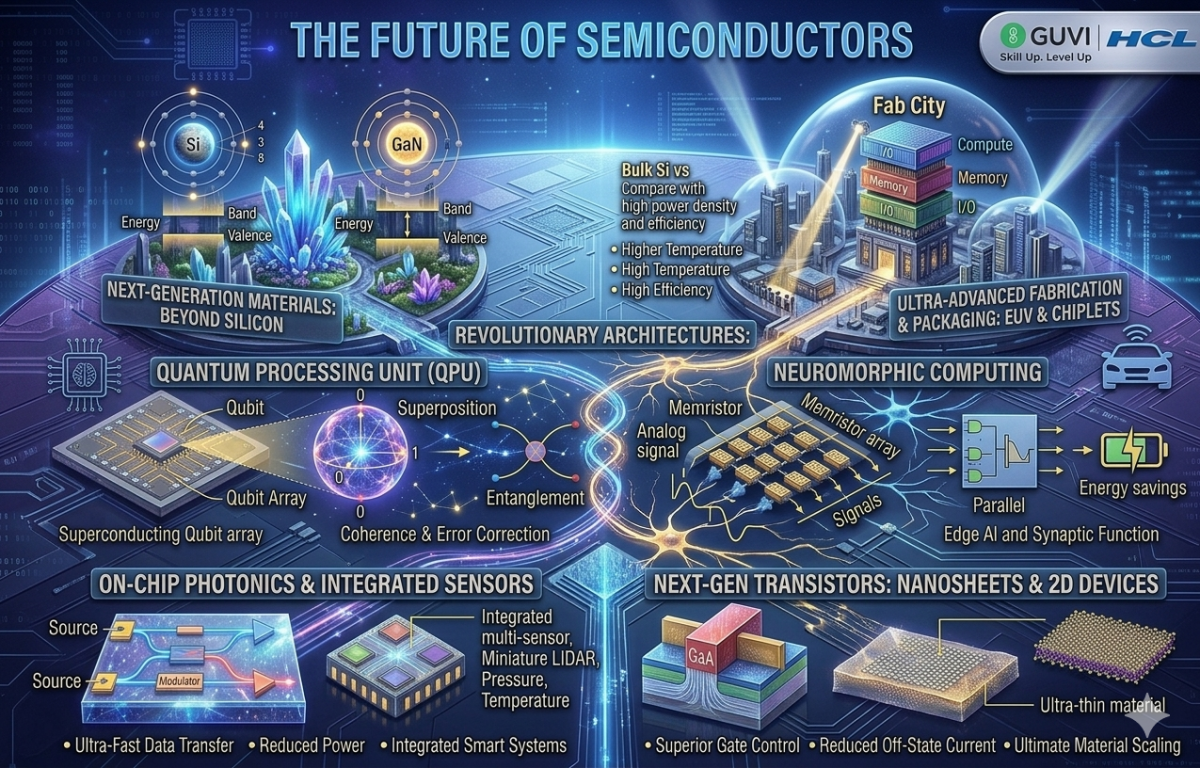
The world is entering a new era of computing and connectivity, and semiconductors are evolving rapidly to meet future demands:
1. Smaller and Denser Chips
- 3nm and 2nm technologies allow packing even more transistors in smaller areas
- Improved energy efficiency and performance per watt
2. New Materials
- Gallium Nitride (GaN) and Silicon Carbide (SiC) for power electronics
- Graphene and carbon nanotubes for high-speed data transmission
3. 3D Chip Stacking & Chiplets
- Vertical integration to reduce footprint and improve performance
- Modular chiplet architecture for customizable system design
4. AI & Edge Computing
- Specialized AI accelerators (e.g., Google TPU, NVIDIA A100)
- Real-time inference at the edge for smart devices

5. Quantum Semiconductors
- Use quantum bits (qubits) for revolutionary computing capabilities
- Still in early research, but shows massive future potential
Challenges in the Semiconductor Industry
While semiconductors are thriving, the industry faces several key challenges:
- Supply Chain Disruptions (as seen during COVID-19 and geopolitical tensions)
- High Fabrication Costs (a single fab costs $10–20 billion+)
- Global Dependency on few countries for chip manufacturing (e.g., Taiwan)
- Talent Shortage in advanced semiconductor R&D and fabrication
Nations are investing heavily in local chip manufacturing to reduce dependency and ensure technological sovereignty.
Conclusion
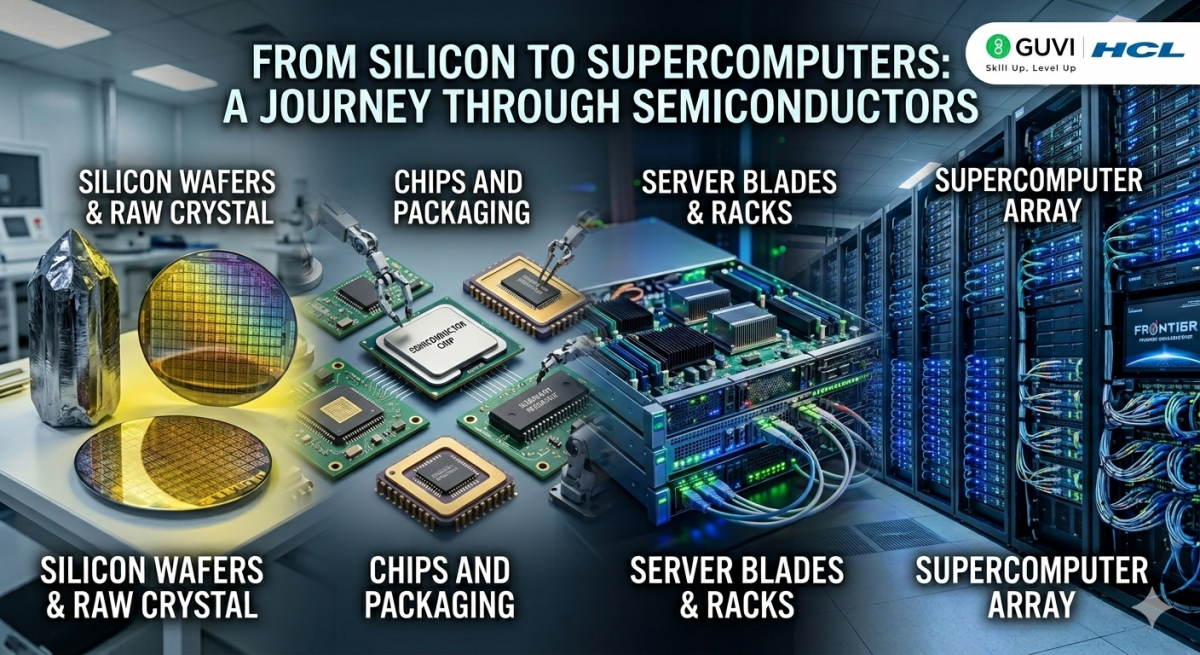
From a simple silicon wafer to powering world-changing supercomputers, the journey of semiconductors is one of scientific brilliance, engineering precision, and relentless innovation. They have transformed the way we live, work, and connect — and will continue to define the digital future of humanity.
As industries move toward AI, 5G, electric vehicles, quantum computing, and space exploration, semiconductors remain at the core of it all — quite literally, the beating heart of modern technology.
Fundamentals of Semiconductors
Learn the core concepts of semiconductor materials, energy bands, charge carriers, and semiconductor devices. This course helps beginners build a strong foundation in electronics and understand real-world applications of semiconductors.
Resources on Semiconductors
Learn more about semiconductors from trusted sources:
FAQ’S
What is a semiconductor?
A semiconductor is a material with electrical conductivity between a conductor and an insulator. It can control the flow of current, making it essential for electronic devices like computers, smartphones, and sensors.
Why is silicon widely used in semiconductors?
Silicon is commonly used because it is abundant, has a stable crystal structure, and forms a reliable oxide layer, which is crucial for building efficient and durable electronic components.
What is doping in semiconductors?
Doping is the process of adding impurities to pure silicon to modify its electrical properties. It creates:
N-type (extra electrons)
P-type (electron holes)
This enables controlled current flow in devices.
What is a PN junction?
A PN junction is formed by joining P-type and N-type materials. It is the fundamental building block of electronic components like diodes, transistors, and integrated circuits.
What are the main components made from semiconductors?
Key components include:
Transistors
Diodes
Integrated Circuits (ICs)
Microprocessors
Memory Chips (RAM, ROM, Flash)
How do semiconductors power modern devices?
Semiconductors act as switches and amplifiers in circuits, enabling computation, data storage, and communication in devices like smartphones, laptops, and smart appliances.
What is Moore’s Law?
Moore’s Law states that the number of transistors on a chip doubles approximately every two years, leading to increased performance and reduced costs over time.
What is the role of semiconductors in AI and edge computing?
What is the role of semiconductors in AI and edge computing?
Semiconductors enable AI processing through specialized chips that handle large data efficiently, while edge computing allows real-time processing closer to the device.
Success Stories

About the Author
Lavish Jain
A Professional Developer Mentor and Corporate Trainer with over 10 years of experience, I have contributed to technological advancements through comprehensive training and mentorship. My journey includes pivotal roles at Cluebix, Focus-4D,ThoughtWorks, and currently with Guvi -HCL Group, where I shape the careers of aspiring developers. I specialize in simplifying complex concepts, making them accessible to learners at all levels, and have successfully trained lakhs of budding developer through corporate and boot camp courses focused on full-stack development.
View all posts by Lavish Jain
Connect with me @











Did you enjoy this article?