


Electric Vehicle Articles
What is Vehicle-to-Grid Technology : How EVs Can Power the Grid
What is a Battery Management System? BMS Working, Uses & EV Role
EV Infrastructure in India: Best Components, Charging Network, Challenges & Future (2026 Guide)
Basics of Electric Vehicle Simulations Using ANSYS (2026 Guide)


Get In Touch For Details! Request More Information
EV Battery Manufacturing Process Explained
May 07, 2026 3 Min Read 1333 Views
(Last Updated)
The EV battery is quietly revolutionising one of the largest changes happening in the world of how we move, and yet, for the vast majority, no one ever really gets to see just what goes into making something like this happen.
The real journey happens inside factories where precision, timing, and innovation come together to build something powerful from the ground up. It’s a process that turns simple materials into the core of modern mobility.
Quick Answer:
EV batteries are manufactured through a straightforward sequence. It begins with raw materials like lithium. From there, individual cells are built. Those cells are grouped into modules, then assembled into packs. The final step involves quality and safety checks before the battery is ready for use in electric vehicles.
Table of contents
- EV Battery: Brief Explanation
- Types of EV Batteries
- Raw Materials Used in EV Batteries
- EV Battery Manufacturing Process (Step-by-Step)
- Step 1: Raw Material Extraction
- Step 2: Material Processing
- Step 3: Electrode Preparation
- Step 4: Cell Assembly
- Step 5: Electrolyte Filling
- Step 6: Cell Sealing
- Step 7: Formation and Ageing
- Step 8: Module Assembly
- Step 9: Battery Assembly
- Step 10: Testing and Quality Check
- Future of EV Battery Manufacturing
- Conclusion
- FAQs
- Which type of EV battery is most widely used and why?
- What factors affect the lifespan of an EV battery?
- How do manufacturers improve EV battery performance?
EV Battery: Brief Explanation
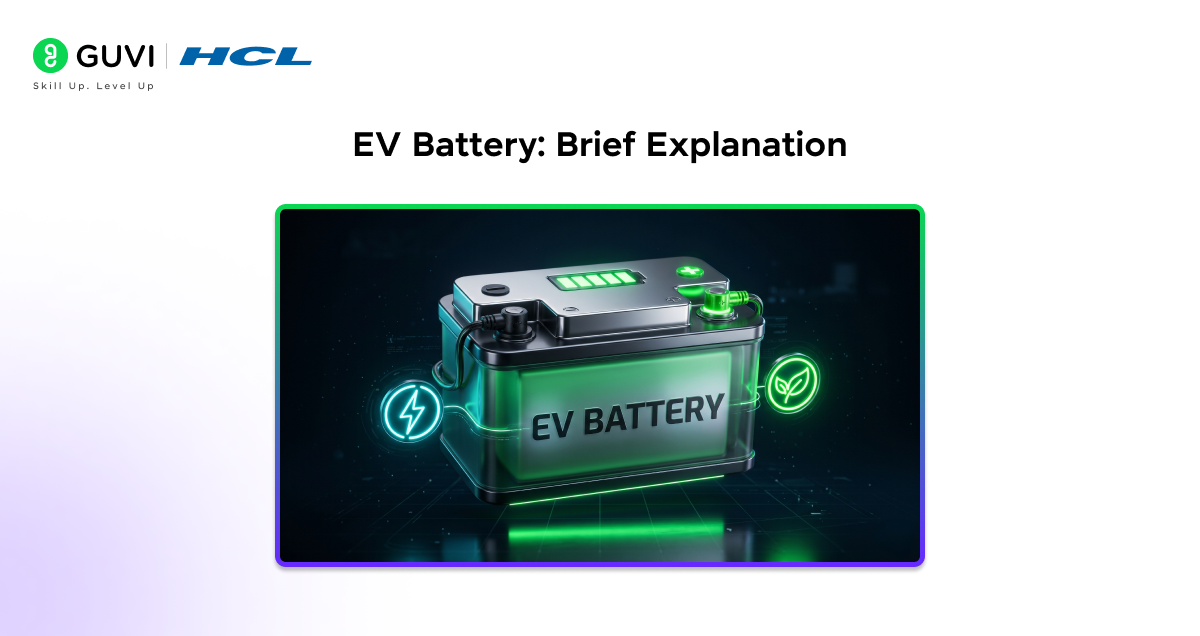
An EV battery is considered the main power source for an Electric Vehicle. It stores electricity and uses it to power the vehicle. An EV battery can be considered a tank, but instead of petrol or diesel, it stores electrical energy to power the vehicle smoothly.
Types of EV Batteries
Here are the most common types of electric vehicle (EV) batteries:
- Lithium-Ion Battery
- Lithium Iron Phosphate (LFP) Battery
- Nickel-Metal Hydride Battery
- Lead-Acid Battery
- Solid-State Battery
Also Read: 6 Important Applications of Battery Technology in EVs
Raw Materials Used in EV Batteries
| Category | Materials | Description |
| Cathode Materials | Lithium, Nickel, Cobalt, Manganese, Iron Phosphate | Store and release energy during battery operation |
| Anode Materials | Graphite, Silicon | Hold and release electrons during charging and discharging |
| Electrolyte Materials | Lithium Salts, Organic Solvents | Enable the movement of ions inside the battery |
| Separator Materials | Polyethylene, Polypropylene | Prevent short circuits by keeping electrodes apart |
| Current Collectors | Aluminum, Copper | Carry electrical current within the battery |
| Supporting Materials | Binders, Conductive Additives | Improve battery stability and performance |
Global EV (lithium-ion) battery demand reached around 550 GWh in 2022, underscoring how quickly Electric Vehicle adoption is accelerating.
EV Battery Manufacturing Process (Step-by-Step)
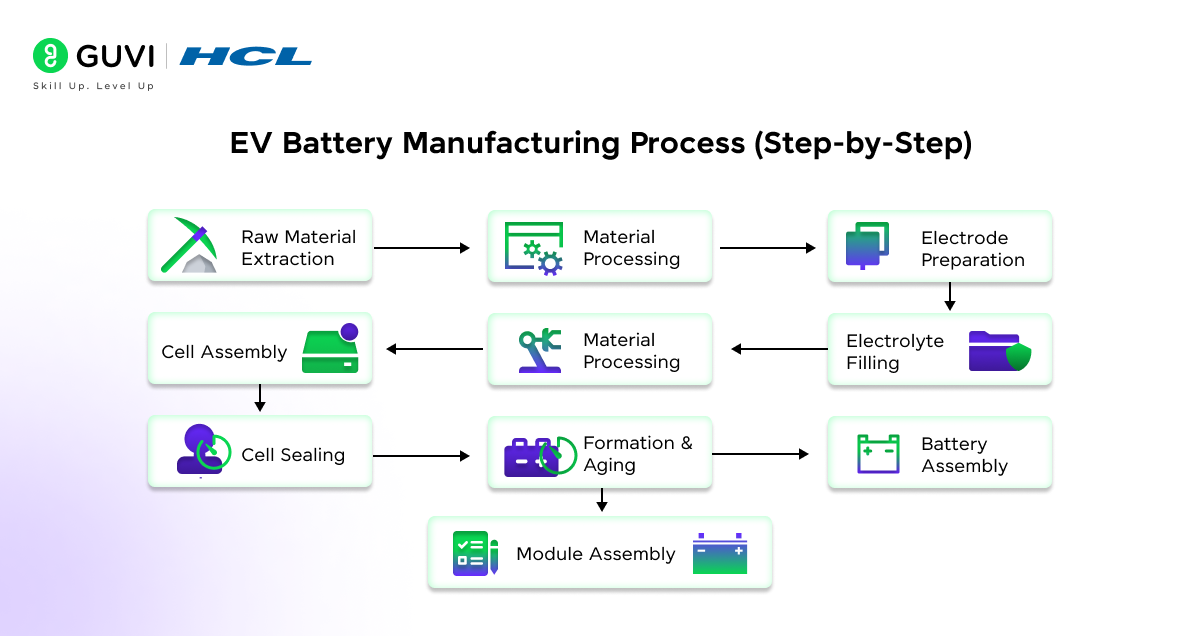
The following are the steps involved in EV battery manufacturing:
Step 1: Raw Material Extraction
This step is all about collecting the basic materials required to make the battery. Metals such as lithium, nickel, and cobalt are obtained from the earth through mining. The materials are obtained deep underground, and this is a crucial process because they form the foundation of the entire EV battery.
Step 2: Material Processing
Once the materials are obtained, the next step is to refine and clean them, making them ready for use. The materials are converted to a pure form to ensure they can work effectively in the battery. The process also eliminates any unwanted materials, ensuring they are ready for use.
Step 3: Electrode Preparation
In this step, the battery’s important parts, the electrodes, are prepared. This is done by coating the materials on thin metal sheets to create the cathode and the anode. After this, they are dried and then shaped into the required shapes. These electrodes are important because they store and release energy during use.
Step 4: Cell Assembly
In this step, the electrodes and the separator are combined to create a battery cell. This is done by arranging the materials in a certain order and then packing them tightly together. This process is very important and requires a high level of accuracy to avoid mistakes. This component is the basic part of the battery that stores energy.
Step 5: Electrolyte Filling
The electrolyte is a special liquid that facilitates the flow of energy in the battery. This liquid is inserted into the cell so that ions can move between the electrodes. This movement enables the battery to charge and discharge. Without this process, the battery would not be able to perform its functions.
Step 6: Cell Sealing
Once this electrolyte has been added, the cell is sealed tightly, locking everything inside. This ensures there is no leakage, thus protecting everything inside. It is a crucial step, especially for ensuring the battery’s long-term performance.
Step 7: Formation and Ageing
In this step, the battery will be charged and discharged for the first time. This will ensure the battery’s performance stabilises, thereby enhancing efficiency. After this, the cells will be left for some time, during which their behaviour will be observed. This will ensure that only stable cells proceed further.

Step 8: Module Assembly
Several cells will be combined into a single module. These cells will be arranged in a proper structure, ensuring increased power and capacity. The cells will be arranged safely and efficiently. In this step, a large energy source will be built from several cells.
Step 9: Battery Assembly
Modules are used to construct the complete battery. All the components are connected to function as a single unit. This is done to ensure the battery’s safety, longevity, and performance. This is the final battery used in Electric Vehicles (EVs).
Step 10: Testing and Quality Check
Finally, the battery is tested to ensure it is safe and works perfectly. The battery is examined to ensure it performs well, lasts long, and is safe. Any battery found to be faulty is discarded at this stage. Only good-quality batteries are used.
Future of EV Battery Manufacturing
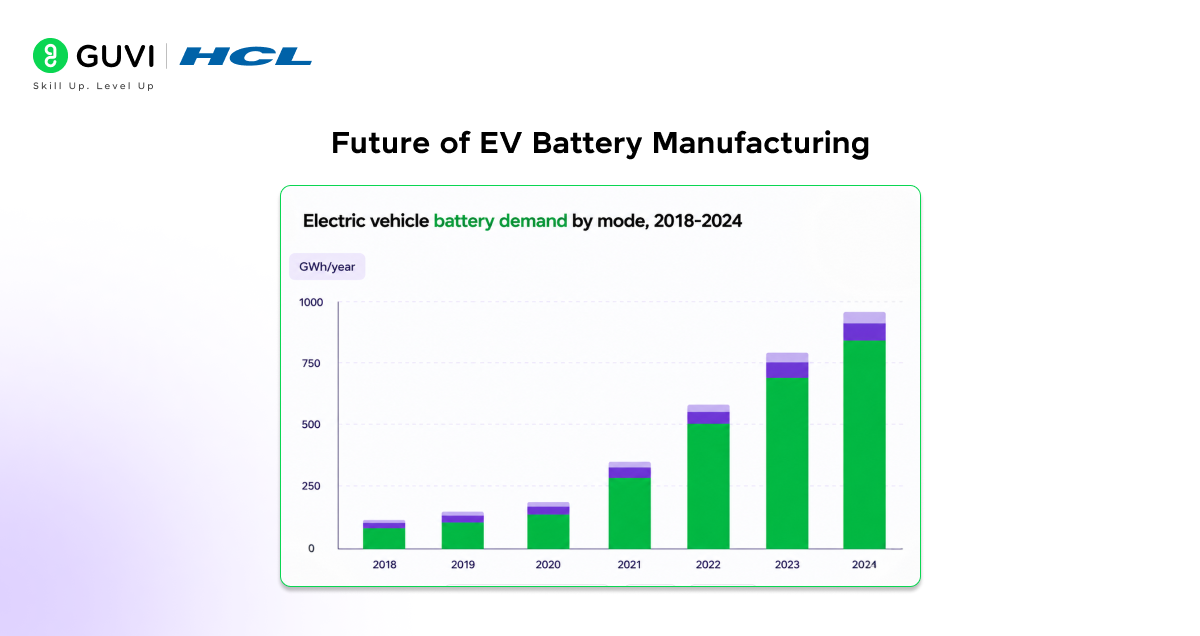
{Source: International Energy Agency[IEA] }
The whole EV battery manufacturing scene is exploding right now. Demand is just skyrocketing every single year. Like, in 2024, we were looking at over 950 GWh in demand, and the market itself hit around 1 TWh, which just shows how crazy the growth is. Then you blink, and by 2025, it’s already pushing 1.6 TWh, all thanks to a ton of investment from places like China, the US, and Europe. Everyone’s scrambling to build these massive gigafactories to keep up and, hopefully, drive costs down.
So what does that actually mean for us? In a few years, owning an EV will just feel normal. Like, you won’t even think about it. Charging will be way quicker, and the battery will easily get you through your day without any “range anxiety.” It’ll just fit into your routine, no fuss. People won’t have to talk themselves into buying one; it’ll just be the obvious choice, whether you’re just popping around the city or heading out on a longer trip.
Begin your journey into Electric Vehicle technology with HCL GUVI’s Advanced Programme in Electric Vehicle Technology Course by CEP, IIT Delhi, and gain practical skills that the industry is actively looking for. Work on real projects, understand core EV systems, and build the confidence to step into a growing field with strong career opportunities. Don’t wait—secure your place in the upcoming batch and move ahead with skills that actually matter!
Conclusion
At the end of the day, making these batteries isn’t just some industrial process. It’s the thing that actually makes Electric Vehicles work in the real world. And as manufacturing keeps improving, the batteries themselves are becoming much more reliable and hassle-free. That’s the real reason EVs are slowly but surely just turning into the practical, go-to option for everyone.
FAQs
Which type of EV battery is most widely used and why?
Lithium-ion batteries are widely used because they offer high energy density, long life, and good performance.
What factors affect the lifespan of an EV battery?
Charging habits, temperature, and usage patterns directly impact how long a EV battery lasts.
How do manufacturers improve EV battery performance?
They use better materials, advanced design, and controlled manufacturing processes to increase efficiency.
Success Stories









Did you enjoy this article?