


Electric Vehicle Articles
What is Vehicle-to-Grid Technology : How EVs Can Power the Grid
What is a Battery Management System? BMS Working, Uses & EV Role
EV Infrastructure in India: Best Components, Charging Network, Challenges & Future (2026 Guide)


Get In Touch For Details! Request More Information
Exploring the Pros and Cons of Electric Vehicles in 2026
May 13, 2026 8 Min Read 1996 Views
(Last Updated)
Electric vehicles are no longer a futuristic concept. They are parked in your neighbourhood, charging in office basements, and quietly taking over Indian roads faster than most people expected. EV sales in India grew 44 percent year on year in early 2026, and brands like Tata, Mahindra, Hyundai, and BYD are competing harder than ever for your money.
But a shiny new EV is still one of the biggest purchases most people make. Before you decide, you deserve an honest look at both sides. This blog breaks down the real pros and cons of electric vehicles in plain language, with current numbers and no brand bias.
Quick Answer
The main pros of electric vehicles are lower fuel costs, minimal maintenance, zero tailpipe emissions, and strong government incentives. The main cons are a higher purchase price, longer charging times, range limitations on highways, and uneven charging infrastructure outside major cities. Whether an EV suits you depends on your daily commute, parking situation, and budget.
Table of contents
- What Is an Electric Vehicle
- Pros and Cons of Electric Vehicles Against Petrol Vehicles at a Glance
- The Pros of Electric Vehicles
- Saving Money on Fuel Every Month
- Spending Less on Maintenance
- Producing Zero Tailpipe Emissions
- Enjoying Better Performance and a Smoother Ride
- Getting Government Incentives and Tax Benefits
- Charging at Home While You Sleep
- The Cons of Electric Vehicles
- Paying a Higher Upfront Price
- Dealing with Longer Charging Times
- Experiencing Range Anxiety on Long Trips
- Finding Charging Stations Outside Major Cities
- Dealing with Battery Degradation Over Time
- Depending on the Electricity Grid
- Pros vs Cons of Electric Vehicles in a Glance
- Pros And Cons Of Different Types Of Electric Vehicles
- 💡 Did You Know?
- Conclusion
- FAQs
- What are the main pros and cons of electric vehicles in India?
- How much does it cost to charge an EV at home in India?
- How long does an EV battery last in India?
- Is it worth buying an EV in India in 2026?
- Which is the best electric car in India in 2026?
What Is an Electric Vehicle
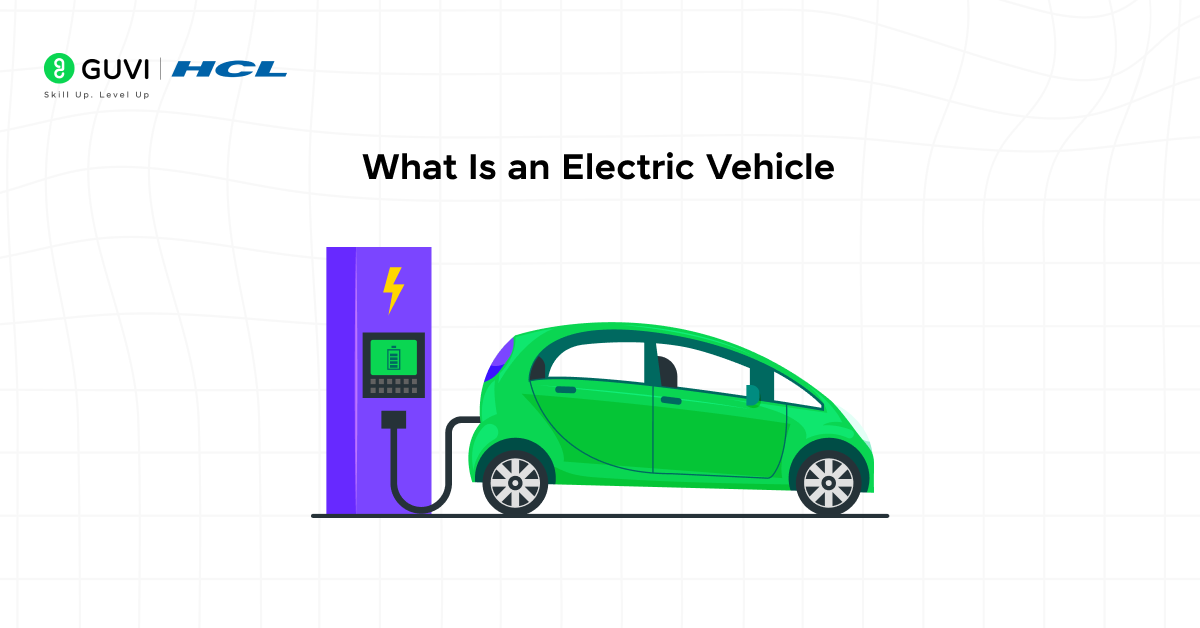
Before diving into the pros and cons of electric vehicles, let’s get the basics right. Not everyone knows exactly how an EV works or how it is different from a hybrid, and that confusion can lead to the wrong buying decision.
Understanding How an EV Works
An electric vehicle runs on a rechargeable battery pack instead of petrol or diesel. When you press the accelerator, the battery sends power directly to an electric motor, which turns the wheels instantly. There is no engine, no fuel tank, no exhaust pipe, and no gear changes.
This direct power delivery is what makes Electric vehicles feel so different to drive. The response is immediate, the acceleration is smooth, and the cabin is almost completely silent even at highway speeds.
Have you ever pressed the accelerator on an Electric Vehicle and felt that instant, noiseless surge? Most first-time EV drivers describe it as the moment they stopped wanting a petrol car.
Knowing the Main Types of EVs
Not every vehicle labelled electric works the same way, and the differences matter a lot when you are comparing options. There are three main types in the Indian market right now, each suited to a different kind of buyer.
Here is a quick breakdown of what each type actually means:
- Battery Electric Vehicles (BEVs): Fully electric with no petrol engine at all. Charged from a plug. Examples include the Tata Nexon EV, Mahindra BE 6, and MG Windsor EV.
- Plug-in Hybrid Vehicles (PHEVs): Have both an electric motor and a petrol engine. Use electricity for short trips and switch to petrol for longer ones.
- Hybrid Electric Vehicles (HEVs): A small electric motor assists the petrol engine but cannot be plugged in to charge. Examples include the Toyota Camry Hybrid and Honda City Hybrid.
When most people talk about the pros and cons of electric vehicles, they are referring to BEVs, fully electric cars with no petrol backup at all.
Do check out HCL GUVI’s Advanced Electric Vehicle Technology Course in collaboration with IIT Delhi, a 6-month course designed to help you build real-world skills in EV systems like batteries, charging, and power electronics through live sessions and hands-on projects. It is ideal for engineers and professionals looking to enter the fast-growing electric mobility industry with guidance from IIT Delhi faculty and industry experts.
Pros and Cons of Electric Vehicles Against Petrol Vehicles at a Glance
Before going into the details, here is a side-by-side comparison of how electric vehicles stack up against petrol cars on the factors that matter most to Indian buyers.
| Factor | Electric Vehicle | Petrol Car |
| Fuel cost per km | Rs 0.80 to Rs 1.50 | Rs 6 to Rs 9 |
| Annual maintenance | Rs 5,000 to Rs 10,000 | Rs 15,000 to Rs 30,000 |
| Upfront price | Higher by Rs 2 to 5 lakh | Lower |
| Tailpipe emissions | Zero | CO2, NOx, particulates |
| Recharge or refuel time | 30 min fast charge to 8 hours home | 3 to 5 minutes |
| Home charging | Possible overnight | Not possible |
| Government incentives | Strong in India | None |
| Performance | Smooth, quiet, instant torque | Noisier, gear changes |
| Long trip suitability | Needs planning | Easy |
The Pros of Electric Vehicles
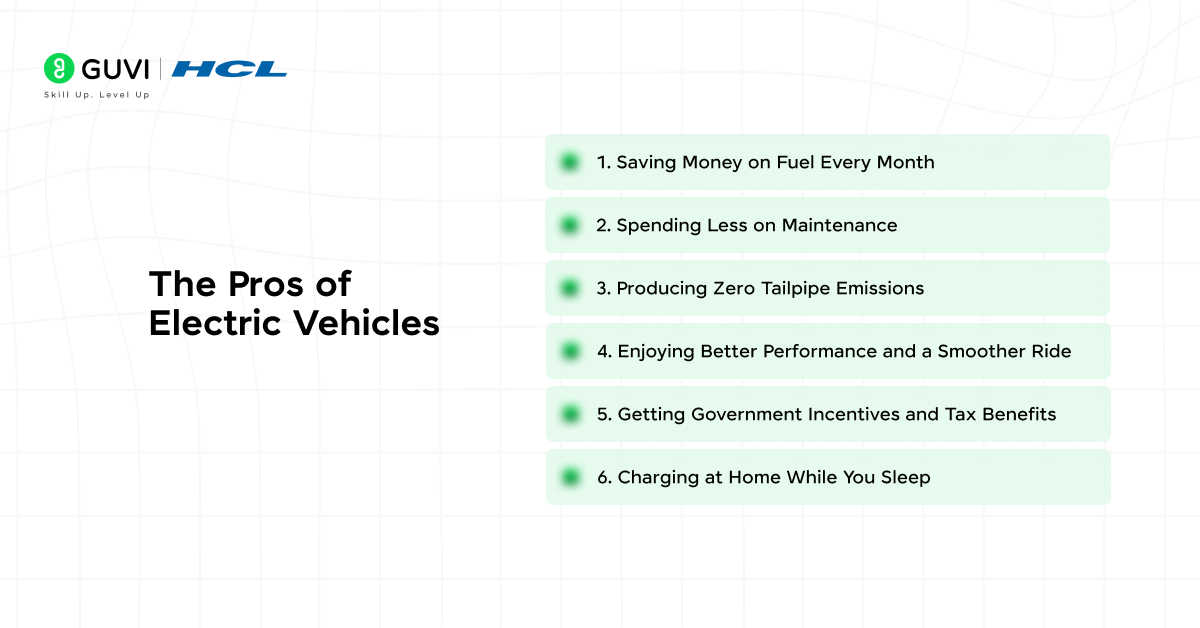
The pros and cons of electric vehicles start with a genuinely compelling case in favour. EVs have moved well past the early-adopter phase, and the advantages are real, measurable, and backed by data from millions of owners worldwide.
1. Saving Money on Fuel Every Month
Fuel savings are the single biggest reason most Indian buyers make the switch to an Electric Vehicle, and the numbers are hard to argue with. Petrol prices in India have remained stubbornly high, while electricity costs significantly less per kilometre of travel.
Charging a mid-range Electric Vehicle at home overnight costs around Rs 150 to Rs 250 for a full charge. The same range in a petrol car costs Rs 1,200 to Rs 1,500 at the pump. Over a month, that gap adds up fast.
- Switching to an EV saves the average driver Rs 1.25 lakh to Rs 1.65 lakh per year on fuel.
- Drivers covering longer distances can save up to Rs 3.75 lakh annually.
- Home charging overnight is the cheapest method and requires no extra effort.
- Over five years, fuel savings alone often more than offset the higher purchase price.
2. Spending Less on Maintenance
One of the quieter advantages of owning an Electric Vehicle is how little it costs to keep running. Petrol and diesel engines have hundreds of moving parts that wear out over time. EVs eliminate most of them entirely.
There is no engine oil to change, no timing belt to replace, no spark plugs, no exhaust system, and no clutch. Fewer parts means fewer service visits and lower bills every year. Brakes also last much longer because regenerative braking, which recovers energy as you slow down, handles most of the work.
- No oil changes: EVs have no combustion engine that needs lubrication.
- No exhaust or timing belt costs: These common petrol car expenses simply do not exist.
- Longer brake life: Regenerative braking reduces physical brake pad wear significantly.
- Typical EV annual maintenance: Rs 5,000 to Rs 10,000 versus Rs 15,000 to Rs 30,000 for a petrol car.
3. Producing Zero Tailpipe Emissions
When an Electric Vehicle drives past you, nothing comes out of the back. No CO2, no nitrogen oxides, no particulate matter. For a country where cities like Delhi, Mumbai, and Bengaluru regularly appear in global air pollution rankings, this is not a small thing.
The science backs this up clearly. According to the National Academy of Sciences, switching entirely to EVs powered by clean electricity could avoid up to 1,70,000 premature deaths and USD 1.5 trillion in damages globally by 2050. The benefit starts the moment an EV replaces a petrol car on the road.
- EVs produce zero tailpipe emissions regardless of how they are driven.
- Even on India’s current grid mix, EVs produce lower lifecycle emissions than petrol cars.
- As India’s solar and wind capacity grows, the environmental benefit of every EV increases further.
- India’s renewable energy capacity is expanding rapidly under national targets for 2030.
Imagine your daily commute route on a Tuesday morning, except every car on that road is producing zero exhaust. That is the direction Indian cities are heading, faster than most people realise.
4. Enjoying Better Performance and a Smoother Ride
Electric Vehicles are not just cleaner, they are genuinely more enjoyable to drive. The instant torque delivery, the absence of gear changes, and the near-total silence make daily city driving noticeably more relaxed than in a petrol car.
Because the battery pack sits low in the floor, EVs also have a lower centre of gravity than most petrol cars, which improves handling and reduces body roll in corners. The overall experience feels more composed, not just quieter.
- Instant torque: Full power is available immediately, with no need to rev up.
- No gear changes: Power delivery is smooth and continuous from start to full speed.
- Lower centre of gravity: Improves cornering and overall stability on the road.
- Quieter cabin: City driving in an EV is significantly less tiring than in a petrol car.
5. Getting Government Incentives and Tax Benefits
Buying an Electric Vehicle in India right now comes with meaningful financial support from both the central government and most state governments. These incentives directly reduce the effective purchase price and help narrow the gap with equivalent petrol vehicles.
The GST difference alone is substantial. EVs are taxed at just 5 percent GST compared to 28 percent plus cess on petrol vehicles, which is a significant difference in on-road price even before other subsidies are counted.
- FAME II Scheme: Direct purchase subsidies on electric two-wheelers and commercial EVs.
- PM E-DRIVE Scheme: Rs 10,900 crore allocated to accelerate EV adoption from 2024 onwards.
- Registration fee waiver: The Ministry of Road Transport has waived registration fees for all battery-operated EVs across India.
- State incentives: Delhi, Maharashtra, Gujarat, and several other states offer additional road tax waivers and purchase subsidies.
6. Charging at Home While You Sleep
This is one of the most underrated advantages of owning an EV, and it is something petrol car owners simply cannot do. Plug your car in before bed and wake up every morning with a full battery, without visiting a petrol station for your daily commute.
Most Indian city commuters drive between 30 and 60 km per day. A modern EV can cover that distance three to five times on a single overnight charge. For daily city use, the charging question essentially disappears entirely.
- Home Level 1 charging on a standard plug takes 8 to 12 hours for a full charge.
- A Level 2 home charger cuts this to 4 to 6 hours and costs Rs 15,000 to Rs 25,000 to install.
- No petrol station visits needed for typical daily city commuting.
- Home charging is significantly cheaper per kilometre than any public charging option.
The Cons of Electric Vehicles
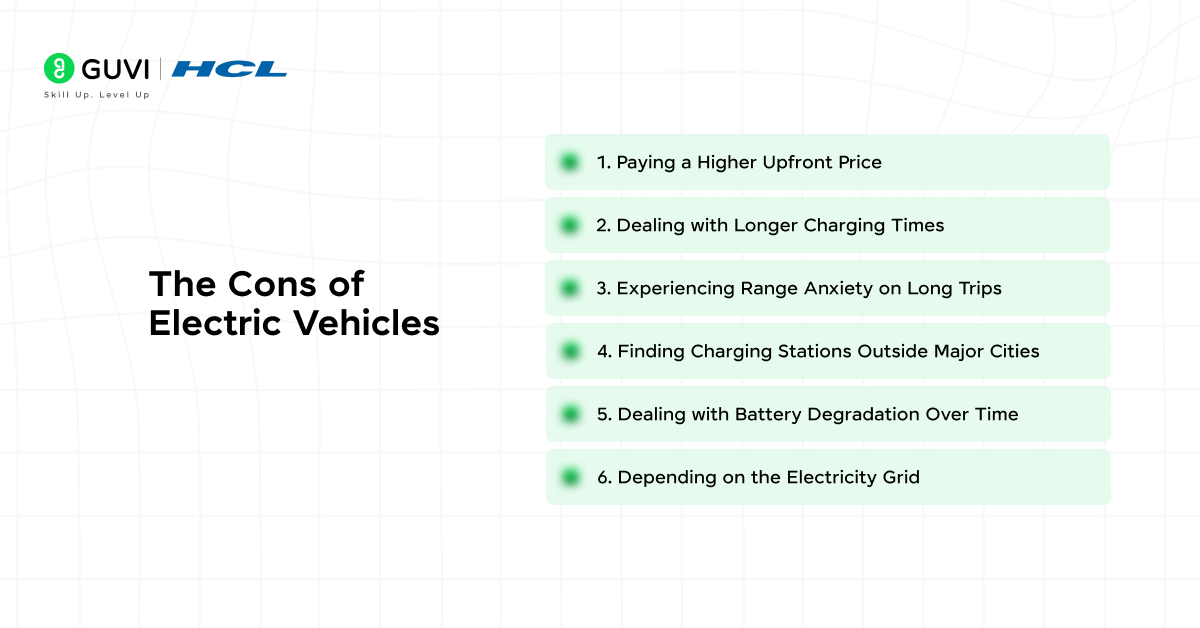
The pros and cons of electric vehicles have to include the honest limitations. Some of these are temporary problems that are improving every year. Others are genuine practical constraints that matter right now in 2026.
1. Paying a Higher Upfront Price
The single biggest barrier for most Indian buyers is the purchase price. EV battery packs are expensive to manufacture, and that cost is reflected in the sticker price, even after incentives. The gap between an EV and an equivalent petrol car in the same segment is real and meaningful.
A Tata Nexon EV starts around Rs 13 to 14 lakh while a comparable petrol Nexon starts below Rs 9 lakh. That Rs 4 to 5 lakh difference is not easy to ignore, even when fuel and maintenance savings are factored in. Battery costs are falling every year, but price parity in India is still two to three years away for most segments.
- EV batteries are the primary driver of the higher purchase price.
- The price gap is most pronounced in the Rs 8 to 15 lakh segment where most Indian buyers shop.
- Most manufacturers offer 8-year or 1,60,000 km battery warranties to protect the investment.
- Total cost of ownership over five years typically favours EVs despite the higher entry price.

2. Dealing with Longer Charging Times
Filling a petrol tank takes three to five minutes. Charging an EV takes meaningfully longer, and this requires a different mindset around how you manage energy. It is not necessarily a dealbreaker, but it is a real change in habit.
The experience varies significantly depending on the type of charger available. Home charging overnight is seamless for daily use, but a long highway trip where you need to stop and wait 30 to 60 minutes on a fast charger is a different situation entirely.
- Standard home plug (Level 1): 8 to 12 hours for a full charge.
- Level 2 home charger: 4 to 6 hours for a full charge.
- DC Fast Charger at a public station: 30 to 60 minutes to reach 80 percent.
- For daily city use, home charging overnight eliminates this problem completely.
3. Experiencing Range Anxiety on Long Trips
Range anxiety is the worry of running out of charge before reaching your destination or a charging station. It is the most commonly cited concern about the pros and cons of electric vehicles, and it is not without basis, especially for long highway drives in India.
Most modern Indian EVs offer 300 to 450 km of claimed range. In real-world conditions with AC running during an Indian summer, the usable range is often closer to 200 to 300 km. For city commuting this is more than enough, but for long intercity trips it requires planning ahead.
- Claimed range is always higher than real-world range, especially with AC on.
- A 2025 AAA survey found 55 percent of non-EV buyers cited fear of running out of charge as a concern.
- Highway routes between smaller Indian cities often have few or no fast chargers.
- Careful pre-trip planning using charging apps largely resolves this for prepared drivers.
How far do you actually drive on a normal day? If the honest answer is 30 to 60 km, a modern EV covers that distance three to five times on a single charge. Range anxiety is a highway problem, not a city problem.
4. Finding Charging Stations Outside Major Cities
India’s charging network has expanded rapidly but remains heavily concentrated in larger cities. As of early 2025, India had 26,367 public EV charging stations, with Karnataka, Maharashtra, Uttar Pradesh, and Delhi accounting for the majority of deployments.
That sounds like a lot until you map those stations against India’s geography. Tier 2 and Tier 3 cities, smaller towns, and rural areas still have very limited public fast-charging options. Apartment residents without dedicated parking and access to a power outlet face an additional practical challenge that petrol car owners simply do not have.
- India had 26,367 EV charging stations as of early 2025, up from 5,151 in FY22.
- The majority are concentrated in large urban centres and on a few major highway corridors.
- Smaller cities and towns still have limited fast-charging availability.
- Apartment charging without dedicated parking remains an unsolved problem for many urban buyers.
5. Dealing with Battery Degradation Over Time
Like any rechargeable battery, an EV battery slowly loses a small amount of capacity with each charge cycle over the years. This means that after several years of use, your EV may offer slightly less range than it did when new. It is not dramatic, but it is real.
Predictive models suggest today’s EV batteries last 12 to 15 years in moderate climates and 8 to 12 years in extreme heat. Indian summers and frequent DC fast charging can accelerate degradation slightly compared to cooler climates with mostly home charging.
- Battery capacity typically reduces by 2 to 3 percent per year under normal use.
- Most manufacturers warrant the battery for 8 years or 1,60,000 km.
- Replacing a battery outside the warranty period is expensive, though costs are falling.
- Charging to 80 percent daily instead of 100 percent noticeably extends long-term battery health.
6. Depending on the Electricity Grid
EVs produce zero tailpipe emissions, but they still use electricity, and India’s grid is not yet fully clean. Around 60 percent of India’s electricity still comes from thermal power plants, primarily coal. This means an EV charged entirely from the current grid is cleaner than a petrol car but not zero-emission from a full lifecycle perspective.
This is a shrinking concern as India rapidly expands its solar and wind capacity under ambitious national renewable energy targets. But it is worth acknowledging honestly, because the environmental case for EVs is strongest when paired with clean electricity.
- India currently generates around 60 percent of electricity from thermal sources.
- An EV on the current grid still produces lower lifecycle emissions than a petrol car.
- As renewable energy capacity grows, every EV automatically becomes cleaner over its lifetime.
- Battery raw material mining including lithium and cobalt carries environmental costs being addressed through recycling programmes.
Pros vs Cons of Electric Vehicles in a Glance
If you are new to electric vehicles, this quick table will help you understand the main benefits and drawbacks in the simplest way possible.
| Pros | Cons |
| Saves money on fuel | Costs more to buy |
| Needs less maintenance | Battery is expensive to replace |
| No pollution from the car | Electricity may still come from coal |
| Smooth and quiet to drive | Takes longer to charge than petrol |
| Can charge at home | Fewer charging stations in some areas |
| Good for daily city use | Not ideal for long trips without planning |
Also read – Electric Vehicle Technology and Components: A Beginner-Friendly Guide
Pros And Cons Of Different Types Of Electric Vehicles
If you are trying to understand which type of EV suits you best, this simple table compares all three .
| Type | Pros | Cons |
| Battery Electric Vehicles (BEVs) | • No petrol needed• Very low running cost• No pollution from car• Smooth and quiet drive | • Expensive to buy• Takes time to charge• Charging stations limited• Range can be limited |
| Plug-in Hybrid Vehicles (PHEVs) | • Can run on electricity for short trips• Petrol backup for long drives• Good fuel savings• Flexible usage | • Expensive• Still uses petrol• Needs both charging and fuel• More complex system |
| Hybrid Electric Vehicles (HEVs) | • Better mileage than petrol cars• No need to charge• Easy to use• Lower emissions | • Uses petrol• Less savings than full EVs• No full electric mode• Not as eco-friendly as BEVs |
💡 Did You Know?
- India’s public EV charging network grew nearly fivefold from 5,151 stations in FY22 to 26,367 stations by early FY25, a 72 percent compound annual growth rate.
- EVs convert 59 to 62 percent of electrical energy into movement, while petrol cars convert only 17 to 21 percent, making EVs nearly three times more energy efficient.
- Two-wheelers and three-wheelers account for over 91 percent of all EV sales in India, making the electric transition far more accessible than the four-wheeler conversation suggests.
- India’s EV market is projected to grow from USD 31 billion in 2026 to USD 1,283 billion by 2035, making it one of the fastest-growing automotive segments on the planet.
Conclusion
If you have home charging and drive within the city daily, the pros of electric vehicles heavily outweigh the cons. The fuel savings are real, the maintenance costs are genuinely lower, and the driving experience is better than most petrol car owners expect until they try one.
If long-distance highway driving is a regular part of your life or you cannot charge at home, a plug-in hybrid is the smarter bridge for now. The charging infrastructure is improving every year, and the cons that exist today in 2026 are noticeably smaller than they were in 2022.
Going electric in some form is no longer a matter of if. The pros and cons of electric vehicles in 2026 make it a matter of when and what.
FAQs
1. What are the main pros and cons of electric vehicles in India?
The main pros are lower fuel costs, minimal maintenance, zero tailpipe emissions, and strong government incentives. The main cons are a higher purchase price, longer charging times, range limitations on highways, and limited charging infrastructure outside major Indian cities.
2. How much does it cost to charge an EV at home in India?
A full home charge costs approximately Rs 150 to Rs 250 depending on your city’s electricity tariff. This compares to Rs 1,200 to Rs 1,500 for a petrol refill covering the same distance, making home charging significantly cheaper per kilometre.
3. How long does an EV battery last in India?
Most EV batteries are designed to last 12 to 15 years in moderate climates. Manufacturers typically offer an 8-year or 1,60,000 km battery warranty. Indian summer heat and frequent fast charging can slightly reduce longevity, but recent battery technology has improved durability considerably.
4. Is it worth buying an EV in India in 2026?
Yes, if you have home charging access and drive within the city daily. Fuel and maintenance savings over five years typically exceed the higher upfront cost. If you cannot charge at home or regularly drive long intercity distances, a plug-in hybrid may be the better choice for now.
5. Which is the best electric car in India in 2026?
The Tata Nexon EV and MG Windsor EV are the most popular and trusted mid-range choices. The Mahindra BE 6 and Hyundai Creta Electric are strong picks for higher budgets. For tighter budgets, the Tata Punch EV and Tata Tiago EV offer solid value and wide service support.
Success Stories

About the Author
Jebasta
I translate the language of data into stories that anyone can understand. As a writer with a data science background, I simplify analytics, AI, and decision-making so beginners and enthusiasts can confidently explore the world of data.
View all posts by Jebasta
Connect with me @







Did you enjoy this article?